AR Collaborative Partnerships' Participant Guide (1)
Page 1: Introduction to Teacher Leadership
NIET: National Institute for Excellence in Teaching
Focus Areas: Teacher Leadership Series, Collaborative Partnerships, Facilitating Growth for Others
Key Themes:
Foundational Leadership
Empowering Teacher Leaders
Instructional Expertise
Data-Driven Decision Making
Page 2: Teacher Leader Model Standards
Domain I: Collaborative Culture
Understand adult learning principles.
Foster an environment of trust, collegiality, and continuous improvement.
Domain II: Research for Improvement
Utilize research to inform policies and teaching practices.
Model systematic inquiry to enhance teacher learning.
Domain III: Professional Learning
Promote job-embedded learning aligned with school improvement.
Adapt to evolving teaching and technologies.
Domain IV: Instructional Improvement
Advance colleagues' skills through reflective practice and collaboration.
Align instructional practices to shared school vision and goals.
Domain V: Data and Assessments
Knowledgeable about formative and summative assessments.
Collaborate to use data for informed decision-making to enhance learning.
Domain VI: Community Involvement
Acknowledge the impact of families and communities on learning.
Promote collaboration with stakeholders for educational improvement.
Domain VII: Advocacy
Understand educational policy-making processes.
Advocate for effective practices and student needs within the educational community.
Page 3: 10 Mindframes for Visible Learning
Key Mindframes:
Success & Failure: Evaluate impacts on student learning.
Change Agents: Belief in all students’ ability to improve.
Learning Focus: Talk about learning, not just teaching.
Assessment as Feedback: Use feedback for improvement.
Dialogue Engagement: Create conversations, not monologues.
Embrace Challenges: Strive for challenge over complacency.
Build Relationships: Foster trust and safety in learning.
Common Language: Define success clearly for students.
Acknowledge Difficulty: Focus on learning to navigate complexities.
Collaborate: Believe in collective efficacy.
Reflection Questions: Identify opportunities to practice these mindframes and help others build them.
Page 4: Characteristics of Effective Professional Development
Essentials for Development:
Empowered Leadership: Led by a knowledgeable teacher leader.
Continuum of Learning: Linked to ongoing educational progress.
Evidence-Based: Grounded in student work and artifacts.
Collaboration: Focused on teacher and student needs.
Ongoing: Continuous engagement and assessment.
Choice & Flexibility: Allowfor participant input and time for growth.
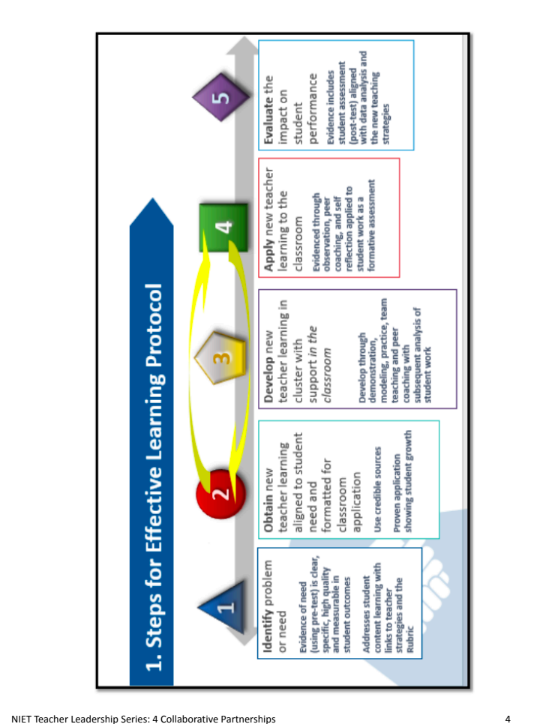
Page 5: Steps for Effective Learning Protocol
Key Steps:
Identify the problem clearly with evidence from assessments.
Align new learning for teachers with student needs.
Develop collaborative support systems in classrooms.
Apply new strategies and gather evidence through observation and reflection.
Evaluate impact on student performance using aligned assessment methods.
Page 6: Professional Development Cycle Example
Meeting Agenda:
Goal: Improve writing craft instruction; enhance student comprehension scores.
Reflection: Analyze student engagement with texts.
Learning Session: Share resources on text structures and model instructional strategies.
Application: Plan and prepare questions for students about text organization.
Page 7: Teacher-Student Questioning Techniques
Techniques for Classroom Engagement:
Encourage discussion around how authors convey messages.
Utilize non-traditional texts for deeper connections.
Page 10-12: Continuum of Self-Reflection
Stages of Reflection:
Unaware Stage: Lack of awareness about teaching impact.
Conscious Stage: Reflects with prompts; limited collaboration.
Action Stage: Committed to affecting outcomes through reflection and collaboration.
Refinement Stage: Responsible for each student’s success; modifies practices based on student needs.
Page 16: CORE Practices for Student-Centered Coaching
Coaching Approaches:
Student-Centered Coaching: Focused on partnership and data-driven instruction.
Teacher-Centered Coaching: Emphasis on teacher accountability.
Relationship-Driven Coaching: Supportive without challenging; foster collegial relationships.
Page 18-22: Creating a Coaching Plan
Scenarios for Coaching:
Scenario 1: Mr. Barrett’s popularity vs. student performance awareness.
Scenario 2: Mr. Pickering’s reluctance to adopt new engagement strategies.
Scenario 3: Ms. Esteban’s struggle with lesson preparation and student comprehension.
Scenario 4: Ms. Harrison’s commitment to change versus student performance outcomes.
Coaching Plan Elements: Set goals, adjust instruction, analyze student progress, and implement coaching support.