Econ Terms Exam 2
CHAPTERS:
7
- Health care: Goods and services, such as prescription drugs, consultations with doctors, and surgeries, that are intended to maintain or improve a person’s health
- Affordable Care Act (ACA): Health care reform legislation passed by Congress and signed by President Barack Obama in 2010
- Health insurance: A contract under which a buyer agrees to make payments, or premiums, in exchange for the provider’s agreeing to pay some or all of the buyer’s medical bills
- Fee-for-service: A system under which doctors and hospitals receive a payment for each service they provide
- Asymmetric information: A situation in which one party to an economic transaction has less information than the other party
- Adverse selection: The situation in which one party to a transaction takes advantage of knowing more than the other party to the transaction
- Moral hazard: Actions people take after they have entered into a transaction that make the other party to the transaction worse off.
- Principal–agent problem: A problem caused by an agent pursuing the agent’s own interests rather than the interests of the principal who hired the agent
- Market-based reforms: Changes in the market for health care that would make it more like the markets for other goods and services
8
- Sole proprietorship: A firm owned by a single individual and not organized as a corporation.
- Partnership: A firm owned jointly by two or more persons and not organized as a corporation.
- Corporation: A legal form of business that provides owners with protection from losing more than their investment should the business fail
- Asset: Anything of value owned by a person or a firm
- Limited liability: A legal provision that shields owners of a corporation from losing more than they have invested in the firm.
- Corporate governance: The way in which a corporation is structured and the effect that structure has on the corporation’s behavior.
- Separation of ownership from control: A situation in a corporation in which the top management, rather than the shareholders, controls day-to-day operations
- Indirect finance: A flow of funds from savers to borrowers through financial intermediaries such as banks. Intermediaries raise funds from savers to lend to firms (and other borrowers).
- Direct finance: A flow of funds from savers to firms through financial markets, such as the New York Stock Exchange
- Bond: A financial security that represents a promise to repay a fixed amount of funds
- Coupon payment: An interest payment on a bond.
- Interest rate: The cost of borrowing funds, usually expressed as a percentage of the amount borrowed.
- Stock: A financial security that represents partial ownership of a firm.
- Dividends: Payments by a corporation to its shareholders.
- Risk: The degree of uncertainty in the return on an asset.
- Liability: Anything owed by a person or a firm
- Income statement: A financial statement that shows a firm’s revenues, costs, and profit over a period of time.
- Accounting profit: A firm’s net income, measured as revenue minus operating expenses and taxes paid.
- Explicit cost: A cost that involves spending money
- Implicit cost: A nonmonetary opportunity cost.
- Economic profit: A firm’s revenues minus all of its implicit and explicit costs.
- Balance sheet: A financial statement that sums up a firm’s financial position on a particular day, usually the end of a quarter or year.
- Wall Street Reform and Consumer Protection Act (Dodd-Frank Act): Legislation passed during 2010 that was intended to reform regulation of the financial system
- Present value: The value in today’s dollars of funds to be paid or received in the future. Future value(n) / (1+ i )^n
- Bond price:

- Stock price:
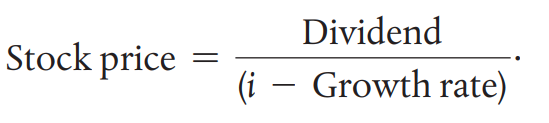
9
- Tariff: A tax imposed by a government on imports
- Imports: Goods and services purchased domestically that are produced in other countries.
- Exports: Goods and services produced domestically and sold in other countries
- Autarky: A situation in which a country does not trade with other countries.
- Terms of trade: The ratio at which a country can trade its exports for imports from other countries
- External economies: Reductions in a firm’s costs that result from an increase in the size of an industry.
- Free trade: Trade between countries that is without government restrictions
- Quota: A numerical limit that a government imposes on the quantity of a good that can be imported into the country
- Voluntary export restraint (VER): A restriction on the quantity of a good that can be imported by one country from another country
- World Trade Organization (WTO): An international organization that oversees international trade agreements.
- Globalization: The process of countries becoming more open to foreign trade and investment
- Protectionism: The use of trade barriers to shield domestic firms from foreign competition.
- Dumping: Selling a product for a price below its cost of production
10
Marginal Utility: The change in total utility a person receives from consuming one additional unit of of a good or service.
Law of Diminishing Marginal Utility: As consumers consume more of a good or service, marginal utility decreases
Budget Constraint: The limited amount of income available to consumers to spend on goods and services.
Substitution Effect: Holding Constant the effect of price change on consumer purchasing power, the change in quantity demanded that results form a change in price making the good more or less expensive relative to the other goods.
Network Externality: A situation in which the usefulness of a product or service increases with the number of consumers using it.
Behavioral Economics: The study of situations in which people make choices that do not appear to be economically rational.
Opportunity Cost: The highest valued alternative given up when deciding to engage in an activity.
Endowment Effect: The tendency of people to be unwilling to sell a good they already own even if they are offered a price that is greater than the price they would be willing to pay to buy the good if they didn’t already own it.
Sunk Cost: A cost that has already been paid and cannot be recovered.
11
Short Run: The period of time in which at least one variable is fixed
Long Run: The period of time in which a firm can vary all of its inputs, adopt new technology, and increase or decrease the size of its physical plant.
Total Cost: The cost of all the inputs a firm uses in production.
Variable Cost: Costs that change as output changes.
Fixed Costs: Costs that remain constant as output changes.
Production Function: The relationship between the inputs employed by a firm and the maximum output the firm can produce with those outputs.
Average Total Cost: Total cost over quantity produced
Marginal Product of Labor: The additional output a firm produces as a result of hiring one more worker.
Law of Diminishing Returns: The principle that adding more of a variable input, such as labor, to the same amount of fixed input will cause the marginal product of the variable input to decline.
Average Product of Labor: The total output produced by a firm divided by the quantity of workers.
Marginal Cost: The change in a firm's total cost from producing one more of a unit of a good or service.
Long-run average cost curve: A curve that shows the lowest cost at which a firm is able to produce a given quantity of output in the long run when all inputs are variable.
Economies of Scale: When a firm’s long term average cost decreases as it increases the quantity of output.
Constant Returns to Scale: Increasing output makes no change to long term average cost
Diseconomies of Scale: Increasing output increases long term average cost.
Minimum Efficient Scale: The level of output at which all economies of scale are exhausted
12
Price Taker: A buyer or seller that is unable to affect the market price, like a firm in a perfectly competitive market.
Profit: Total Revenue minus total cost.
Average Revenue: Total revenue divided by quantity of product sold
Marginal Revenue: Change in total revenue from selling one more unit of a product.
Sunk Cost: A cost that has already been paid and cannot be recovered.
Shutdown Point: The minimum point on a firm's average variable cost curve; if the price falls below this point, the firm shuts down production in the short run.
Economic Profit: A firm’s revenue minus all of its implicit and explicit costs.
Economic Loss: The Situation in which a firm’s total revenue is less than its total cost, including all implicit costs.
Long run competitive equilibrium: The situation in which the entry and exit of firms results in the typical firm breaking even.
Long run supply curve: A curve that shows the relationship in the long run between the market price and the quantity supplied.
13
Monopolistic Competition: A market structure in which barriers to entry are low and many firms compete by selling similar, but not identical, products.
Marketing: All the activities necessary for a firm to sell a product to a consumer.
Brand Management: The actions of a firm intended to maintain the differentiation of a product over time.
14
Oligopoly: A marketing structure in which a small number of interdependent firms compete.
Barrier to entry: Anything that keeps new firms from entering an industry in which firms are earning economic profits.
Economies of scale: The situation in which a firm’s long-run average cost falls as it increases the quantity of output it produces.
Patent: The exclusive legal right to produce a product for a period of 20 years from the date the patent application is filed with the government.
Game theory: The study of how people make decisions in situations in which attaining their goals depends on their interactions with others; in economics, the study of the decisions of firms in industries where the profits of a firm depend on its interactions with other firms.
Business strategy: A set of actions that a firm takes to achieve a goal, such as maximizing profits.
Payoff matrix: A table that shows the payoff that each firm earns from every combination of strategies by the firms.
Collusion: An agreement among firms to charge the same price or otherwise not to compete
Dominant strategy: A strategy that is the best for a firm, no matter what strategies other firms use.
Nash equilibrium: A situation in which each firm chooses the best strategy, given the strategies chosen by other firms
Cooperative equilibrium: An equilibrium in a game in which players cooperate to increase their mutual payoff.
Noncooperative equilibrium: An equilibrium in a game in which players do not cooperate but pursue their own self-interests.
Prisoner’s dilemma: A game in which pursuing dominant strategies results in noncooperation that leaves everyone worse off.
Price leadership: A form of implicit collusion in which one firm in an oligopoly announces a price change and other firms in the industry match the change.
15
Monopoly: A firm that is the only seller of a good or service for which there is not a close substitute.
Patent: The exclusive legal right to produce a product for a period of 20 years from the date the patent application is filed with the government.
Copyright: A government-granted exclusive right to produce and sell a creation.
Public franchise: A government designation that a firm is the only legal provider of a good or service.
Network externality: A situation in which the usefulness of a product increases with the number of consumers who use it.
Natural monopoly: A situation in which economies of scale are so large that one firm can supply the entire market at a lower average total cost than can two or more firms.
Market power: The ability of a firm to charge greater than marginal cost.
Price discrimination: The practice of charging different prices to different customers for the same good or service when the price differences are not due to differences in cost.
Collusion: An agreement among firms to charge the same price or otherwise not to compete
Antitrust laws: Laws aimed at eliminating collusion and promoting competition among firms.
Horizontal merger: A merger between firms in the same industry.
Vertical merger: A merger between firms at different stages in the production of a good.