Textbook Notes
Isotopes
Stable Isotopes ae those that remain indefineitly.
Radioactive Isotopes are unstable and undergo a process of radioactive decay to produce another nuclide, plus a particle or gamma ray and considerable energy. The OG unstable isotope is the parent, the resulting isotope is the daughter.
Daughter isotopes, bc they are created by radioactive decay, are called radiogenic isotopes.
7.1 Stable Isoptopes
Bc stable isotopes of an element are chemically identical, they cannot fractionate chemically between two phases, as would two trace elements such as Rb and Sr.
Mass fractionation is the only process that can separate the existing isotopes of a single element.
-For mass fractionation, the light isotope always fractionates, preferably into the phase with weaker bonds vapor, then liquid, then solid.
7.2 Radioactive and Radiogenic Isotopes:
The K-Ar system:
40K decays to either Ca40 or Ar40.
Ar40 is an inert gas, and all of the Ar escapes when a rock is hot enough. The Ar escaping resets the radiometric clock because all of the daughter gets removed, and the K thats left over starts producing Ar40 again as a fresh start. When magmas form, the clock is reset and any Ar40 in the rock must come from the decay of 40K.
The Rb-Sr system
87Sr is created through the breakdown of 87Rb
86Sr is a stable element not made by any breakdown of other elements
Rb behaves like K and concentrates in micas and amphiboles
Sr behaves like Ca, so it concentrates in plag and apatite (but not in CPX)
The isochron technique allows you to overcome the issue of not knowing which Sr87 was originally in the rock and which was added by decay of Rb87
The isochron technique uses two or more samples and normalizes the isotopes that vary with time to 86Sr which isnt radiogenic or radioactive and is a constant
For example:
The value of 87Sr/86Sr at the present is equal to the orignal ratio of the sample at the time it first crystallize (87sR.86sR)0, plus the radiogenic Sr87 formed since that time. Once again, this latter amount is determined by the Rb concetration in the original sample and time. Its important to realize that these heavy Sr isotops do not mass fractionate during meltong or crystliization, but Sr and Rb may chemically fractionate during these processes.
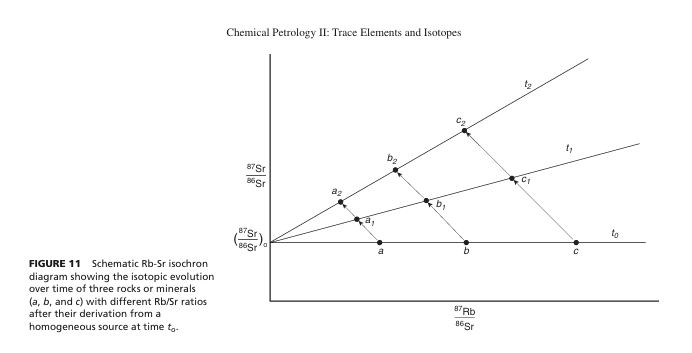
The three dots on the figure a b and c could either represent the analysis of three minerals in a single rock or three cogenetic rocks with a spread of Rb and Sr concentrations
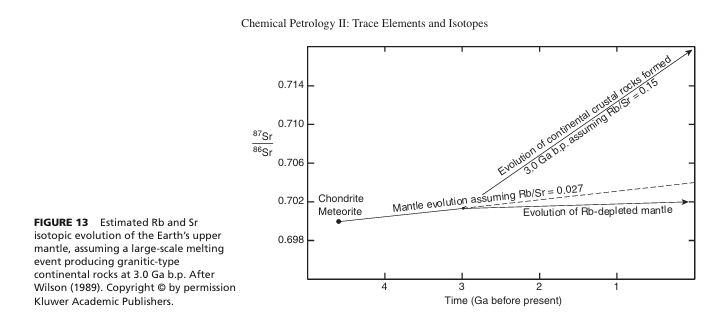
Very low initial (Sr87/Sr86)o ratio probably result from Rb depletion in areas of the mantle that have been extensively melted to extract crustal rocks. Higher ratios indicate greater input from Rb-richer sources, probably old K-Rb rich crust.
The Sm-Nd system:
Both Sm and Nd are LREE, they are incompatible elements and prefer to fractionate into melts
Nd has a lower atomic number, and is a little larger than Sm and is concentrated slightly more in liquids relative to Sm.
As a result, Sm/Nd ratio decreases in partial melts (compared to source) or in late liquids resulting from progressive fractional crystallization
144Nd is not radiogenic
147Sm breaks down to 143Nd
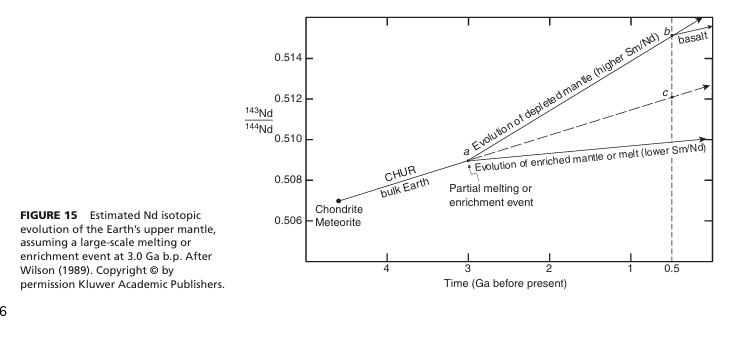
Sm-Nd is opposite to Rb-Sr
The depleted mantle shows higher 143Nd/144Nd ratios with than than the enriched melt or mantle. This is bc partial melting of the mantle removes more Nd than Sm. This depletes the mantle in the daughter isotope.
U-Th-Pb System
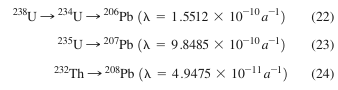
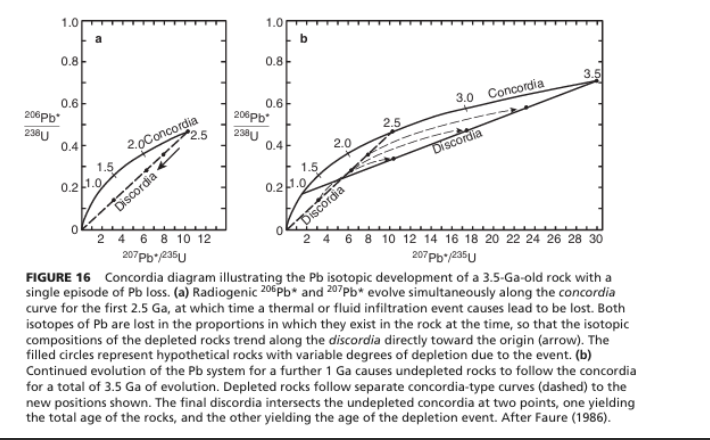
This system involves three radioactive isotopes of U (U234, U235, U238) and three radiogenic isotopes of Pb (206Pb,207Pb, 208Pb). Only Pb 203 is nonradiogenic.
U, Th, and Pb are all incompatible, and they concentrate in early melt to become incorporated in the crust (particularly in continental crust)
Mantle Melting and the Generation of Basaltic Magma
Petrology of the mantle:
-composed of mostly mafic silicate minerals (olivine and pyroxene)
1.Ophiolites:
Large sheet like mafic to ultramafic masses, presumed to be ancient ocean crust and upper mantle thrust onto the edge of continents and/or incorportated into mountain belts
Dredge samples from oceanic fracture zones
Nodules in basalts
Ultramaifc xenoliths, or nodules in basalts, are occassioanly carried to surface by basalt
Xenoliths in kimberlites
Kimberliees tap an upper mantle sources as deep as 250 to 350 km and travel rapidly to the surface, bringing a variety of mantle and crustle samples as xenoliths
“Typical” mantle is composed of peridotite, most specificlaly, a four-phase Lherzoite, composed of olivnie, OPX, CPX, and a suboridnate Aluminous phase, such as garnet, spinel, or plagioclase.
Dunite and Harzburgite appear to be related to Lherzolite as refractory residuum (fig 1)
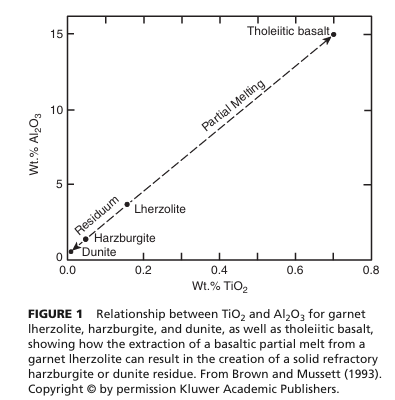
Note that the compositions of dunite, harzburgite, lherzolite, and tholeiitic basalt are collinear, and that lherzolite composition lies at an intermediate position between the basalt and the other two rock types. If the tholeiite is created by partial melting of the lherzolite, extraction of the liquid will shift the composition of the remaining material directly away from the tholeiite toward harzburgite and dunite
The aluminous lherzolite represents undepleted mantle, also called fertile mantle, with a composition presumed to be close to that of the original mantle. It is a prime source for generating basaltic partial melts
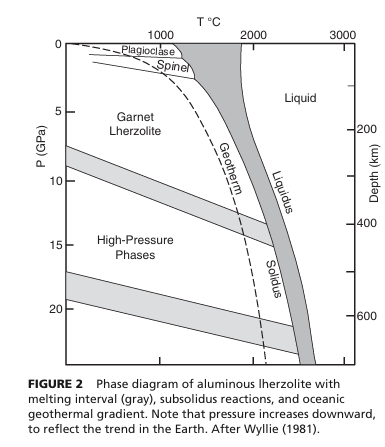
Where this geotherm intersects a particular reaction, the pressure–temperature conditions become appropriate for the reaction to take place. Thus at low pressure (below 30 km), plagioclase is stable, then spinel from 30 to 80 km, and finally garnet from about 80 to 400 km. At greater depths, high-pressure phases occur.
This sequence of reactions explains how we can have compositionally equivalent spinel and garnet lherzolites and also tells us that plagioclase lherzolites are a low-pressure alternative, also with the same chemical composition. It further explains why plagioclase, spinel, and garnet are rarely found together in the same sample and why plagioclase lherzolites are found only in shallow mantle samples (ophiolites and some oceanic basalts), whereas garnet lherzolites occur more commonly in kimberlites that tap a deeper mantle source. Because plagioclase peridotites are limited to depths less than about 30 km, which is less than the thickness of much of the continental crust, we would expect plagioclase peridotite to be absent in most of the subcontinental mantle, the top of which is commonly deeper than 30 km. This explains why it is so rare in kimberlites.
Melting of the mantle:
We can either raise the temperature, lower the pressure, or change the composition.
Raising the temperature:
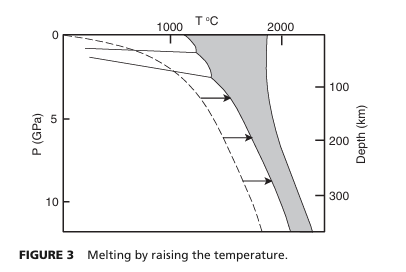
The most obvious manifestations of locally high heat flows are the hotspots, such as hawaii, which are narrow pipe-like conduits of basaltic magma that appear to have a stationary source in the mantle.
There are a number of these hotspots (Figure 14.1), and they are definitely a way to add extra heat to the mantle and produce basalts, but they are local phenomena and cannot produce basalts in some of the places where basalts commonly occur, such as the mid-ocean ridges.
Lowering Pressure
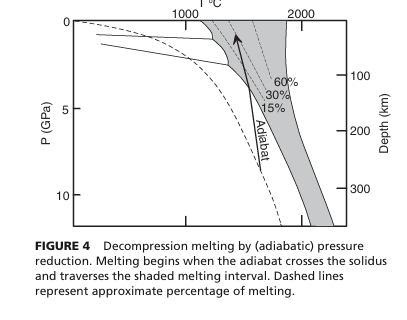
A more plausible way to lower pressure is to raise mantle rocks to shallower levels while maintaining their stored heat content. When material moves upward, the pressure is reduced and the volume increases slightly, resulting in a slight temperature reduction
If, on the other hand, the rise were sufficiently rapid to minimize heat loss to the surroundings, the only temperature difference would be due to expansion. If conductive heat loss were zero, the process is referred to as adiabatic, and any rising rock material would follow a path with the ~10°C/GPa (0.3°C/km) slope (Figure 4), called the adiabat.
Continued upwelling of mantle material beneath extensional areas may allow flow and adiabatic rise to shallower levels, departing from the shallow geo therm and following a P-T path with a much steeper slope than the solidus (~130°C/GPa), eventually intersecting the solidus and initiating melting. Once melting begins, the latent heat of fusion will absorb heat from the rising mass, causing the adiabatic path to follow a shallower temperature/pressure slope closer to the solidus curve, thus traversing the melting interval more obliquely. As a result, upwelling mantle material will diverge from the solidus slowly, producing limited quantities of melt. The process is called decompression partial melting.
Upwelling of mantle material occurs at divergent plate boundaries, where two plates are pulling apart, and mantle material must flow upward to fill in.
Adding Volatiles
Adding H2O drastically lowers the solidus temperature, especially at higgh presssure
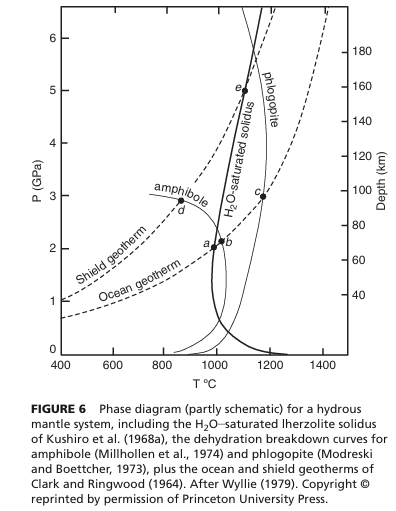
The requirements for melting in this system are to satisfy both of the following: ¢ ¢ 1. Free H2O, unbound in minerals, and 2. Temperature/pressure conditions sufficient to melt the lherzolite under H2O-saturated conditions
Experiments on CO2-bearing peridotite systems can also produce small amounts of melt at pressures in the vicinity of 2 to 4 GPa
Generation of Basalts from a chemically Uniform Mantle
although the chemical composition of the mantle may be constant, the mineralogical composition is variable with depth.
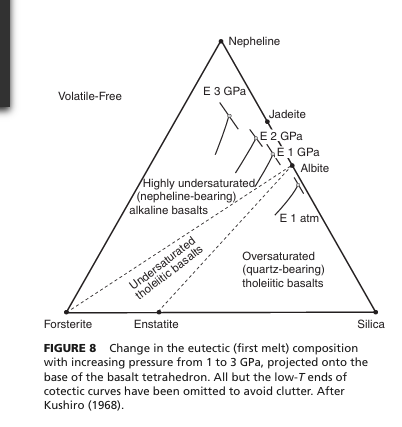
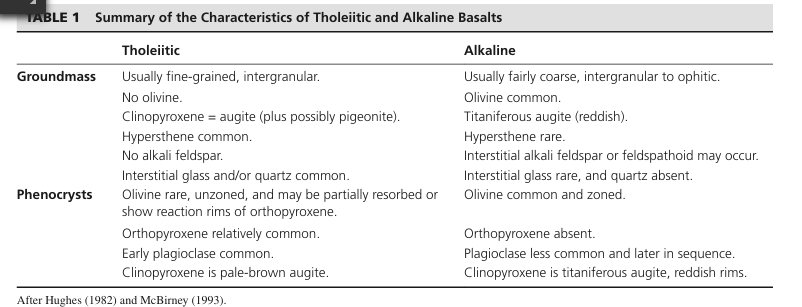
In the Ne-Fo-Q system, the eutectic moves with increasing pressure from silica-saturated (tjoleiitic) to haghly silica undersaturated and alkaline melts.
The implication from this simplified basalt system is that tholeiites are favored by shallow melting, and silica-undersaturated alkaline basalts are favored by deeper melting.
We should remember that fluids in the mantle can also affect the type of melts generated. H2O shifts the eutectic toward silica saturation (tholeiites), whereas CO2shifts it toward more alkaline composition
To summarize, most models of basalt petrogenesis indicate the following (modified from Wyllie, 1971):
1. The composition of primary basalts is controlled by the depth of partial melting and segregation from mantle peridotite, the degree of partial melting, and the amount and type of the volatile phase, if present.
2. The composition of the basalt reaching the Earth’s surface is also controlled by any subsequent crystal fractionation during post-segregation ascent.
3. Tholeiites may be formed by shallow melting or by olivine fractionation during rise of deep-seated picritic liquids. Tholeiites are also favored by H2O-rich volatiles. Silica-poor alkaline basalts are derived by low degrees of partial melting, deeper sources, and CO2-rich volatiles.
4. Tholeiites may also be formed when olivine fractionates during rise of deep-seated picrites, and alkaline basalts may be formed by deep-seated fractionation of Al-rich silicate phases.
Primary Magmas:
Primary magmas are those that formed by melting at deoth and were no subsequently modified,
The simplest criteria are that a magma plots at the extreme end of a differentiation index (such as low % SiO2, high Mg# [Mg/(Mg + Fe)], low alkalis, etc.) and that it has a high extrusion temperature.
We refer to a melt that is saturated in several phases at once as a multiply saturated melt
A CHEMICALLY HETEROGENEOUS MANTLE MODEL
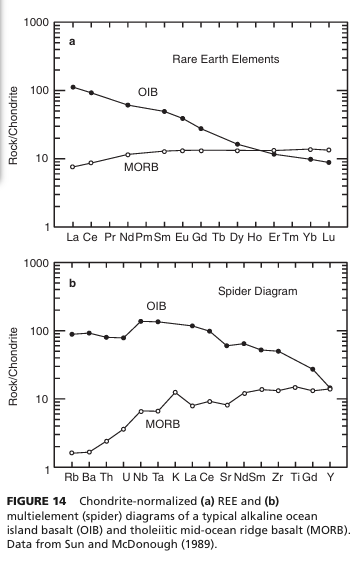
The negatively sloping OIB pattern in each diagram is a typical enriched pattern and can readily be explained via a model of either partial melting of peridotite or fractional crystallization of a peridotite-derived melt, in which the more incompatible elements are concentrated in the liquid (OIB) fraction. The positively sloping MORB trends, on the other hand, cannot be reconciled with any process of partial melting or fractional crystallization of chondrite-like mantle that incorporates the HREE and other relatively compatible elements into the liquid in preference to the less compatible elements. The only way a partial melt can have a pattern with a positive slope on the diagrams in Figure 14 is to melt a significant proportion of a solid that is already LREE and incompatible element depleted and thus has a positive slope to begin with. In order to become depleted in LREE and incompatible elements, these elements must be extracted from the mantle and incorporated into melts prior to the formation of the MORB. In other words, the most common magma on the planet must be derived from a mantle that has been previously depleted (probably by the In order to become depleted in LREE and incompatible elements, these elements must be extracted from the mantle and incorporated into melts prior to the formation of the MORB. In other words, the most common magma on the planet must be derived from a mantle that has been previously depleted (probably by the earlier extraction of melts to form the oceanic crust and continental crust). The other common magma of the ocean basins shows no such pattern and appears to be derived from a nondepleted (fertile) mantle source. We are faced with the conclusion that, despite our earlier success in generating different magma types from a singular mantle source, the mantle is not homogeneous and contains at least two principal reservoirs— one depleted and the other fertile.
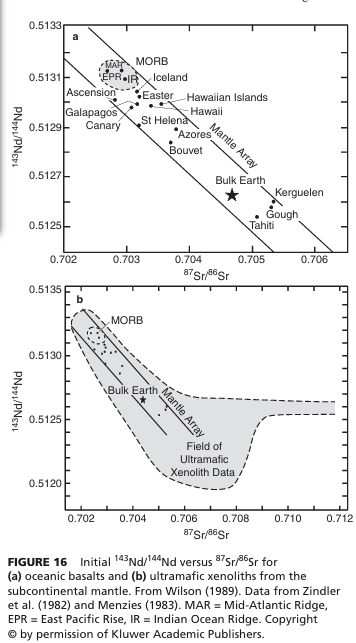
The upper-left part of the array (where MORB plots) has the high-143Nd/144Nd and low-87Sr/86Sr characteristics of a depleted source, and the lower-right part of the array is progressively less depleted. The large star represents the isotopic ratios of chondritic meteorites, the values we ascribe to the primitive Earth (neither depleted nor enriched). Note, then, that most of the “mantle array” reflects variable depletion, with MORB being derived from the most depleted source.
Summary:
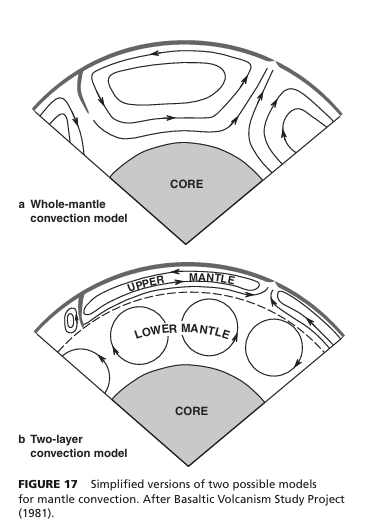
Mantle-derived samples may be delivered to the Earth’s surface as ophiloites (slivers of oceanic crust and upper mantle caught up in orogenesis), nodules in basalts, or xenoliths (particularly noteworthy in kimberlites). Partial melting of the mantle is probably the original igneous rock-producing process on Earth, and it is still the predominant one occurring today. We infer from samples believed to be delivered to the surface that primitive undepleted mantle has a lherzolitic composition with sufficient aluminum to produce a subordinate Al-rich phase (plagioclase at very shallow levels, giving way to spinel and then garnet with increasing depth in the upper mantle). Melting of the mantle is not considered a natural consequence of increasing depth, considering the P-T trajectory of the lherzolite solidus and normal shield or oceanic intraplate geotherms. Melting may be realistically achieved by hotspot plumes, addition of volatiles (particularly H2O), or plate divergence followed by adiabatic mantle rise and decompression partial melting. Primary magmas may be recognized on the basis of high Mg# ( 0.66), Cr ( 1000 ppm), and Ni ( 400 ppm) concentrations, as well as through multiple saturation with several mantle phases at some high pressure and temperature in melting experiments. It is possible to generate the two most common types of primitive basalts, tholeiitic and alkaline, from a chemically homogeneous mantle. Alkaline basalts are favored over tholeiites by a lower percentage of partial melting of the lherzolite, medium-high pressure fractional crystallization from a tholeiite, greater depth of partial melting, and less H2O and/or more CO2in an associated fluid phase. In spite of this, trace element and isotopic variations suggest that the mantle is chemically heterogeneous, requiring at least two mantle reservoirs developing distinct isotopic signatures without having been mixed and homogenized for at least 2 Ga. A few whole-mantle and two-layer mantle convection models may satisfy both seismic/ geodynamic and geochemical requirements.
Magma Diversity
Partial Melting
Separation of a liquid from the partially melted solid residue is a form of diversification because it involves partitioning and separation of chemical constituents, and it can produce a variety of melt compositions from a single source.
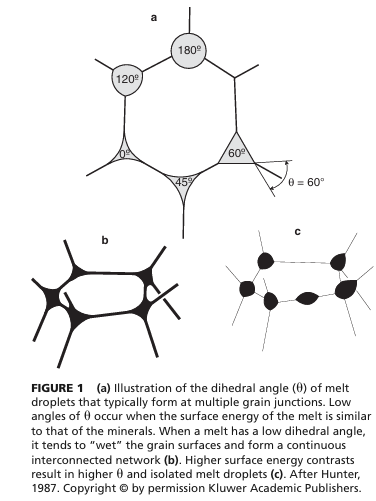
When a rock begins to melt, a tiny fraction of initial melt forms discrete liquid drops at the junctions of mineral grains, usually at the points where three or four grains meet (Figure 1). Only when a critical quantity of melt is produced will there be a sufficient liquid volume that: 1. The liquid forms an interconnected network. 2. The interior body of the liquid can be free from the restraining effects of crystal surface adsorption.
Separation of a melt may require higher melt fractions, however, than indicated by and the permeability threshold. Viscosity is an important factor in melt segregation, once a continuous network has been formed. High-viscosity silicic melts, such as granitic–rhyolitic liquids, are less easily extracted. T
he critical melt fraction, or rheological critical melt percentage (RCMP) (Wickham, 1987), is the percentage of melt at which a crystal-dominated, more rigid granular framework gives way to a melt-dominated, fluid suspension, commonly called a crystal mush.
Liquid separation is commonly motivated by gravitational effects as the buoyant liquid seeks to rise and escape the crystal residue. Because melt source regions are generally deep and under pressure, the separation may be aided by a process known as filter pressing, or compaction, in which the crystal–liquid system is squeezed like a sponge, and the liquid migrates from the compacted solids
Partial melting is the process by which mantle lherzolite fractionates to produce a range of primary basaltic magma
Magmatic differentiation
Magmatic differentiation is defined as any process by which magma is able to diversify and produce a magma or rock of different composition. Differentiation (and partial melting) involves two essential processes:
1. Creation of a compositional difference between one or more phases as elements partition themselves in response to a change in an intensive variable, such as pressure, temperature, or composition. This determines the trend of the differentiation process.
2. Preservation of the chemical difference created in part 1 by segregating the chemically distinct portions, which then evolve as separate systems. Fractionation is the physical process by which different portions (usually distinct phases) are mechanically separated. The effectiveness of the fractionation process determines the extent to which differentiation proceeds along a particular trend.
Fractional Crystallization
Fractional crystallization has traditionally been considered the dominant mechanism by which most magmas, once formed, differentiate.
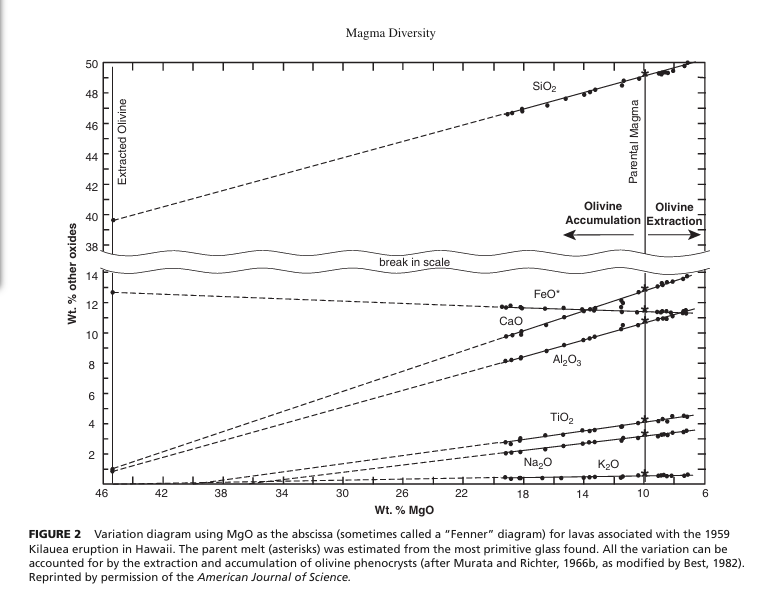
A volcanic series can be evaluated for the effects of fractional crystallization by using variation diagrams. You should be familiar with the theoretical method to evaluate the evolution of a suite of lavas based on fractional crystallization. Figure 2 illustrates a particularly clear and simple relationship among a series of Hawaiian lavas that can be related by the crystallization of a single phase
All the lavas in Figure 2 plot along linear paths connecting the proposed parental magma and extrapolating to the proposed olivine phenocrysts.
How might fractional crystallization occur? Gravity settling
Gravity settling, such as the sinking of Bowen’s olivines, has long been considered the dominant mechanism by which fractional crystallization is accomplished. It involves the differential motion of crystals and liquid under the influence of gravity due to their differences in density.
Gravity settling of minerals in a magma can be quantitatively modeled if we make a few simplifying assumptions. If we simplify the geometrical shape of the mineral to a spherical particle and then assume that the magma is a Newtonian fluid (a fluid with no yield stress, deforming as soon as a differential stress is applied), the settling under the influence of gravity is governed by Stokes’ Law:
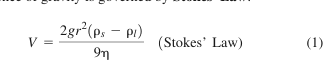
This analysis using Stokes’ Law is overly simplified for a number of reasons. First, the assumption of spherical shaped crystals is unrealistic. Tabular, accicular, and platy minerals are common and settle with slower velocities, but it is difficult to determine exactly how much slower they are.
A far more serious problem involves the assumption of Newtonian fluid behavior. McBirney and Noyes (1979) pointed out that only basaltic magmas near or above their liquidus temperatures behave as Newtonian fluids. Once these begin to crystallize, they develop a significant yield strengtht hat must be overcome before any motion is possible.
Filter pressing (compaction):
In addition to gravity settling, three other mechanisms may facilitate the separation of crystals and liquid. Filter pressing (compaction), mentioned earlier in reference to partial melting, is also possible in crystal mushes that form as cumulates or crystal suspensions. The amount of trapped intercumulus liquid between cumulate minerals may be as high as 60 vol. % (Irvine, 1980b). With the added weight of further accumulation, the crystal mush may be compacted (McKenzie, 1984), squeezing much of the liquid out into the main magma body. Another method of filter pressing involves the movement of a phenocryst-laden crystal mush. Any constriction in the conduit causes the crystals to interfere and slow with respect to the liquid.
Flow Segregation:
Another similar mechanism by which crystals may be segregated from the liquid occurs when crystal-rich magmas flow in a laminar fashion near the walls of the magma body. The process is known as flow segregation (or flow[age] separation, or flow[age] differentiation). The motion of the magma past the stationary walls of country rock (Figure 4) creates shear in the viscous liquid as a result of the velocity gradient near the walls. The resulting differential motion forces the magma to flow around phenocrysts,thereby exerting pressure on them at constrictions where phenocrysts are near one another or near the contact itself. The pressure, called grain dispersive pressure (Komar, 1972), forces the grains apart and away from the contact. This effect is greatest near the walls, and it drops off quickly toward the magma interior, where the flow becomes uniform. Phenocrysts thus concentrate away from the walls to mitigate the pressure buildup. This concentration is most apparent in dikes and sills, where the volume affected by the contact comprises a substantial proportion of the body, resulting in a distinct concentration of coarse phenocrysts toward the center (Figure 5). Flow segregation is an interesting, though localized, phenomenon and cannot be responsible for the evolution of more than a small proportion of igneous rocks.
Polybaric fractionation:
The majority of fractional crystallization models assume that fractionation has taken place in a stationary magma chamber at constant pressure. The rise of basaltic magmas, as pointed out by O’Hara (1968b), may involve fairly continuous fractional crystallization as it rises, which must obviously be a polybaric fractionation process. One result is that the fractionating minerals vary as their stability fields are crossed (e.g., garnet to spinel to plagioclase). Another is that the shift in the eutectic point with pressure also causes the quantity of the liquidus phases that crystallize to vary. In particular, the increase in the size of the field a b c d e FIGURE 5 Increase in size and concentration of olivine phenocrysts toward the center of small dikes by flow differentiation. Isle of Skye, Scotland. After Drever and Johnston (1958). Reproduced by permission of the Royal Society of Edinburgh. 218 for olivine with decreasing pressure requires that a lot of olivine must form as the melt composition follows the liquidus away from the olivine side of the diagram in a rising basaltic melt (see Problem 1). Thus, the relative amount of olivine that crystallizes with a rising basaltic magma will be far greater than the amount that forms during isobaric crystallization.
Volatile Transport
Chemical differentiation can also be accomplished when a separate vapor phase coexists with a magma and liquid–vapor fractionation takes place. A vapor phase may be introduced in any of three principal ways.
First, a fluid may be released by heating of hydrated or carbonated wall rocks.
Second, as a volatile-bearing but undersaturated magma rises and pressure is reduced, the magma may eventually become saturated in the vapor, and a free vapor phase is released. Because the vapor phase has a lower density than the melt, it rises, diffusing through the magma, and concentrates near the top of the magma chamber. Such concentrated fluid may even permeate into the roof rocks
A third mechanism for generating a separate fluid phase is a result of late-stage fractional crystallization. Most early-formed igneous minerals are anhydrous (even hydrous minerals are less so than associated melts), so their segregation from a hydrous melt enriches the melt in H2O and other volatile phases. Eventually the magma reaches the saturation point, and a hydrous vapor phase is produced
Liquid Immiscibility
Three natural magmatic systems are widely recognized as having immiscible liquids in some portion of their compositional range. The first is the system mentioned above, which most commonly translates to natural Fe-rich tholeiitic basalts, which experience an initial trend toward iron enrichment. In the later stages of fractionation, a “granitic” melt ( SiO 775% 2) separates from a basaltic melt ( '40%SiO2 ). Once separated, the silicic liquid must have a much lower density than the Fe-rich mafic liquid, and we would expect it to rise and collect near the top of the magma
A second system displaying immiscible liquid behavior is the separation of a sulfide-rich liquid from a sulfidesaturated silicate magma. Small, round, immiscible sulfide droplets in a silicate glass matrix, similar to Philpotts’ (1982) granitic–tholeiitic examples above, have been observed in a number of quenched ocean basalt glasses. Economically important massive sulfide segregations in large, layered mafic complexes have formed by separation and accumulation of immiscible sulfide melts.
A third liquid immiscibility gap occurs in highly alkaline magmas that are rich in CO2. These liquids separate into two fractions, one enriched in silica and alkalis and the other in carbonate. These give rise to the nephelinite–carbonatite association.
Magma Mixing
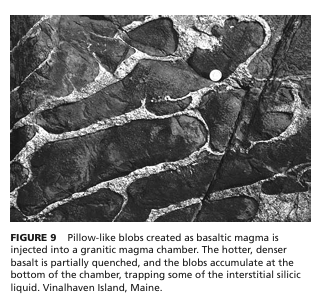
There is ample evidence for the mixing process taking place. It is most evident in cases in which the magmas are very different, such as basaltic and intermediate or silicic liquids. Due to the large differences in the physical properties of the contrasting magmas, the degree of mixing of these magmas may be limited. Two magmas can commonly be seen as commingled swirls of contrasting colors (Figure 8) on the hand sample or outcrop scale, or even as intimate mixtures of contrasting glass in thin section. As mentioned above, because basaltic is initially at a higher temperature than silicic magma, their commingling would tend to chill the basalt and superheat the silicic magma. Basaltic magmas entering granitic chambers commonly form pillow-like structures with curved boundaries and glassy quenched marginal textures that accumulate at the bottom of the chamber
Assimilation
Assimilation is the incorporation of chemical constituents from the walls or roof of a magma chamber into the magma itself. Assimilation may be capable of significantly altering the composition of a magma. Evidence for partial assimilation can be found in variously altered and resorbed contacts or xenoliths suspended in igneous rocks. Historically, there have been several zealous proponents of assimilation who have argued that many of the compositional variations in igneous rocks result from extensive assimilation of country rocks by more primitive magmas
Probably the best way to detect the effects of assimilation, particularly the contamination of mantle-derived magmas by continental crust, is isotopically. The continental crust becomes progressively enriched over time in 87Sr/86Sr and depleted in 143Nd/144Nd. Primitive magmas with unusually high values of 87Sr/86Sr and low values of 143Nd/144Nd are thus probably contaminated by ancient continental material. 87Sr/86Sr values below 0.706 would be appropriate for relatively unmodified mantle melts, whereas ratios above that value are probably contaminated by old continental components. The continental crust is greatly enriched in U, Pb, and Th relative to the mantle and the oceanic crust. Given decay schemes, we can see that, over time, the continental crust becomes enriched in 207Pb and 206Pb by the breakdown of U in the crust. Because 204Pb is nonradiogenic, we can thus expect the 207Pb/204Pb and 206Pb/204Pb ratios to be considerably higher in the older continental crust than in the mantle or in mantle-derived melts (because no isotopic fractionation occurs during melting). Initial 87Sr/86Sr and 143Nd/144Nd ratios or 207Pb/204Pb or 206Pb/204Pb can be plotted against some differentiation index on Harker-type variation diagrams for suites of cogenetic magmas to determine the extent of crustal contamination. Linear enrichment trends in isotopic ratios with increasing differentiation suggest either continuous assimilation or mixing of mantle and crustal magmas, although I suspect that the latter is more common. Increased crustal isotopic signatures in only the most evolved magmas is more likely with assimilation of felsic crust in the marginal portions of the chamber. Field criteria, such as commingled magmas or partially melted crustal xenoliths, may also help us choose between the alternatives.
Boundary layers, in Situ crystallization, and compositional convection:
?////?/////?????????????????????????????????????????
Mixed Processes
Two or more of the processes discussed above may work simultaneously or in sequence during the generation, migration, and solidification of magmatic systems. A number of magmas (and the resulting rocks) may thus be complex hybrids reflecting the combined effects of crystal fractionation, magma mixing, assimilation, volatile transport, and/or liquid immiscibility.
In some cases, a combined process may be more than coincidence, and two processes may operate cooperatively. For example, mixing of two magmas of different compositions and temperatures commonly produces thermal instabilities, resulting in quenching of the hotter magma and heating of the cooler one. Combinations of magma mixing, fractional crystallization, and convection are thus possible. Another example is the combination of assimilation and the accompanying fractional crystallization required to supply the necessary heat, as proposed above.
One approach to the problem is to devise mathematical models (similar to Rayleigh fractionation and other models) for the behavior of certain trace elements and isotopes (or ratios) based on a combination of processes. This has been done by DePaolo (1981c) for the assimilation + fractional crystallization process (which he called AFC), fractional crystallization + recharge of more primitive magma (O’Hara and Matthews, 1981), and all three combined (Aitcheson and Forrest, 1994), using iterative techniques to model the ratio of contaminant to original magma.
Tectonic-Igneous Associations
, I have subdivided the various major igneous phenomena into groups commonly called tectonic–igneous associations.
1. Mid-ocean ridge volcanism
2. Ocean intraplate or ocean island volcanism
3. Continental plateau basalts
4. Subduction-related intra-oceanic island arcs
5. Subduction-related volcanism and plutonism of continental arcs
6. Granitoid rocks
7. Mostly alkaline igneous associations of stable craton interiors
8. Anorthosites
Summary:
Simply put, diversification in geologic systems requires:
1. Two (or more) phases in which components are unequally distributed
2. A physical process in which the phases are separated
When combined, these two processes allow geologic materials, such as rocks, melts, fluids, etc., to change composition.
Partial melting is one such situation, during which the chemical constituents are distributed unequally between the melt being formed and the solid residuum, so that the melt, when finally separated, and the residuum both have different compositions than the original rock melted. The compositions of the melt and residuum depend upon the initial host compo sition, the conditions of melting, and the fraction melted (F). The fraction melted must reach some critical value before it can form a continuous intergranular network and escape the host as a result of buoyancy gained by expansion upon melting.
Fractional crystallization has been invoked as the principal process by which a magma, once formed, may differentiate toward more “evolved” compositions. The most important mechanism for fractional crystallization is gravity settling: the sinking (or floating) of crystals in a liquid due to contrasting density. We can calculate ideal rates of settling using Stokes’ Law, but natural systems are complicated by non-spherical grain shapes and the non-Newtonian behavior (particularly yield strength) of silicate liquids. Gravity settling may be enhanced by compaction (filter pressing) in which the interstitial liquid is squeezed out from a crystal-laden mush. Flow segregation may also play a minor role in differentiating crystal–liquid suspensions flowing through a narrow conduit such as a dike.
Crystallization and rising to lower pressure (with perhaps some wall-rock dehydration) may result in fluid saturation of an originally H2O-undersaturated melt. The late stages of crystallization in a rising (typically hydrous granitic) magma body may thus lead to retrograde boiling: the release of a silicate-saturated fluid phase that is capable of fractur ing the roof rocks and escaping to form pegmatites and/or hydrothermal veins and ores. 229Magma Diversity
Liquid immiscibility, once believed to be a major mechanism of diversification and a pathway to granites, is now relegated to a minor role in basaltic evolution, producing a small quantity of late silicic liquids in some Fe-rich tholeiites, typically trapped interstitially with the late basaltic melt. Liquid immiscibility may be important in the segregation of a late sulfide liquid to form massive sulfide deposits and in the development of carbonatites.
Magma mixing can be observed as commingling of silicic and mafic liquids in some volcanic hand specimens and as basaltic pillows at the base of some crystallized granitic magma chambers. Chemical and textural evidence for replenishment of differentiating magma chambers with reinjected primary magma has also been documented at many localities, particularly at mid-ocean ridges. Mixing of disparate magmas in shallow magma chambers is increasingly recognized as an important process in the diversification of magmas in a variety of igneous provinces.
Assimilation of wall rocks is another source of contamination of magmas and can best be detected by trace element or isotopic patterns. Assimilation is limited by the amount of heat available in the magma, which is generally restricted to the latent heat of crystallization.
Recent studies of magma chambers and volcanic sequences reveal features that the traditional mechanisms above fail to explain. In situ crystallization within an initially stationary liquid or within a stationary crystal–liquid suspension boundary layer may produce an evolved liquid with reduced density. Thermal gradients near the chamber walls and roof may produce gradients in the degree of crystallization of the magma and, hence, in the composition of the liquid. Compositional convection, the rise of less dense liquids from the solid suspension, may result in highly evolved liquids segregating toward the top of the chamber, perhaps forming a stagnant, density-stratified cap boundary layer.
None of the above processes need work in isolation, and any combination may be possible in natural systems.
Mid-Ocean Ridge Volcanism
MORBs are generated at the mid-ocean ridges, where adjacent plates diverge. As two plates separate, the mantle flows upward to fill the potential gap. Rising mantle lherzolite undergoes adiabatic decompression and eventually reaches the solidus temperature, resulting in basaltic partial melts. The melts separate and rise to the crustal rift, where they collect and solidify and add to the trailing edge of the separating oceanic plates. As the magnetic poles periodically reversed, this plate accretion led to the familiar symmetric magnetic anomaly striping that was a fundamental component in the development of plate tectonic theory. We begin with a survey of the geophysical, petrographic, and geochemical data for ridge volcanism so that we can constrain and refine this simple model.
THE MID-OCEAN RIDGES
The rate at which plate divergence (spreading) occurs at mid-ocean ridges is not the same for all ridge segments. The approximate spreading rates of various segments are given in Table 1 and illustrated in Figure 1 as relative vectors.
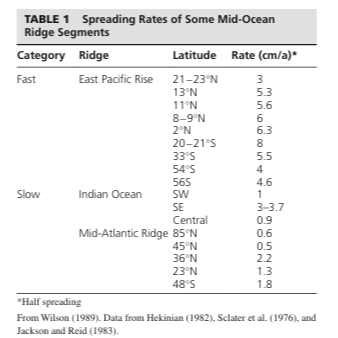
Ridges with a spreading rate less than 3 cm are considered slow-spreading ridges, whereas those with a rate greater 5 cm than are considered fast-spreading ridges.
Slow- and intermediate-spreading ridges typically have a pronounced axial valley about wide and deep, with step-like inward-facing scarps, similar to rift valleys on land. Within this larger valley there is commonly a wide inner rift valleywith a flat floor.Volcanism and crustal extension are concentrated on this innerrift valley floor, where fissures open, and pillow lavas, constrained by the scarp walls, flow mostly parallel to the ridge axis. Volcanic activity is not evenly distributed, and typically several volcanic mounds up to high occur, scattered across the floor
Fast-spreading ridges are smoother and less disrupted by large fault displacements. There is typically a narrow 12 to 5 km2 axial rise, with a small ( 40 to 250 m wide by 5 to 14 m deep) axial summit trough (or caldera). The neovolcanic zone on the EPR is generally regarded as a zone of nearly continuous volcanism 0.5 to 2 km wide. In fast-spreading ridges, small pillow lava hills are flanked by smooth lava plains, attributed to sheet lavas formed by faster lava extrusion associated with the more rapid spreading and higher heat flow. Beyond the neovolcanic zone, the basalts become progressively (although not uniformly) older and more fractured.
As a general rule, fissure-fed eruptions characterize fast-spreading ridges, and point-source volcanism (although probably fissure controlled) is more common at slow-spreading ridges.
Segmentation
Mid-ocean ridges are segmented on a range of scales (Schouten et al., 1985; Macdonald et al., 1988; Macdonald, 1998; Dunn et al.; 2005). The tectonic (physical) segments have been classified on a four-tiered hierarchy (Figure 3),
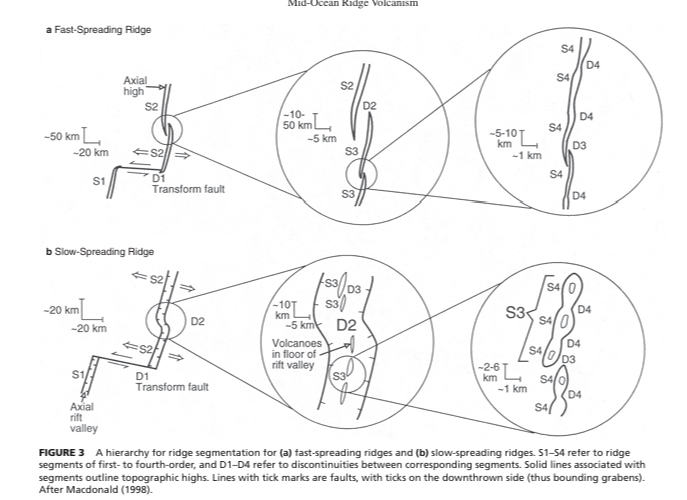
First-order tectonic segments are the longest ( 300 to 900 km on fast-spreading ridges and 200 to 600 on slow-spreading ridges), are typically offset more 1730 km2 1 70.5 Ma2 active portions of the offset between the first-order ridge segments are subparallel strike-slip faults (see Figures 1 and 3) called transform faults (Wilson, 1965). Where active spreading and volcanism at a ridge encounter a transform, the activity terminates abruptly against older, cooler, more stable lithosphere on the flank of a separate ridge segment across the offset. The nearly aseismic fracture zone extensions beyond the ridges are very linear features that appear to offset the magnetic anomaly patterns and extend in many cases across the ocean floor (Fox and Gallo, 1986, 1989). Second-order segments are typically 50 to 230 km ridges and 20 to 80 km long on fast-spreading long on slow-spreading ridges, with offsets of 2 to 30 km .
Second-order segments are typically 50 to 230 km ridges and 20 to 80 km long on fast-spreading long on slow-spreading ridges, with offsets of 2 to 30 km . Second-order discontinuities on fastspreading ridges are usually associated with large overlapping spreading centers (OSCs) (Macdonald and Fox, 1983). An OSC occurs at a location on a ridge where two offset segments extend along the axis past each other, so that their tips overlap without a major fault (D2 in Figure 3a). Secondorder offsets on the more tectonically disrupted slow-spreading ridges are generally associated with shear zones oriented obliquely to the axis or with kinks in the axial rift without obvious faulting (D2 in Figure 3b).
Third-order segments are long on fast-spreading ridges, where they are '20 to 80 km offset 0.5 to 2 km 5 to 25 km by smaller OSCs, and they are perhaps long and offset by gaps between linear volcanic centers in slow-spreading ridges (D3s in Figure 3).
Fourthorder segments (D4 in Figure 3) are '6 to 22 km fast-spreading ridges and offset less than 1 km long in by small axial strike changes, collectively termed devals (for deviations from axial linearity) by Langmuir et al. (1986). Fourth-order segments in slow-spreading ridges are individual axial highs along a linear volcanic fissure, so the discontinuities are apparently gaps between volcanic vents.
STRUCTURE OF THE OCEANIC CRUST AND UPPER MANTLE
Our understanding of the petrologic nature of the oceanic lithosphere has been greatly enhanced by field studies in ophiolite terranes on land. Ophiolites are considered to be masses of oceanic crust and upper mantle thrust onto the edge of a continent or incorporated in mountain belts, where they are tectonically disrupted and now exposed by erosion
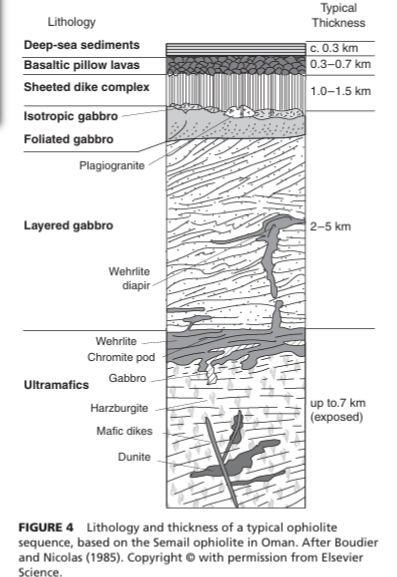
Layer 1 is a thin layer of pelagic sediment that is absent on the newly generated crust at ridge axes and thickens away from the axes as sediment accumulates on progressively older crust.
Layer 2 is basaltic. It can be subdivided into two sublayers. Layer 2A is believed to comprise pillow basalts and sheet-lavas, and Layer 2B is believed to comprise vertical sheeted dikes emplaced in the shallow, brittle extensional environment at the ridge axis.
Layer 3 is more complex and a bit more controversial but is generally believed to comprise mostly gabbros, presumably crystallized from a shallow axial magma chamber that fed the dikes and basalts. Layer 3A, again by analogy with ophiolites, represents uppermost isotropic and lower, somewhat foliated (“transitional”) gabbros, whereas Layer 3B is more layered, typically exhibiting cumulate textures. Both layers 3A and 3B are well foliated and lineated in the Semail (Oman) ophiolite
At the top of the gabbros in the Oman are small discontinuous diorite and tonalite (“plagiogranite”) bodies, presumed to be late differentiated liquids that are filter pressed and mobilized to rise and collect along the gabbrosheeted dike contact, occasionally extending up into the pillow layer.
Layer 4 has seismic velocities that correlate well with ultramafic rocks. In ophiolites, the base of the gabbro grades into layered cumulate wehrlite and gabbro. Diapir-like bodies of wehrlite also appear to have moved upward into the layered gabbros. Cumulate dunite with harzburgite xenoliths and chromite lenses is usually found below the wehrlite layer. Below this is a tectonite harzburgite and dunite interpreted to be the unmelted refractory residuum of the source mantle left behind after basaltic magma was extracted. A few gabbroic dikes may also occur in this layer.
The boundary between Layers 3 and 4 is, broadly speaking, the Moho. The upper portion of Layer 4 is thought to be layered and of cumulate origin, as olivine and pyroxenes accumulate at the bottom of the axial magma chamber. Below this portion is original, unlayered, residual mantle material.
MORB PETROGRAPHY AND MAJOR ELEMENT GEOCHEMISTRY
ADD MORE HERE
. We can thus distinguish between N-MORB(“normal” MORB), which taps the depleted, or incompatible-poor mantle, and E-MORB (“enriched” MORB, also called P-MORB for “plume”), which taps an incompatible-richer mantle. N-MORBs with Mg#765 K2O 6 0.10 , and TiO2 6 1.0 have , whereas E-MORBs have K2O 7 0.10 and TiO2 7 1.0 for the same Mg#
MORB TRACE ELEMENT AND ISOTOPE GEOCHEMISTRY
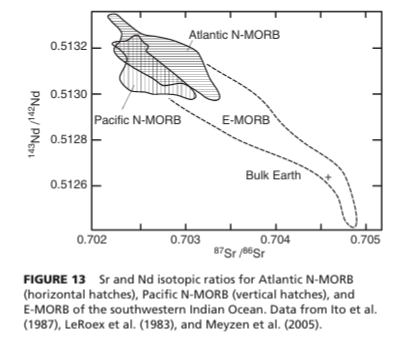
Figure 13 shows the 143Nd/144Nd versus 87Sr/86Sr data for MORBs. N-MORBs plot as a relatively tight cluster with 87Sr/86Sr 6 0.7035 143Nd/144Nd 7 0.5030 and , both of which indicate a depleted mantle source. Note that E-MORBs extend the MORB array to much more enriched values (higher 87Sr/86Sr and lower 143Nd/144Nd), providing further strong support for distinct mantle reservoirs for N-type and E-type MORBs. T-MORBs also show intermediate (mixed) values.
The trace element and isotopic data thus provide confirming evidence that MORBs have more than one source region and that the mantle beneath the ocean basins is not homogeneous. Petrologists have preferred a model in which N-MORBs tap an upper depleted mantle and E-MORBs tap a deeper enriched source, but this layered model is controversial. The time required for the isotopic systems to develop suggests that these reservoirs, whether layered or as distributed segregations, have been distinct for a very long time. T-MORBs are probably produced by mixing of the Nsource and E-source magmas during ascent and/or in shallow chambers
Summary
The mid-ocean ridge system is a globe-encircling submarine mountain range centered on mature divergent plate boundaries. The popular consensus is that plate separation results principally from the negative buoyancy of dense oceanic lithosphere, and the mantle rises passively in response to plate subduction and divergence. Rising mantle retains heat, and the pressure reduction can result in (decompression) partial melting. The extent of mantle melting depends on the temperature of the initial rising mantle and how long the flowing mantle remains in the partial melting region beneath the ridge before flowing laterally into regions cooled effectively by convective circulation of seawater through the fractured crust. Upwelling normally originates in the isotopic and incompatible-element depleted upper mantle (probably above the 660 km 60 to 80 km seismic discontinuity), but melting generally occurs at depths less than . Non-depleted (and possibly even enriched) mantle appears to originate in deeper plumes, perhaps as deep as the core/mantle boundary. Depleted mantle melts at ridges produce normal or N-MORBs, and enriched mantle melts produce E-MORBs (also called P-MORBs). Partial melting beneath ridges is a process in which small melt increments (probably 61% ) separate at various depths from the rising, melting source, and are focused toward a narrow zone beneath the ridge axis. These melts rarely maintain equilibrium with the mantle host and must therefore travel along some sort of semi-isolated conduits. The contrasting melts then accumulate and mix to varying extents in shallow magma chambers to form complex hybridized mixtures, ranging from N-MORB to E-MORB, including transitional T-MORB. Crystal fractionation in shallow chambers produces chemical trends on FennerHarker-type diagrams that indicate over 60% crystallization in some erupted lavas.
The shallow ridge-axis magma chambers release dikes upward into the cool roof, and the dikes in turn feed basalt sheet flows and pillow lavas onto the seabed. The chamber itself crystallizes along the floor and walls to produce gabbros and ultramafics. The sequence of abyssal sediments, basalts, sheeted dikes, gabbros, and ultramafics comprise the main layers of the oceanic lithosphere and of ophiolites, which are now considered to be slabs and slivers of oceanic lithosphere tectonically disrupted and emplaced into orogenic belts. The classical concept of sub-ridge-axis magma chambers as large, persistent bodies has recently been replaced by one in which thin melt lenses wax and wane near the top of a larger partially molten crystal mush.
Ridges are tectonically segmented on a number of scales and are offset by transforms, OSCs, or devals. Major segments seem to have a separate mantle upwelling and magmatic source near the segment center, and the magma then propagates parallel to the axis toward the segment ends. Lower-order segments have less contrasting origins.
Several competing models presently attempt to relate the small magma lens to the ophiolite layers (particularly the gabbros). The thermal structure of a ridge reflects a balance between magmatic heat input and hydrothermal cooling, and ridge segments differ in character, depending largely on the rate of spreading. Fast-spreading ridges are hotter, with more persistent magmatism. Magmatic accretion onto the receding plate edge thus dominates over tectonism, resulting in smoother, higher ridges. Slow-spreading ridges are cooler and tectonic disruption is more pronounced, resulting in pervasively normal-faulted rough topography, a distinct axial graben, and even detachment faulting. The complex interactions of magmatism and tectonism suggest that the petrological units of oceanic lithosphere, particularly if created at slow-spreading ridges, are really more complex than the deceptively simple horizontal seismic layers and the generalized ophiolite sequence.
Oceanic Intraplate Volcanism
. As with MORB, the dominant magma type for oceanic intraplate volcanism is basalt (commonly called ocean island basalt (OIB)), suggesting a mantle origin.
Figure 1, perhaps the most famous of which is the Hawaiian-Emperor seamount chain. Island chains in the same plate follow subparallel paths and progress in age in the same direction, leading Wilson (1963) to conclude these chains were the result of volcanism generated by rising plumes. Most investigators believe that major plumes rise from a thermal boundary layer at the core–mantle boundary (see Nataf, 2000, and Thorne et al., 2004, for a summary of seismic evidence) and carry heat from the core
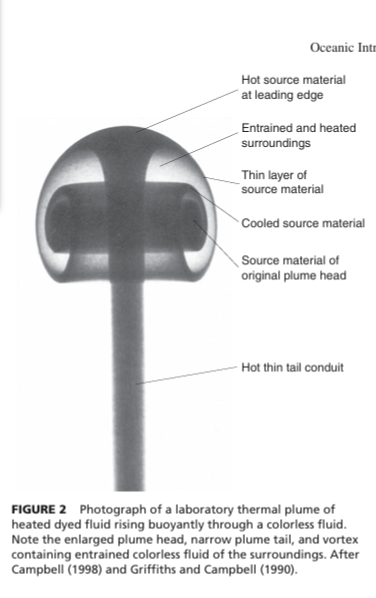
. Because the plume meets resistance in the cooler and more viscous surroundings at its rising front, a flattened bulbous plume head forms, fed by continuing hot additions up the thinner conduit, or tail. The head spreads from the leading tip and entrains some of the surroundings in an eddy-like Lord Howe vortex
. Because the plume meets resistance in the cooler and more viscous surroundings at its rising front, a flattened bulbous plume head forms, fed by continuing hot additions up the thinner conduit, or tail. The head spreads from the leading tip and entrains some of the surroundings in an eddy-like Lord Howe vortex
TYPES OF OIB MAGMAS
Two principal magma series result from ocean intraplate volcanism. The more common type is a tholeiitic series, with a parental ocean island tholeiitic (OIT) basalt. This basalt is similar to MORB, but we shall see some distinct chemical and mineralogical differences. There is also a subordinate alkaline series (with parental ocean island alkaline basalt (OIA)).
Two principal magma series result from ocean intraplate volcanism. The more common type is a tholeiitic series, with a parental ocean island tholeiitic (OIT) basalt. This basalt is similar to MORB, but we shall see some distinct chemical and mineralogical differences. There is also a subordinate alkaline series (with parental ocean island alkaline basalt (OIA)).
The Hawaiian Islands are the best studied of all the ocean islands, and they present us with some interesting material for consideration. Hawaii reveals a sequential, or cyclic, pattern in eruptive history. A cycle is believed to begin in a pre-shield stage with submarine eruptions of alkaline basalt and highly alkaline basanites followed by tholeiitic basalt.
The Hawaiian Islands are the best studied of all the ocean islands, and they present us with some interesting material for consideration. Hawaii reveals a sequential, or cyclic, pattern in eruptive history. A cycle is believed to begin in a pre-shield stage with submarine eruptions of alkaline basalt and highly alkaline basanites followed by tholeiitic basalt.
The remaining three shields on Hawaii (Mauna Kea, Hualalai, and Kohala) have moved on to the next stage of development, a post-shield stage that typically follows caldera collapse. This stage is characterized by waning activity that is more alkaline, episodic, and violent. The lavas are also more diverse, with shallow fractionation producing rocks ranging from hawaiites to trachytes. This activity eventually fades, and, following a long period of dormancy , a late, post-erosional stage takes place. 10.5 to 2.5 Ma2 This stage is characterized by highly alkaline and silicaundersaturated magmas, including alkali basalts, basanites, nephelinites, and nepheline melilites. The two late alkaline stages represent '1% of the total lava output. The alkaline stages are noted for the variety of xenoliths brought to the surface. Some are mafic and ultramafic cumulates from magma chambers of the early tholeiitic stage, whereas others are mantle materials representing various stages of depletion by melt extraction
The Hawaiian pattern encompasses all three major OIB magma series in a single geographic occurrence. This pattern of early and voluminous tholeiites giving way to later, less extensive alkaline magmas has been traditionally related to (1) decreasing partial melting of the mantle as the heat productivity wanes or (2) tholeiitic to alkaline evolution accomplished by fractional crystallization in a magma chamber.
OIB PETROGRAPHY AND MAJOR ELEMENT GEOCHEMISTRY
OITs are similar to MORBs, but they do have some distinguishing characteristics. Table 1 lists some analyses of Hawaiian tholeiites. For the same Mg# OITs typically have higher K2O, TiO2, and P2O5, and lower Al2O3 than MORBs. There is more overlap in the other major elements. Magma types range from silica-saturated to slightly undersaturated olivine tholeiites to picrites. Olivine (Fo70–90) is the dominant phenocryst phase in OITs, with Cr-spinel subordinate. Much of the evolution of tholeiitic series in OIBs can be modeled by fractional crystallization of olivine alone. The linear pattern for a Hawaiian tholeiite, for example, is different from the curved and kinked variation diagrams for MORBs where plagioclase and clinopyroxene crystallize as well.
OITs are similar to MORBs, but they do have some distinguishing characteristics. Table 1 lists some analyses of Hawaiian tholeiites. For the same Mg# OITs typically have higher K2O, TiO2, and P2O5, and lower Al2O3 than MORBs. There is more overlap in the other major elements. Magma types range from silica-saturated to slightly undersaturated olivine tholeiites to picrites. Olivine (Fo70–90) is the dominant phenocryst phase in OITs, with Cr-spinel subordinate. Much of the evolution of tholeiitic series in OIBs can be modeled by fractional crystallization of olivine alone. The linear pattern for a Hawaiian tholeiite, for example, is different from the curved and kinked variation diagrams for MORBs where plagioclase and clinopyroxene crystallize as well.
Alkaline basalts (OIAs) are characterized by higher alkali and lower silica content than tholeiites. This should also be clear from a comparison of Tables 1to 3(accounting for the differences in Mg#). Although the alkaline series are highly variable compared to MORB and OIT, some fairly consistent mineralogical differences reflect the alkali/silica contrast. Because of the lower silica content, olivine is even more prevalent in OIAs, occurring in the groundmass as well as an ubiquitous phenocryst phase. Olivine also occurs over a broader range of the differentiated spectrum and has a greater compositional range (Fo35–90) than it does in OIT. There is usually only one pyroxene in OIAs, a brownish Ti-rich augite. Amphibole is also an occasional phenocryst phase, indicatinga higher volatile content. Due to the low-P curvature of dehydration curves in pressure–temperature space, hydrous phases such as amphiboles become unstable at low pressure and eruptive temperatures in excess of , so groundmass amphiboles are rare, and phenocrysts may be resorbed, or develop reaction rims of fine anhydrous phases as the volatiles escape from the crystal perimeter. The groundmass of alkali basalts usually contains all of the phenocryst phases plus an alkali feldspar as well as feldspathoids(such as nepheline, leucite, or sodalite).
From the major element chemical composition, we can conclude that OITs are distinct from MORBs and that the former are either a result of less extensive partial melting or melting of less depleted mantle, such as the depleted mantle reservoir deeper than . OIAs are also distinct, and heterogeneous, suggesting complex melting processes, a chemically heterogeneous mantle source, or both.
OIB TRACE ELEMENT GEOCHEMISTRY
The LIL trace elements (K, Rb, Cs, Ba, Pb2+, and Sr) are incompatible (except for Sr and Ba in plagioclase), and are all enriched in OIB magmas with respect to MORBs
For N-MORBs KBa is high (usually ), whereas for E-MORB it is in the mid-30s, OITs range from 25 to 40, and OIAs in the upper 20s. Thus all appear to have distinctive sources. HFS elements (Th, U, Ce, Zr, Hf, Nb, Ta, and Ti) are also incompatible and are enriched in OIBs over MORBs. Ratios of these elements have also been used to distinguish OIB mantle sources. The ZrNb ratio, for example, is generally high for N-MORB and low for OIB . MORBs near ocean island plumes commonly show lower ZrNb and YNb values that fit a mixing line between N-MORB and the adjacent plume OIB, implying that the two components are variably combined during ascent
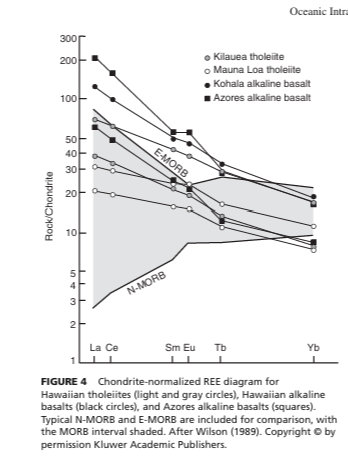
A number of REE curves for OIBs are illustrated in Figure 4. The bounding curves for N-MORB and E-MORB are included for reference. Note that ocean island tholeiites (represented by the Kilauea and Mauna Loa samples) overlap with MORB and are not unlike E-MORB. The alkaline basalts have steeper slopes and greater LREE enrichment, although some fall within the upper MORB field.
From the consistent negative slopes in Figure 4, we can deduce that E-MORBs and OIBs (OIAs and OITs) are distinct from N-MORBs (positive slope) and appear to originate in an enriched mantle reservoir, although very low degrees of partial melting may also produce LREE-enriched melts from a primordial or slightly depleted source. I argue that MORB tholeiites probably originated in the depleted upper mantle, and alkali basalts in an enriched mantle reservoir (perhaps in the lower mantle). Now it appears that EMORB and ocean island tholeiites also have an enriched reservoir source.
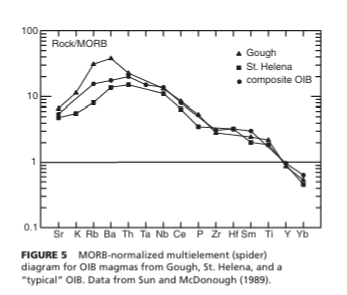
A broad spectrum of trace elements for OIB and N-MORB can be compared using the N-MORB-normalized spider diagram. Figure 5 compares some OIBs from Gough and St. Helena, as well as a composite “average” OIB proposed by Sun and McDonough (1989). All three are enriched in incompatible elements over N-MORB (normalized values greater than one). They show the broad central hump in which both the LIL (Sr-Ba) and HFS (Yb-Th) element enrichments increase with increasing incompatibil ity (inward toward Ba and Th). This is the pattern we should expect in a sample enriched by some single-stage process (such as partial melting of a four-phase lherzolite) that preferentially concentrated incompatible elements. The hump pattern is regarded as typical of melts generated from relatively undepleted mantle in intraplate settings.
OIB ISOTOPE GEOCHEMISTRY
The isotope chemistry of OIBs is much more variable than shown for MORBs. E-MORBs have recently been found to be more variable than originally thought as well, indicating that they tap a broader spectrum of mantle source material, a subject to be explored more fully in this chapter. The isotopic signature of melts believed to be derived directly from the mantle provides us with one of the best perspectives on the nature of the mantle itself. The isotopic variation shown in the ocean volcanics reveals that the mantle is far from a uniform reservoir, even in the simplest case of the suboceanic mantle.