Chapter 1.1 Returns
Capital loss is the same as negative capital gain
Total dollar return: Sum (∑) of dividend income & capital gains (losses)
Value of investment is the capital gain + (additionally now) dividends
if not sold, does it become a gain or a loss? →YES
“paper” gain, not a cash gain if not sold? → NO, ‘paper gain/loss’ (unrealized gain/loss)
Capital gain is as much as apart of a return as the dividend, therefore should be counted as part of a return.
Because not selling (“realizing” the gain) is irrelevant, you can convert to cash
Converting gain → cash: sell stock → reinvest by buying the stock back
Therefore, there isn’t a difference between reinvesting from buying stocks back & not selling (this assumes no transaction costs / tax consequences)
Percent Returns
It is easier to summarize info about return in percentage forms, removing dependency on dollar amounts invested.
Question being answered from percent returns: How much do we get for each dollar invested?
This leads to cash flow calculations based on price stock and the dividends paid on the stock during the year, expressing everything on a per-share basis:
= Price of stock at the beginning of the year
= Stock price periods later
= Dividend paid on the stock during the year
Dividend Yield: Dividing the dividend income by the beginning stock price
Annual stock dividend as a percentage of the initial stock price.
For every dollar invested, we received $ in dividends.
Dividend Yield
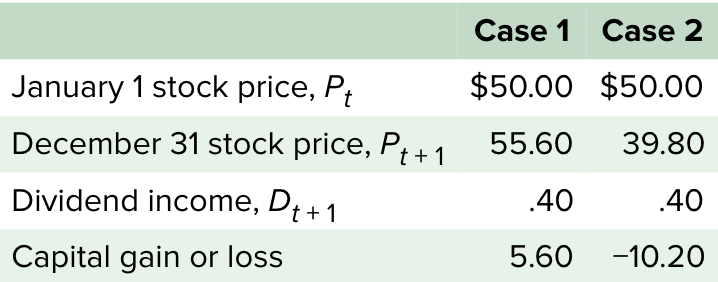
For Example:
Case 1:
Case 2:
→ Therefore, for every dollar invested, we receive .80 cents in dividends.
Capital Gains Yield: Change in the price during the year (capital gain/loss) divided by beginning price
Capital Gains Yield
For Example:
Case 1: \frac{\left(P_{t+1}-P_{t}\right)}{P_{t}}=\frac{\left(\$55.60-\50.00\right)}{\50.00}=\$0.1120,11.20\%
Case 2:\frac{\left(P_{t+1}-P_{t}\right)}{P_{t}}=\frac{\left(\$39.80-\50.00\right)}{\50.00}=\$-0.2040,-20.4\%
→ Thus, a 11.20% ( or -20.4%) yield means for every dollar invested, we get about 11.20 (-20.40, a loss per dollar invested) cents in capital gains/loses.
Total Percent Return: Putting it all together (dividend yield & capital gains yield) we get a rate of return (“return”) on an investment.
Percent Return = Dividend yield + Capital gains yield
Case 1:
→ Previously: The Dividend Yield (11.20) + Capital Gains Yield (0.80) = .12, or .12/100, aka: 12%
Case 2:
Example Problem:
Suppose you buy some stock in Concannon Plastics for $35 per share. After one year, the price is $49 per share. During the year, you received a $1.40 dividend per share. What is the dividend yield? The capital gains yield? The percentage return? If your total investment was $1,400, how much do you have at the end of the year?
$35
$49
$1.40
Dividend Yield:
Capital Gains Yield:
Percentage Return:
End of Year: \1,400\cdot44\%=\
Annualizing Returns
To compare investments, we need to express returns on a per-year or “annualized” basis
Example Problem:
For example, suppose you bought 200 shares of Cisco Systems (CSCO) at a price of $30 per share. In three months, you sell your stock for $31.50. You didn’t receive any dividends. What is your return for the three months? What is your annualized return?
N/A ($0)
$30
$31.50
Dividend Rate: N/A
Capital Gains Yield:
Percentage Return:
For this, since we’re selling before a full period (1 year), this is a holding period.
we need to figure out what it would look like on a per-year basis
Convert to an annualized return
This is an effective annual return (EAR)
EAR = 1 + EAR = (1 + Holding period percentage return)
= number of holding period in a year
holding period / 12
→ 1 + EAR = (1 + Holding period percentage return)
→ annualized return 21.55%