Unit 7
Perpendicularity
3 ways to determine a plane:
2 non-collinear points
a line and a point not on it
2 intersecting lines
Collinear: a line that contains all the points of the set
Coplanar: a plane that contains all the points of the set
Plane-Space Postulate
Ever plane contains at least 2 different non-collinear points
Space contains at least 4 different noncoplanar points
If a line intersects a plane. not containing it, then the intersection contains a point.
If 2 different planes intersect, then their intersection is a line.
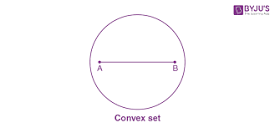
Convex: a collection of points in which the line AB connecting any two points A, B in the set lies completely within the set
 Definition of perpendicularity: A line and a plane are perpendicular if they intersect and if every lone lying in the plane and passing through the point of intersection is perpendicular to the given line
if a line is perpendicular to plane, you can say segments on that plane are perpendicular to that line
Basic Theorem in Perpendiculars: if a line is perpendicular to each of 2 lines at their point of intersection, then it is perpendicular to the plane that contains these lines.
if you have two segments on the same plane that are perpendicular to a line, that line is perpendicular to that plane
Perpendicular Bisecting Plane Theorem: The perpendicular bisecting plane of a segment, is the set of all points equidistant form the endpoints of the segment
The Second Minimum Theorem: The shortest segment to a plane from an external point is the perpendicular segment
Two lines perpendicular to the same plane are coplanar
Parallel Lines
Theorems Proving Lines Parallel and Converse:
Theorems Proving Lines Parallel | Converse |
|---|---|
In a plane, two lines perpendicular to the same line are parallel | if a line is perpendicular to one two parallel lines, then it is perpendicular to the other |
If two lines are cut by a transversal so that a pair of alt. int. angles are congruent, then the lines are parallel | if 2 parallel lines are cut by a transversal, alt. int. angles are congruent |
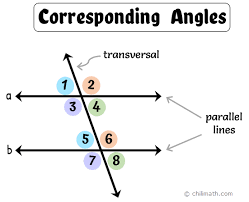
If two lines are cut by a transversal so that a pair of corresponding angles are congruent, then the lines are parallel | if 2 parallel lines are cut by a transversal, corresponding angles are congruent |
If two lines are cut by a transversal so that int. angles on the same side of the transversal are suppl, then the lines are parallel | if 2 parallel lines are cut by a transversal, the same side int, angles are suppl. |
If two lines are cut by a transversal so that alt. ext. angles are congruent, then the lines are parallel | if 2 parallel lines are cut by a transversal, alt. ext. lines are congruent |
Different Angles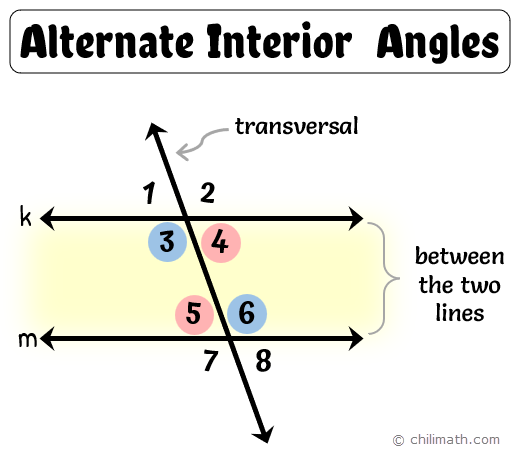
hhhh
hhhh
hhh
h
hhh
h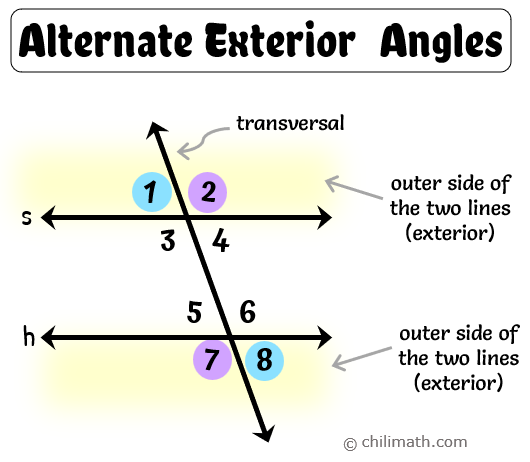
Examples for Always, Sometimes, Never
there is only one plane perpendicular to the line