Energy
Stores and Transfers:
What do these terms mean?
Energy stores describe the type of energy an object contains.
Energy transfers are how energy moves from one store to another.
Remember the conservation of energy:
Energy cannot be created or destroyed, it can only be transferred from one store to another.
Energy Stores
Complete the table with the correct energy store:
Energy Store | Description |
|---|---|
Magnetic | Stored when magnetic poles are pushed together or pulled apart |
Internal (Thermal) | Total kinetic + potential energy of particles; more in hotter objects |
Chemical | Stored in chemical bonds |
Kinetic | Energy of a moving object |
Electrostatic | Stored when charges are moved apart or pushed together |
Elastic potential | Stored in stretched or squashed objects |
Gravitational potential | Stored due to height above the ground |
Nuclear | Stored in the nucleus of atoms |
Identify the energy stores:
Uranium-235 fuel in nuclear power station – Nuclear
A banana – Chemical
Moving wind turbine – Kinetic
Drawn bow (before release) – Elastic potential
Hot water bottle – Internal (Thermal)
Ball at the top of a slope – Gravitational potential
Separated charged objects – Electrostatic
Two N-poles held close together – Magnetic
Energy transfers
Complete the table:
Energy Transfer | Description |
|---|---|
Heating | Energy moves between objects due to a temperature difference |
Electrically | Energy moved by an electric current |
By radiation | Energy transferred by a wave (light, sound etc.) |
Mechanically | Energy moved via a force causing motion or deformation |
Identify the type of transfer:
Battery to bulb in a torch – Electrically
Oven to pie inside – Heating
Tennis racket to ball – Mechanically
Siren to surroundings – By radiation
Transfer of energy between stores
Energy transfer can be shown using flow diagrams. Each box shows an energy store, and each arrow shows the type of transfer between stores. If there are multiple steps, show them in order.
E.g. Describe the energy transfers for a tennis ball which is dropped through the air until just before it hits the floor.

Draw a flow diagram for example 1 above:

Transfer of energy between stores
Some processes involve several stages of energy transfer.
You should show each stage clearly using joined flow diagrams.
Each box = an energy store
Each arrow = a transfer (mechanical, heating, electrical, radiation)
Often, energy ends up transferred to the surroundings, usually as thermal (internal) energy – this is often called wasted energy.
In each case, it is important to give the following information:
Which type of store the energy is
Where the store is
How it is transferred to/from another store
Calculating energy:
The only energy stores you will be asked to calculate in GCSE Physics are GPE and kinetic energy.
The unit of energy is the joule, J or KJ (1×10 to the power of 3 J) or MJ(1× 10 to the power of 6 J). This is the same for all stores and transfers.
Gravitational potential energy
Gravitational potential energy (J) is calculated using the equation:
GPE = mass (kg) × gravitational field strength (N/kg) × height (m)
or simply:
GPE = mgh
Always check your units before calculating—convert mass from grams to kilograms, and height from centimetres to meters if needed.
Kinetic energy
Kinetic energy (J) is calculated using the formula:
KE = ½ × mass (kg) × speed² (m/s)
or in symbols:
KE = ½ mv²
As with gravitational potential energy, always check and convert your units if necessary before calculating.
Conversions between GPE and KE:
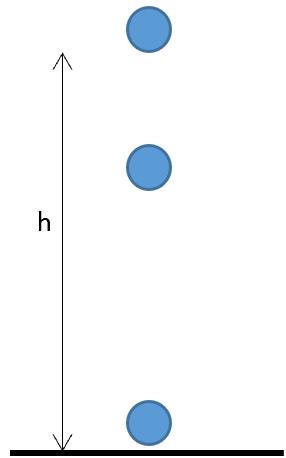
At the top, the ball has a large store of GPE and no KE (as it is not moving)
As it falls, some of the GPE has been converted to KE, so it has a smaller store of GPE, but now also has a store of KE.
The total amount of energy is the same.
Just before it hits the ground, all the GPE has been converted into KE.
The KE here equals the GPE at the top.
Energy conservation
Energy is conserved, meaning no energy is lost to air resistance.
Gravitational potential energy (GPE) at the top equals kinetic energy (KE) at the bottom.
To calculate the final speed (v) when the initial height is known:
GPE at top = KE at bottom
mgh = ½ mv²
gh = ½ v²
2gh = v²
v = √2gh
Final speed does not depend on the mass of the falling object.
Energy on impact:
When the ball hits the floor, energy is transferred to:
The thermal store of the ball.
The thermal store of the surroundings.
Some energy is radiated as sound.
Examples:
(For all of these examples, take g = 10 N/kg.)
Gravitational Potential Energy (GPE)
a. What is the GPE gained when a mass of 250 g is raised 15 m into the air?GPE = mgh
Convert mass: 250 g = 0.25 kg
GPE = 0.25 × 10 × 15
b. An object loses 220 J of GPE when it falls 11 cm. What is the mass of the object?
GPE = mgh
Convert height: 11 cm = 0.11 m
220 = m × 10 × 0.11
c. Calculate the height of an object with a mass of 300 kg and 15 kJ of GPE.
Convert energy: 15 kJ = 15000 J
GPE = mgh
15000 = 300 × 10 × h
Kinetic Energy (KE)
a. What is the kinetic energy of a mass of 4 kg traveling at 0.2 km/s?Convert speed: 0.2 km/s = 200 m/s
KE = ½ mv²
KE = ½ × 4 × 200²
b. Calculate the speed of a mass of 500 g with 25 J of kinetic energy.
Convert mass: 500 g = 0.5 kg
KE = ½ mv²
25 = ½ × 0.5 × v²
c. What is the mass of an object traveling at 10 m/s with a kinetic energy of 400 J?
KE = ½ mv²
400 = ½ × m × 10²
Falling Object (Speed Calculation)
A mass of 2 kg falls from rest through a height of 5 m.
a. Calculate its speed just before hitting the ground.Use energy conservation: GPE = KE
mgh = ½ mv²
2 × 10 × 5 = ½ × 2 × v²
b. What would the speed be if the mass were just 1 kg?
Use the same approach: mgh = ½ mv²
1 × 10 × 5 = ½ × 1 × v²
Stone Fired Vertically
A stone of mass 500 g is fired vertically upwards from a catapult with a speed of 20 m/s.
Assuming air friction is neglected, how much potential energy has the stone gained just before it starts to fall back down?KE = GPE
GPE = ½ mv²
Convert mass: 500 g = 0.5 kg
GPE = ½ × 0.5 × 20²
Other Calculations with Energy Transfers:
Energy Transfers Overview
We calculate various energy transfers (heating, electrical, and mechanical).
Mechanical energy transfers are covered in this booklet (Upper IV level).
Work Done
"Work done" describes the amount of energy transferred.
Work done = energy transferred
Work done can refer to any type of transfer (e.g., electrical work, work done by heating).
Unit: Joules (J), the same as all forms of energy.
Mechanical Work
When a force moves an object, energy is transferred and mechanical work is done.
Mechanical work = Force × distance moved in the direction of the force
Example: When Amy stretches a rubber band, she applies a force. Energy is transferred from Amy’s muscles (chemical energy from food) to the rubber band (elastic potential energy).
Since a force is involved, the energy transfer is mechanical.
Power
Power is the rate at which energy is transferred.
Example: The engine in a Mini transfers energy from the petrol’s chemical store to the car's kinetic energy store, just like in a Ferrari. But a Ferrari engine transfers energy more quickly, making it more powerful.
Power = work done / time taken = energy transferred / time taken
Unit: Watt (W)
1 watt = 1 joule per second.
Efficiency
Energy Transfer in Motors
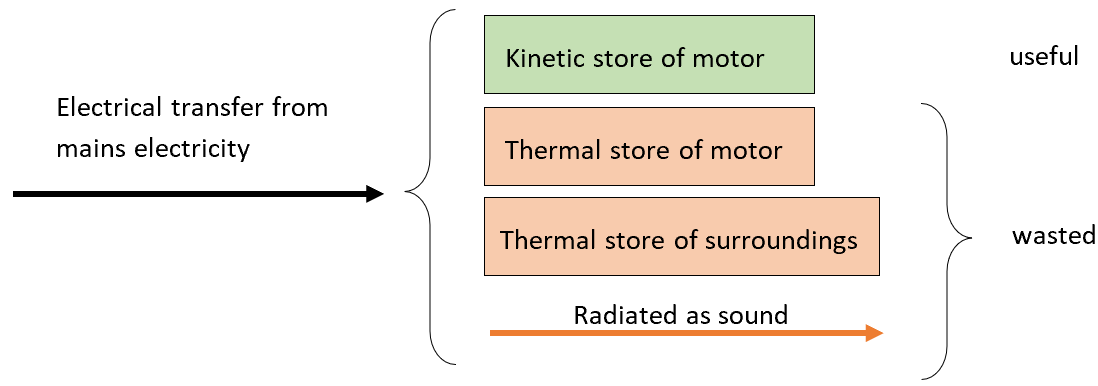
A motor (e.g., in a fan) takes electrical energy and outputs kinetic energy.
This kinetic energy can be transferred to other stores, like gravitational potential energy (GPE).
However, most of the energy is lost due to friction and is transferred to the thermal stores of the motor and its surroundings.
Some energy is also radiated as sound when the motor operates.
Wasted Energy
The energy lost to friction and sound is considered wasted energy.
The energy flow diagram would show the input, useful output, and wasted energy.
Efficiency
Efficiency measures how well energy is converted into useful work.
Efficiency = (useful energy output) / (total energy input) × 100%
Efficiency can also be calculated using power:
Efficiency = (useful power output) / (total power input) × 100%Both methods give the same final result.
Examples:
Mechanical Work Done
a. How much mechanical work is done by a 20 N force which moves an object for 50 m in the direction of the force?
Work done = Force × Distance
Work done = 20 N × 50 m
Work done = 1000 J
So, the mechanical work done is 1000 joules.
b. How much work would be done in lifting a 50 kg box from the floor to a table which is 80 cm high?
First, calculate the force (weight) of the box:
Force = mass × g
Force = 50 kg × 10 N/kg
Force = 500 N
Then calculate the work done:
Work done = Force × Distance
Convert height: 80 cm = 0.8 m
Work done = 500 N × 0.8 m
Work done = 400 J
So, the work done is 400 joules.
c. How much work is done by a person on a bag of shopping of weight 300 N if they carry it a distance of 200 m at a constant height?
Since the bag is carried at a constant height, no work is done in the vertical direction. Work is only done if there’s a change in height.
Work done = 0 J (because there's no vertical movement).
Power Output of the Machine
A machine raises a mass of 250 kg through a height of 3 m in a time of 5 s. Find the output power of the machine.
First, calculate the work done:
Work done = m × g × h
Work done = 250 kg × 10 N/kg × 3 m
Work done = 7500 J
Then, calculate the power:
Power = Work done / Time taken
Power = 7500 J / 5 s
Power = 1500 W
So, the output power of the machine is 1500 watts.
Efficiency Calculations
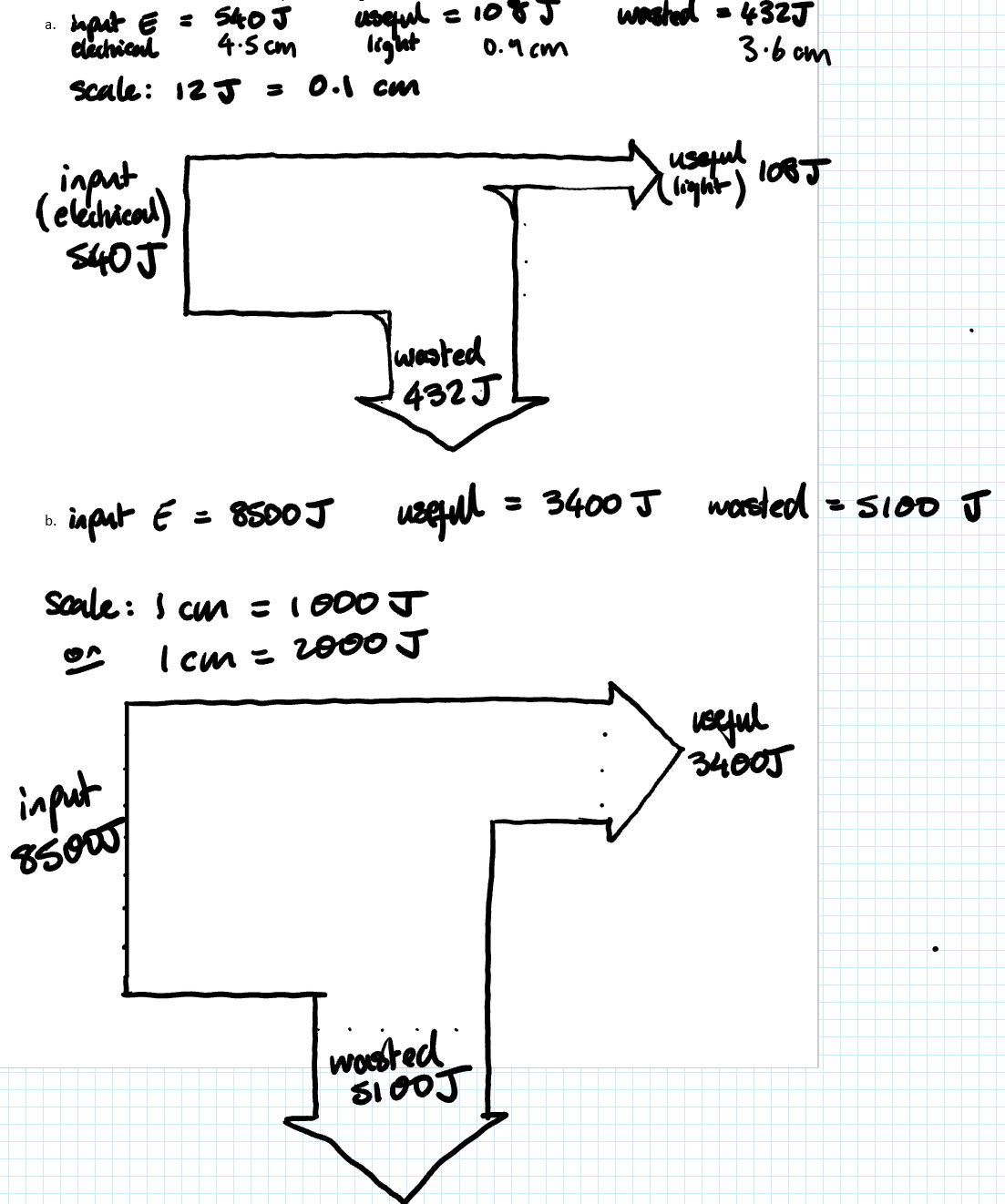
a. What is the percentage efficiency of a light bulb if 540 J of energy is transferred electrically to the bulb, and 108 J of energy is radiated out as light?
Efficiency = (useful energy output / total energy input) × 100%
Efficiency = (108 J / 540 J) × 100%
Efficiency = 0.2 × 100%
Efficiency = 20%
So, the efficiency of the light bulb is 20%.
b. An electric heater is 40% efficient. How much (useful) heat is given out if 8500 J of energy is transferred electrically to the heater?
Efficiency = (useful energy output / total energy input) × 100%
40% = (useful energy output / 8500 J) × 100%
Solve for the useful energy output:
Useful energy output = 40% × 8500 J
Useful energy output = 0.4 × 8500 J
Useful energy output = 3400 J
So, the useful heat given out is 3400 joules.
Sankey Diagrams
Energy Transfers Representation
Sankey diagrams are used to represent energy transfers.
Energy Flow:
Energy transferred to useful stores flows horizontally.
Wasted energy (lost to friction, heat, etc.) flows downwards.
Arrow Widths:
The width of each arrow represents the amount of energy in that transfer.`
The width of the input arrow must equal the sum of the widths of the output (useful energy) and wasted energy arrows (due to energy conservation).
Scale Accuracy:
Arrows are drawn to scale, so measuring their width allows you to calculate the energy in each store or transfer.
Examples: for an electric motor
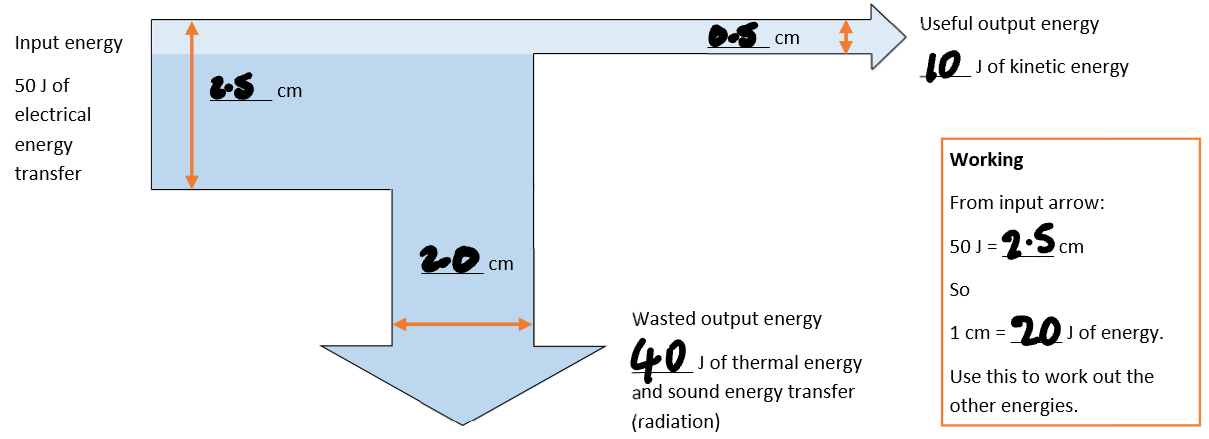
Self drawn examples: