Heuristics and biases in judgement and decision making
Social Judgement Theory
Based on the Lens Model of judgement
Utilizes statistical methods to infer cues used in judgements
Implementing a "weighing and adding" model: weigh cues and sum them
Approach taken:
Statistical approach (regression) for decision making
Not purely psychological theory
Repeated judgements can be improved by using an actuarial model instead of human judgment.
Fast and Frugal Heuristics
Individual heuristics discussed with examples:
Recognition Heuristic: Choose based on recognition
Take the Best: Search cues ranked by ecological validity
Choose the Last: Use the last successful cue
Minimalist Heuristic: Random selection from cues
Take the Best Algorithm
Recognition Principle (Diamond 1)
Searching for cue values (Diamond 2)
Discrimination Rule (Diamond 3)
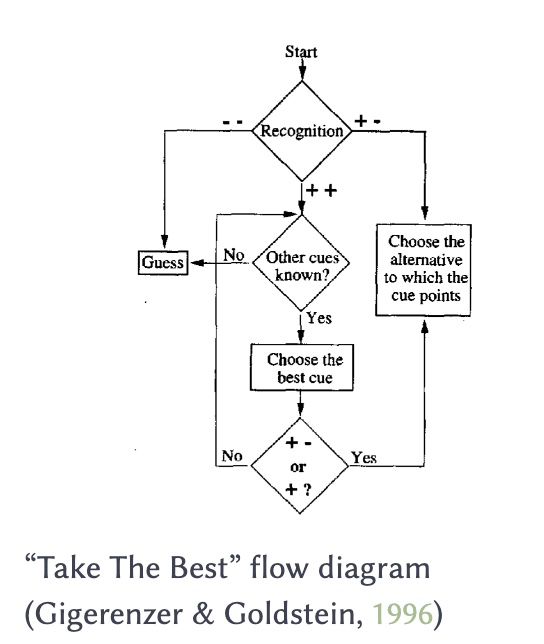
Probabilistic Mental Models
Theory specifies cognitive mechanisms for making decisions
Emphasizes “fast and frugal” heuristics
Differences from traditional models: No "weighing and adding"
Key process involves:
Sequential search for relevant cues that will enable the choice between different outcomes or options
Search halts upon finding a single discriminating cue
Concept of “One-reason decision making”
Evidence Supporting Heuristics
Computer simulations of City Size Judgement Study (Gigerenzer & Goldstein, 1996):
Accuracy:
Take The Best: 65.8% (3 cues)
Multiple Regression: 65.7% (10 cues)
Human Studies of population judgements (Goldstein & Gigerenzer, 2002): 90% alignment with recognition heuristic
Limitations of Heuristics
Despite simulation evidence:
Limited or partial empirical evidence for fast and frugal heuristics
Challenging to control for additional knowledge in judgments people make (Oppenheimer, 2003)
Studies indicate reliance on multiple information sources, in line with Social Judgement Theory.
Assessing Good Judgement
Two evaluation methods defined:
Correspondence Theories: does judgement correspind with the state of the world
Gigerenzer’s ecological rationality emphasizes the match between the structure of heuristics and environments
Coherence Theories: is the process of forming a judgement rational
Tversky and Kahneman heuristics and biases approach explore the deviation of judgement from normative laws and the errors that occur
Heuristics and Biases
Investigated by Tversky and Kahneman (1974):
Focused on judgement under uncertainty and systemic biases due to coherence failures, whether the process of froming a judgement is rational :
Coupled with concepts of:
Attribute substitution
Natural assessment
Attribute Substitution and Natural Assessment
Attribute Substitution: Judgement switches to an easier heuristic attribute, when people make a judgement about something hard
Natural Assessment: Certain attributes are easier to evaluate because they are judged using natural assessment of properties (size, distance, similarity, etc.).
Evidence for Substitution
Evidence types include:
Correlation of target attributes and judgments with heuristic attributes, with which they have been substituted
Documented biases arising from lack of coherence with normative laws, in certain situations.
Extensive evidence collected by Kahneman and Tversky documenting various heuristics and biases
Representativeness Heuristic
Definition: Assesses the correspondence between a sample and its population, etc.
Evaluates probability based on essential properties similarity to its source.
Compound events
Conjunction of two events cannot be more probable than the probability of either individual component event
Conjunction Fallacy: Estimating combined probabilities incorrectly higher than single events
Example: Linda problem by Kahneman & Tversky (1972): Context given about Linda's character. people think it is more likely that Linda is a bank teller and is active in the feminist movement than she is a bank teller
The representativeness heuristic
An assessment of the degree of correspondence between a sample and a population, an instance and a category, an act and an actor or, more generally, between an outcome and a model
Common stereotypes can skew probability assessments.
Judgement examples: Likelihood of being a computer games designer vs. having an investment fund.- Judgements based on resemblance to a stereotype- people make judgements based on similarity
Base Rate Neglect Problems
Judging likelihood of a situation often ignores relevant data:
Example profiles without context lead to skewed conclusions—Tom being a musician over a farmer despite demographics.
Availability Heuristic
A heuristic relying on immediate examples that come to mind when making a judgement
Evaluates frequency/probability based on ease of recollection.
Positive Aspects of Availability Heuristic
Serves well most of the time for frequency estimates, as frequent events are easier to recall.
however, at times the heuristic will produce errors, and it is these errors that have been the focus of research
Errors from the Availability Heuristic
People tend to asses the importance of issues by the ease with which they are retrieved from memory- and this is largely determined by the extent of coverage in the media.
Anchoring and Adjustment
Judgements begin with a value and then adjust relative to that point.
Adjustment from that anchor tends to be insufficient.
Can bias various types of judgement (Keren & Teigen, 2004)
Anchoring and adjustment does not fit within the “attribute substitution” framework. Rather, it works by increasing the plausibility of a particular value of the target attribute (Kahneman & Frederick, 2002)
Wheel of Fortune Anchor Study
Participants’ estimates are highly influenced by arbitrary anchor values presented beforehand.
Summary
Heuristics and biases approach has been highly influential
▶ More “psychological” than the actuarial models statistical approach of last week
▶ Reveals the biases that occur when people use heuristics when making judgements under uncertainty
▶ Gigerenzer argues that these are valuable short cuts that help us make “quick and dirty” judgements when we don’t have all the facts or can’t compute the probabilities
▶ Tversky and Kahneman focus on where these lead us to make errors