Topic 14: advanced stoichiometry with limited and excess reagents
We will be revisiting the chemical equation and learning how to use it to find out how much product we can make and/or reactant we need
a chemical equation works exactly the same was as a recipe: it tells us the ratio of things we need
when the actual amounts are equivalent to the ratio from the chemical equation, that means there is no limiting reagent
when one of the reactants limits the amount of product, that reactant is called the limiting reagent. the other reactant is called the excess reagent
the limiting reagent is completely consumed in the reaction
the excess reagent is not completely consumed in the reaction
How to do basic limiting reagent problems
construct the equation
balance the equation
convert given masses (grams) of reactants to moles using their molar mass
identify limiting reactant by diving the given quantity of moles by its stoichiometric coefficient in the balanced equation. tip:
lowest value = limiting reactant
higher value = excess reactant
us the moles of the limiting reactant to calculate the theoretical yield (in moles) of the products using the stoichiometric mole ratio
determine the amount of moles that the excess reactant used in the reaction
determine the moles of amount of excess reactant there is left
convert moles to grams if needed
but when we are doing labs what we can measure are grams not moles, so we need to know how to use stoichiometry to do gram to gram calculations about excess and limiting reagents
given: grams of substance a and B
convert to moles of substance a and B using molar mass
use the coefficicients of A and B from the balanced chemical equation to find out which is the limiting reactant
divide moles actually present by moles in balanced equation
lowest value = limiting reactant
highest value = excess reactant
calculate the mols of product produced given the limiting reactant
convert mols to grams
steps given in video
write and balance the chemical equation
convert all masses from grams to mols
se the stoichiometric coefficients to find the limiting reagent and predict the moles of the desired species (other reactant/s or product)
convert the moles of product/other reactant (based on the limiting reagent) to grams of the product/other reactant
Percent yield calculations
theoretical yield: 100% yield. this is the amount that we predict being able to make from the stoichiometry
actual yield: what we actually produce
we report the efficiency of the reaction (how close we got to the theoretical yield) as the percent yield
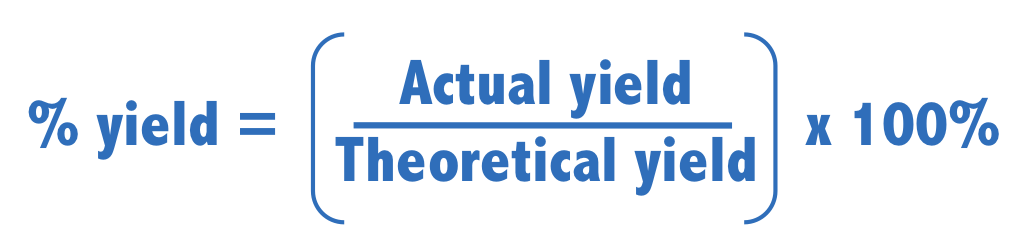
NOTE: typically, when we report an amount produced, it is the actual yield