Unit 3 - Reproductive Strategies
#cb2157
#e5f6f6
#4f9494
Introduction
Like humans, most animals use se-xual reproduction (ie., the production of gametes by meiosis followed by fertilization between two parental gametes to produce genetically distinct offspring). However, there are many other organisms that have a wide variety of life cycles. Many organisms use asexual reproduction, which produces genetically identical offspring. However, there are many other organisms that have a wide variety of life cycles.
Asexual Reproduction
binary fission

Many prokaryotes (ie., bacteria) use a process called binary fission to replicate DNA and create two daughter cells. Due to the fact that these cells have no nucleus and there’s only one chromosome, the process is much simpler than mitosis.
conjugation
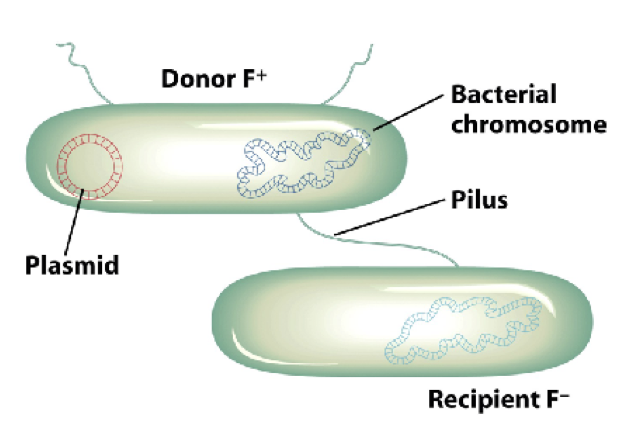
Some bacteria can reproduce through a process called conjugation. Genetic material can be transferred between non-genetically identical bacterial cells through a bridging structure called a pilus (plur. - pili). This creates cells with new genetic combinations and thereby provides a chance that some cells may be better adapted to a changing environment.
budding

Budding is a form of asexual reproduction in which a complete but miniature version of the parent grows out from the parent’s body. Brewer’s yeast (Saccharomyces cerevisiae) and members of the phylum Cnidaria called hydras are examples of organisms that undergo this process. Many plant species use a form of asexual reproduction similar to budding.
vegetative reproduction

Vegetative reproduction can occur in any type of shoot or root, resulting in a new plant that’s genetically identical to the parent plant. Examples of this would be suckers in elms & roses, tubers in potatoes & runners in strawberry plants.
fragmentation

Fragmentation involves the creation of a new organism from a portion of a parent. Gardeners rely on fragmentation to propagate new plants from cuttings. Other organisms that use this technique include molds, lichens, flatworms, some annelids, echinoderms & coral.
parthogenesis

Parthenogenesis is a form of asexual reproduction in which an unfertilized egg develops into an adult. It occurs naturally in many plants and some invertebrate species such as scorpions and honeybees. In honey bees, the queen bee lays both fertilized and unfertilized eggs. The fertilized eggs develop into female worker bees, while the unfertilized eggs develop into male drones. The New Mexico whiptail lizard is a species that undergoes this process. Individuals are hybrids that originated from a mating of the little striped and western whiptail lizards. This hybridization prevented healthy males from forming, resulting in a female-only population.

Se-xual Reproduction
spores
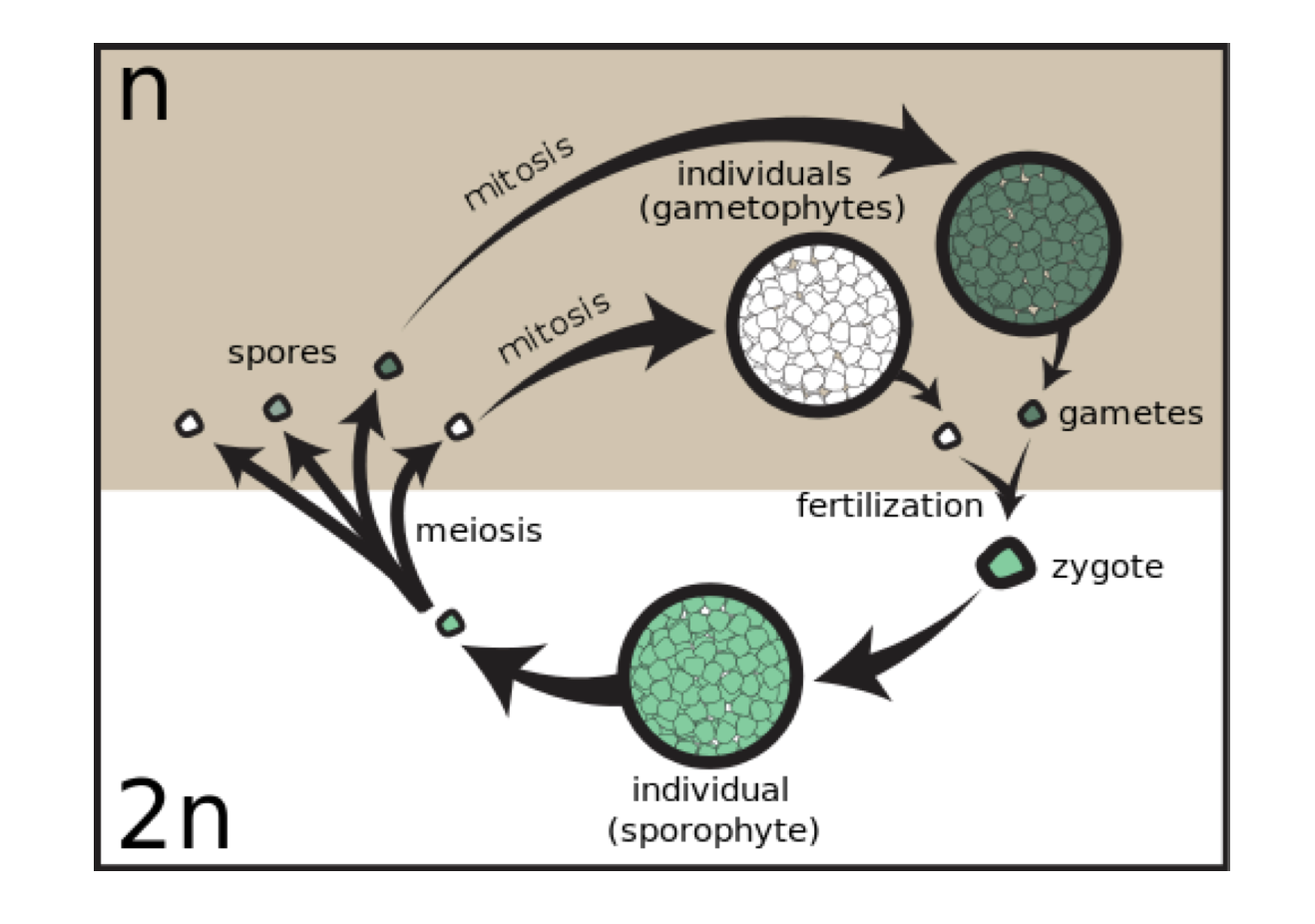
Spores are structures that contain genetic material and cytoplasm surrounded by a protective sheath or wall. Organisms that utilize them (ie., plants, algae, fungi & protozoa) are able to disperse their offspring long distances. They are usually haploid and unicellular.
alternation of generations
Some organisms produce spores by meiosis, resulting in alternation of generations. Some animals’ life cycles alternate between an asexual and a sexual reproducing phase.
plants

The life cycle of plants consists of two alternating generations:
The diploid generation is called the sporophyte, which produces one or more haploid spores which develop without fertilization.
Each haploid spore grows into a plant body called the gametophyte, which produces male and female gametes. These fuse at fertilization and develop into the sporophyte, completing the cycle.
In some plants, sporophytes will produce two types of spores, which will develop into male and female gametophytes (ie., conifers)
cnidaria

Most of the members in the phylum Cnidaria (ie., jellyfish, sea anemones and corals) alternate reproductive phases. Their life cycles are characterized by two distinct adult forms: a non-motile polyp and a free-swimming medusa.
gametogenesis
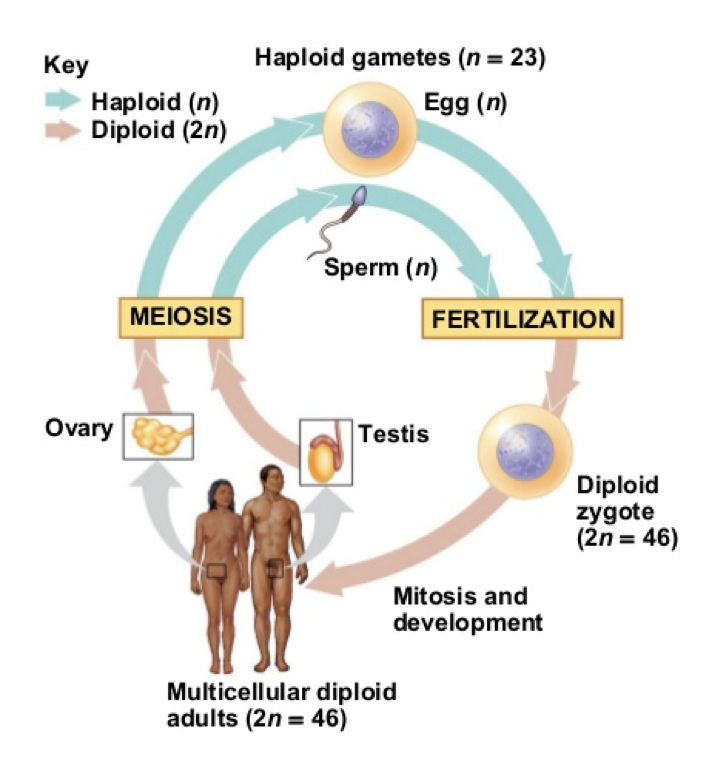
Gametogenesis is the production of germ cells (sperm and eggs) that takes place through the process of meiosis; each contains half the number of chromosomes as the parent. It occurs in the gonads.
spermatogenesis


Spermatogenesis begins with a diploid spermatogonium (plural: spermatogonia) in the seminiferous tubules, which divides mitotically to produce two diploid primary spermatocytes. The primary spermatocyte then undergoes meiosis I to produce two haploid secondary spermatocytes. The haploid secondary spermatocytes undergo meiosis II to produce four haploid spermatids. Each spermatid begins to grow a tail and a mitochondrion-filled midpiece, while the chromatin is tightly packaged into an acrosome at the head. Maturation removes excess cellular material, turning spermatids into inactive, sterile spermatozoa that are transported via peristalsis to the epididymis. The spermatozoa gain motility in the epididymis, but do not use that ability until they are ejaculated into the vagina. Spermatogenesis requires optimal environmental conditions.
oogenesis


Oogenesis starts with the process of developing oogonia via the transformation of primordial follicles into primary oocytes, a process called oocytogenesis. Oocytogenesis is complete either before or shortly after birth in humans. During the menstrual cycle, primary oocytes complete maturation through further meiotic divisions. The first meiotic division is coordinated by hormones: follicle-stimulating hormone (FSH), estrogen, luteinizing hormone (LH), and progesterone. The first meiotic division results in a secondary oocyte and a first polar body. A polar body is a small haploid cell; they frequently die and disintegrate (by apoptosis), but in some cases can remain, as they are important in the life cycle of an organism.
The secondary oocyte enters meiosis II, but is frozen in metaphase II until fertilization occurs. During ovulation, the egg matures further and is released from the ovarian follicles into the oviduct. If it is fertilized by sperm, it finishes meiosis II and becomes an ootid. In meiosis II, secondary polar bodies are produced, analogous to meiosis I. The ootid matures into an ovum, with sperm already fertilizing it. Once the sperm and egg nuclei fuse, a diploid cell called the zygote is formed, which rapidly grows into a new organism.