NZQA Biology AS 91603: Ecological Niche
Niches
Ecological niche: the functional position of an organism in its environment; the range of resources and conditions allowing the species to maintain a viable population
Fundemental niche: the full range of environmental conditions (biological and physical/biotic and abiotic) under which the organism can exist
Realised niche: the niche that is actually occupied, narrower than the fundemental niche and is the result of pressure from, and interactions with, other organisms
A niche comprises of:
- the habitat in which the organism lives * Microhabitat: the precise location within a habitat where a species is normally found. It is small, often highly specialised, and effectly isolated * lichens are * found on rocks, threes, and bare ground * most frogs, like the leopard frog, live in or near fresh water; few can survive dry habitats * woodlice may be found beneath the bark of rooting wood (microhabitat)
- the organism’s activity pattern (photoperiodism, circa- cycles, etc)
- the resources it obtains from the habitat
The physical conditions influence the habitat in which an organism lives, including aspects such as humidity, sunlight, temperature, and altitude among other things.
The Law of Tolerance states that for each abiotic factor, an organism has a range of tolerances within which it can survive.
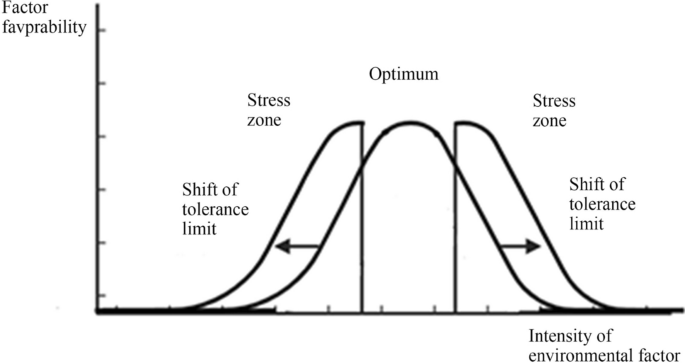
Competition: the active demand between two or more organisms for a resource. It may be intraspecific or interspecific. Each competitor is inhibited in some way by the interactiom between them.
Competition will affect the size of the competitor’s realised niche. It will depend on the intensity and type of competition.
- intense interspecific competition results in a very narrow realised niche as species specialise to exploit a narrower range of resources * interspecific competition is usually less intense than intraspecific competiton as niche overlap between species is not complete
- intense intraspecific competition results in a broader realised niche as individuals are forced to occupy suboptimal conditions
Gause’s competitive exclusion principle states that two or more resource-limited species, having identical patterns of resource use, cannot coexist in a stable environment: one species will be better adapted and will out-compete or otherwise eliminate the other(s).
- In the zone of overlap, interspecific competition will be the most intense.
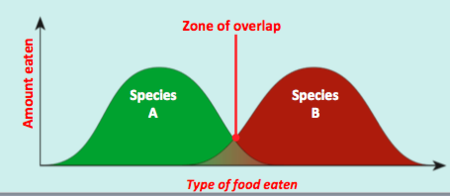
Species with similar ecological requirements may reduce competition by exploiting different microhabitats within the ecosystem.
- For example, damsel fish at Heron Island in Queensland, Australia, are found at different regions over the coral reef where they exploit different resources despite being ecologically similar
Adaptations
Adaptation: an inherited feature of an organism that enables it to survive and reproduce in its habitat. They are the end result of evolutionary changes.
Adaptations are important for:
- biorhythms and activity patterns (photoperiodism, circa- cycles, etc)
- locomotion
- defense of resources
- predator avoidance
- reproduction
- feeding
Organisms may or may not have the adaptations needed to fully exploit all available resources in their respective habitats. But in order to survive, they must develop these adaptations or be subject to intense resource competition.
- In the African savanna, grazing and browsing animals exploit different food resources within the same area or even within the same type of vegetation
Adaptations may be behavioural, physiological, or morphological.
In a praying mantis, these adaptations include:
- presense of wings for flight
- mantid behaviour when seeking, capturing, and manipulating prey
- the female mantid produces a frothy liquid to surround and protect the groups of eggs she lays
Plant Adaptations
Many plant adaptations are concerned with maintaining water balance. Rice plants are prime examples, with their ability to grow even during floods.
| Adapation for water conservation | Effect of adaptation | Example |
|---|---|---|
| thick, waxy cuticle to stems and leaves | reduces water loss through the cuticle | Pinus species, ivy, sea holly, prickly pear |
| reduced number of stomata | reduces the number of pores for water loss | prickly pear, Nerium species |
| leaves curled, rolled, or folded when flaccid | reduces surface area for transpiration | marram grass, Erica species |
Plants evolve defenses, such as camouflage, spines, thorns, or poisons against effecient herbivores.
\