5 - Clinical Psychology Assessment - Psychological test
Universitas Gadjah Mada: Assessment in Clinical Psychology: Psychological Test
Mission: Locally rooted, globally respected
Outline of Topics
Basic Concepts in Psychological Testing
Cultural Fairness and Bias in Psychological Testing
Cognitive, Neuropsychological, & Personality Assessment
The Current Status of Psychological Testing
The Future of Psychological Testing
Basic Concepts in Psychological Testing
Definition of a Test:
Systematic procedure for observing and describing behavior in a standard situation (Cronbach, 1970).
Tests as objective measures that are standardized.
Distinct from other assessment techniques.
Quantitative approach allows for comparison to statistical norms.
Can be administered individually or in groups.
What Do Tests Measure?
Assess/measures various psychological aspects
Types of methods use to administer tests:
Direct specific questions vs. general reactions
*When you ask a clear, specific question, you usually get a focused answer
example: yes or no answer
*When you react to something in a general way, your response might be
broader and not directly answer a specific question.
example: facial expression
Paper-and-pencil vs. oral
Verbal skills vs. nonverbal tasks.
*Some abilities show up more in spoken or written words (verbal skills).
*Others appear in actions or physical tasks (nonverbal skills).
How well someone performs may depend on whether they're using words or actions
Tests are classified into three categories:
Intellectual or cognitive abilities
Attitudes, interests, preferences, values(test minat bakat)
Personality characteristics
Test Construction and Quality
How are test constructed:
Analytic/Rational Approach: Creating questions for a test by carefully looking & understanding the subject area to be assessed.
Empirical Approach: Analyzing whole group responses; useful for predictions.
Avoiding distortion in test score
Potential error
Influences from test administrators and respondents (e.g., malingering: exaggeration of symptoms, not giving good instructions because of low mood, etc)
Minimizing extraneous sources of variability
reducing external factors or influences that might impact the test results
Reducing distortion
ensuring the test data accurately reflects what it is intended to measure, there by avoiding misleading interpretations
-clear instructions and expert involvement.
-paying attention to circumstances surrounding the test.
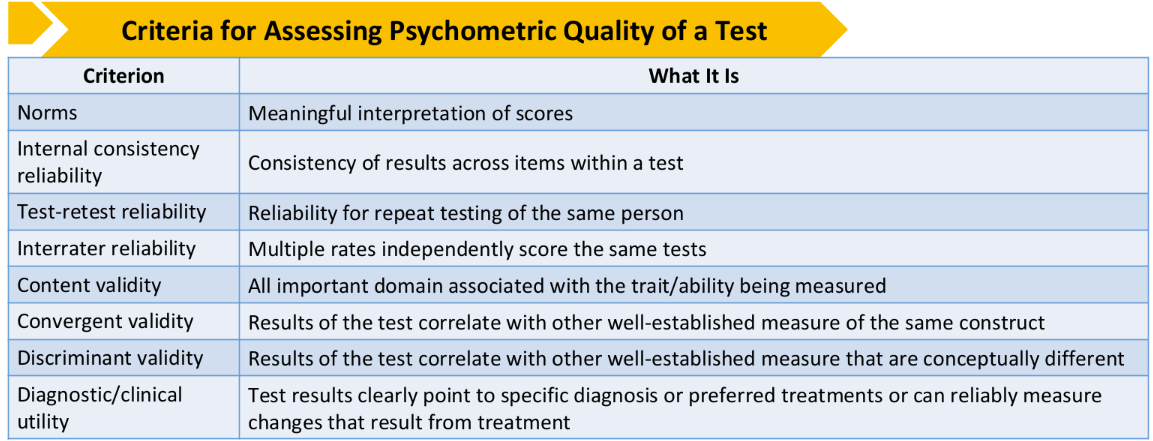
Criteria for Psychometric Quality of Tests
*psychometric: theory and technique of psychological measurement
Norms: Interpretation of scores.
*example: the score 90 is a grade A in this school
Reliability Types:
Internal consistency - consistent results across items(question)
Test-retest - consistency across time.
Interrater - multiple raters yield similar results.
Validity Types:
Content validity - important domain/content associated w the trait
convergent validity - results of the test correlates w other well established measure of the same construct
discriminant validity - results of the test correlates w other well established measure of conceptually different constructs
diagnostic utility - results point to specific diagnosis
Cultural Fairness & Bias in Testing
Examines bias leading to differences in scores among cultural and age groups.
Certain minorities score differently on average on standardised tests when compared to majorities
Examining test use across cultural and age groups
Cognitive Assessment
What is Intelligence?
Describes cognitive ability encompassing:
Understanding complex ideas
Various reasoning forms
Problem-solving and adapting to demands
Learning from experience
Debate on whether intelligence is a singular factor or multiple factors (e.g., CHC model).
Understanding IQ
Originated by Terman (1916) based on Binet and Simon’s work.
Formula: IQ = (Mental Age/Chronological Age) x 100
Mean = 100; standard deviation = 15.
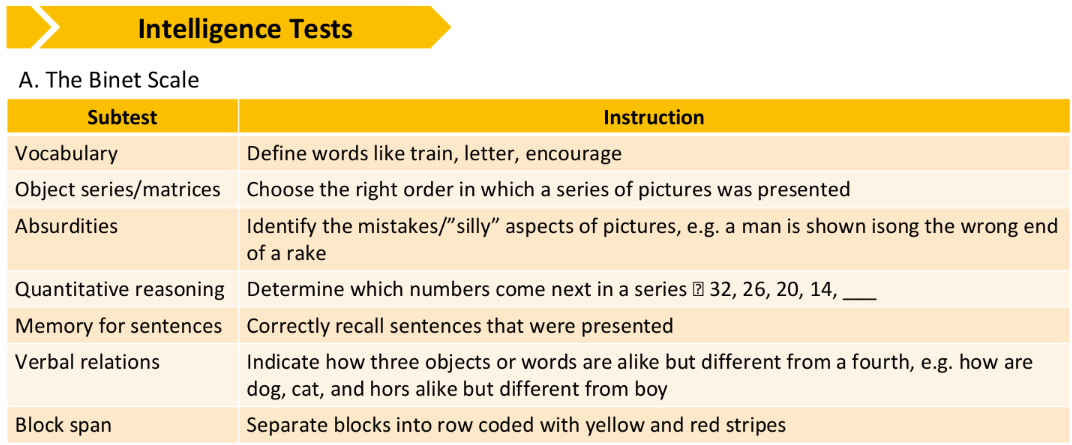
Intelligence Tests: The Binet Scale
Intelligence Tests: WAIS-IV
A widely used test for adults aged 16 to 90.
Assesses a broad spectrum of cognitive abilities through various subtests.
Provides an overall IQ score (Full-Scale IQ) and different various domain scores.
WAIS-IV Index Scores(the various domain scores)
Verbal Comprehension Index (VCI): Ability to understand and use verbal info.
Perceptual Reasoning Index (PRI): Nonverbal reasoning abilities.
Working Memory Index (WMI): Short-term memory manipulation.
*example: remembering what is in your bag
Processing Speed Index (PSI): Speed of processing visual info.
*example: processing something visually in your mind without seeing it
Children’s Intelligence Tests
WISC: For ages 6-17; full-scale IQ and composite scores.
WPPSI: For ages 2.5-7; assesses cognitive abilities of younger children.
Neuropsychological Evaluations
Neuropsychology:
Concerns brain-behavior relationships.
Experimental Neuropsychology: Studies the relationship.
Clinical Neuropsychology: Assessment and treatment of brain damage.
Purposes of Neuropsychological Evaluations
Diagnosis: Classifying neurological and psychiatric symptoms.
Patient Care: Aids in adjusting to disabilities.
Evaluation of Rehabilitation: Helps in planning and assessing cognitive strength/weakness.
Research: Organizes brain studies related to behavior.
Domains Important to Assess in Neuropsychology
Orientation, Sensation and Perception, Attention, Motor Functioning, Language and Verbal Function, Visual-Spatial Organization, Memory, Abstract Reasoning.
Comprehensive Neuropsychological Assessments Include:
Review of referral information, medical records, and an in-depth interview.
Administration of neuropsychological tests to assess functioning.
Neuropsychological Test: Fixed Batteries
Halstead Reitan: Assesses functioning with an impairment index; includes input functions, verbal abilities, etc.
Luria Nebraska: Comprehensive assessment with numerous item variations focusing on brain function.
Personality Assessment Types
Objective Tests: Unambiguous items, limited responses, often questionnaires.
Projective Tests: Ambiguous stimuli with open-ended responses.
Minnesota Multiphasic Personality Inventory 2 (MMPI-2)
A popular objective personality test providing behavior insights.
Features validity scales for lying, defensiveness, and infrequency.
Beck Depression Inventory - II (BDI-II)
A targeted objective test assessing depressive symptoms.
Contains 21 self-report items ranging from thoughts on dying to feelings of sadness.
Projective Personality Test: Rorschach Inkblot Method
Consists of 10 standardized inkblots used to assess responses and interpretations.
Insights into personality through interpretation of perceived stimuli.
Projective Personality Test: Thematic Apperception Test (TAT)
Developed by Murray; utilizes vague images for storytelling.
Focuses on internal desires (needs) influenced by external environment (press).
Use of Psychological Test Results in Clinical Practice
Diagnosis & Assessment: Aligning with diagnostic manuals and testing needs.
Treatment Planning: Selecting tailored interventions based on results.
Monitoring Progress: Continuous assessment for effective treatment adjustments.
Current Status of Psychological Testing
Validity is comparable to medical testing; utility in treatment selection and outcomes assessment.
Future of Psychological Testing
Resilience of valid tests; diminished use of low-reliability tests.
Expansion into cross-ethnic and cross-cultural applications and increased technological integration.