Principles of Marketing Chapter 1: Creating Customer Value and Engagement
Introduction to Emirates Airlines
Business Model:
Emirates Airlines operates a hub-based business model in Dubai, which is strategically located within 8 hours of 75% of the world's population. This model facilitates swift connections for international travelers, maximizing efficiency and operational reach.
Growth and Reach:
Founded in 1985, Emirates has expanded rapidly to operate across six continents, with a network serving 157 cities worldwide. The airline employs about 45,000 individuals from an impressive 172 nationalities, highlighting its commitment to diversity and inclusion in its workforce.
Focus on Customer Value:
Emirates’ strategy revolves around creating exceptional customer value and deepening brand engagement. This positioning allows the airline to lead in international aviation by consistently offering innovative products and services that enhance the travel experience.
Digital Marketing:
Emirates has made a notable shift towards digital and social media marketing, effectively utilizing platforms such as Facebook, Twitter, Instagram, and YouTube to achieve high engagement rates with customers. This strategy fosters community building and strengthens brand loyalty.
Brand Engagement Example:
The “Hello Tomorrow” campaign exemplifies Emirates’ efforts positioning the airline as more than just a travel option; it connects cultures and experiences worldwide, integrating storytelling through various media forms to captivate audiences.
Service Differentiation:
Rather than competing solely on price, Emirates emphasizes high-quality service, innovative in-flight enhancements, and unique customer experiences. This includes access to exclusive lounges, the onboard ICE entertainment system, and the Skywards loyalty program which rewards frequent travelers.
Understanding Marketing
Definition:
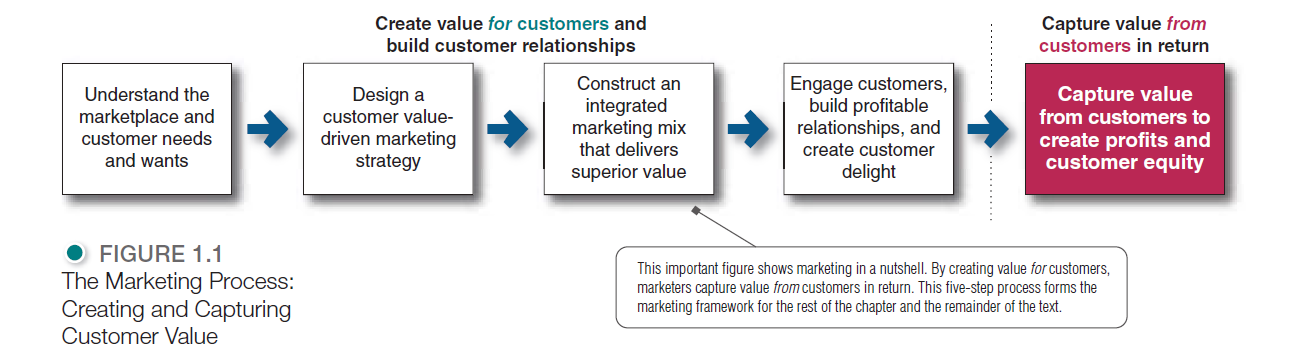
Marketing is defined as the set of strategies and activities by which companies acquire and engage customers, build strong customer relationships, and create superior customer value in order to capture value from customers in return.
Core customer and marketplace concepts:
Customer Needs, Wants, and Demands
Needs: States of felt deprivation. Includes basic human requirements, such as food, clothing, and shelter, that must be satisfied.
Wants: The form human needs take as they are shaped by culture and individual personality. For example, a person may need food but want a specific type of cuisine.
Demands: Human wants that are backed by buying power; customers will demand products that fulfill their wants when they have the resources to buy.
Market Offerings
Some combination of products, services, solutions, and experiences offered to a market to satisfy a need or want. Market offerings can be tangible goods, such as shoes or electronics, or intangible services, like healthcare or education. More broadly, market offerings also include other entities, such as persons, places, organizations, information, ideas, and causes.
Many sellers make the mistake of paying more attention to the specific products they offer than to the benefits and experiences produced by these products. These sellers suffer from marketing myopia.
Customer Value and Satisfaction
Value: The ratio of perceived benefits to the cost incurred to obtain those benefits. Companies must focus on providing superior value to establish competitive advantage.
Satisfaction: The extent to which a product's perceived performance meets a buyer's expectations. High satisfaction levels foster customer loyalty and can lead to repeat purchases.
Exchanges and Relationships
Exchanges: The act of obtaining a desired object from a person or an organization by offering something in return. Effective exchanges depend on mutual agreement and satisfaction between parties involved.
Relationships: The ongoing interactions between businesses and customers that build trust and loyalty. Long-term relationships can lead to brand advocacy and repeat business.
Markets
A market is the set of actual and potential buyers of a product or service. Markets can be segmented based on various factors such as economic, demographic, geography, behavior, or psychographics to tailor marketing efforts effectively.
Designing a Customer Value–Driven Marketing Strategy and Plan
To design a winning marketing strategy, the marketing manager must answer two important questions: What customers will we serve (what’s our target market)? and How can we serve these customers best (what’s our value proposition)?
Selecting Customers to server: Companies segment markets to target specific groups effectively, tailoring offerings to meet unique preferences and behaviors.
Choosing a Value Proposition: Companies must clearly define how they will differentiate themselves from competitors, which is vital for attracting and retaining customers (e.g., JetBlue, Spirit Airlines).
Marketing Orientations
There are five alternative concepts under which organizations design and carry out their marketing strategies: the production, product, selling, marketing, and societal marketing concepts.
Production Concept: The idea that consumers will favor products that are available and highly affordable; therefore, the organization should focus on improving production and distribution efficiency.
Product Concept: The idea that consumers will favor products that offer the most quality, performance, and features; therefore, the organization should devote its energy to making continuous product improvements.
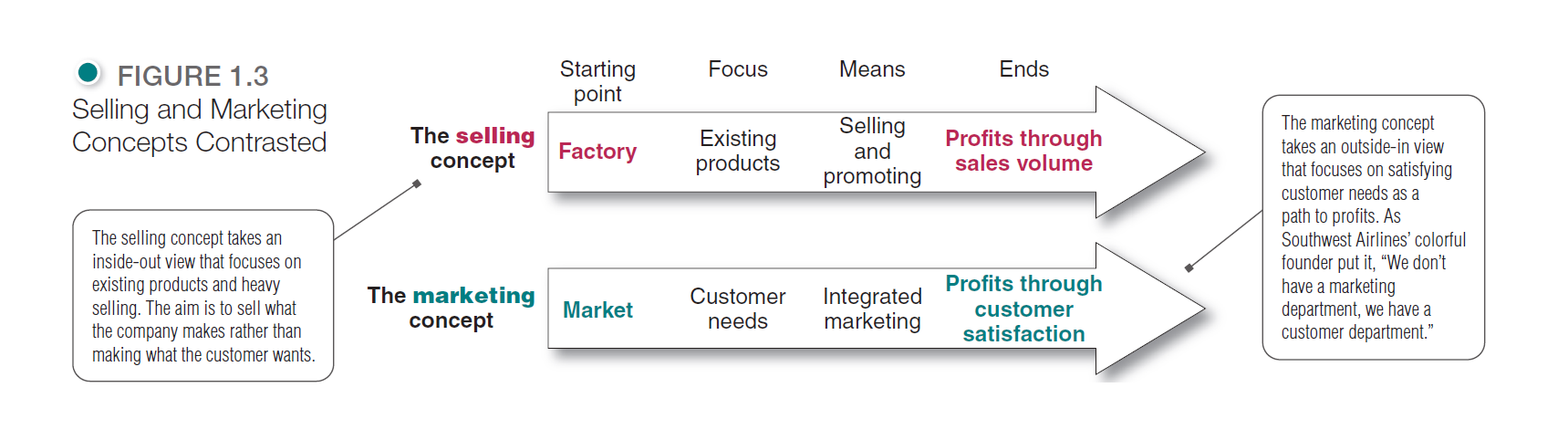
Selling Concept: The idea that consumers will not buy enough of the firm’s products unless the firm undertakes a large-scale selling and promotion effort.
Marketing Concept: A philosophy in which achieving organizational goals depends on knowing the needs and wants of target markets and delivering the desired satisfactions better than competitors do.
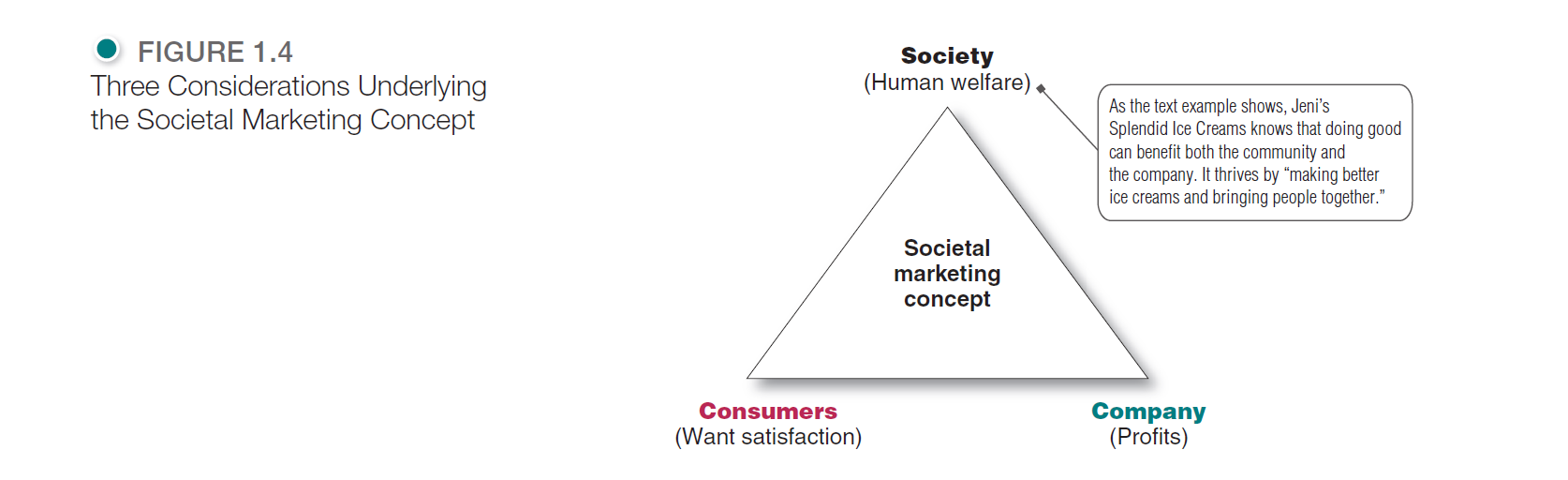
Societal Marketing Concept: The idea that a company’s marketing decisions should consider consumers’ wants, the company’s requirements, consumers’ long-run interests, and society’s long-run interests.
Preparing an Integrated Marketing Mix
The major marketing mix tools are classified into four broad groups, called the four Ps of marketing: product, price, place, and promotion. To deliver on its value proposition, the firm must first create a need-satisfying market offering (product). The firm must then decide how much it will charge for the offering (price) and how it will make the offering available to target consumers (place). Today, the “place” includes not just traditional brick-and-mortar stores but also the internet, mobile channels, and other media that facilitate digital interaction and delivery. Finally, it must engage target consumers, communicate about the offering, and persuade consumers of the offer’s merits (promotion).
Customer Relationship Management (CRM)
CRM is the overall process of building and maintaining profitable customer relationships by delivering superior customer value and satisfaction. It deals with all aspects of acquiring, engaging, and growing customers.
The key to building lasting customer relationships is to create superior customer value and satisfaction.
Satisfied customers are more likely to be loyal customers and give the company a larger share of their business.
A customer buys from the firm that offers the highest customer-perceived value:
This refers to the customer’s evaluation of the difference between the benefits delivered by and the costs of obtaining and using a market offering, relative to those of competing offerings.
Customers often do not judge values and costs “accurately” or “objectively”; they act on perceived value.
Value can mean different things to different consumers:
Some consumers might consider value to be sensible products at affordable prices.
Others might feel that value is paying more to get more.
Example: A luxurious Patek Philippe watch costs between $20,000 and $1,000,000. To those who own one, it represents a great value.
Customer satisfaction is the pleasure a buyer feels when a product’s perceived performance matches or exceeds their expectations.
If the product’s performance falls short of expectations, the customer is dissatisfied.
If performance matches expectations, the customer is satisfied.
If performance exceeds expectations, the customer is highly satisfied or even delighted.
Customer Engagement and Today’s Digital Media
Today’s digital technologies have profoundly changed the ways that companies and brands connect with customers and how customers connect with and influence each other’s brand behaviors. Companies historically focused mostly on mass marketing brands at arm’s length to broad segments of customers. In contrast, companies now use online, mobile, and social media to refine their targeting and to engage customers more deeply and interactively.
This new marketing is named customer-engagement marketing.
Customer-engagement marketing is making the brand a meaningful part of customers’ conversations and lives by fostering direct and continuous customer involvement in shaping brand conversations, experiences, and community.
Beyond building brand loyalty and purchasing, marketers want to create customer brand advocacy, actions by which satisfied customers initiate favorable interactions with others about a brand.
Greater customer empowerment means that companies can no longer rely on marketing by intrusion. Instead, they must practice marketing by attraction—creating market offerings and messages that engage customers rather than interrupt them. For example, companies post their latest ads and videos on social media sites, hoping they’ll go viral.
Customer-Generated Marketing
One form of customer-engagement marketing is customer-generated marketing, where customers themselves—invited or uninvited—help shape their own brand experiences and those of others.
Example: Oreo ran a #MyOreoCreation contest asking fans to come up with new flavor ideas. Three finalist flavors hit the stores for two months before fans voted online for a winner, who received $500,000.
Partner Relationship Management
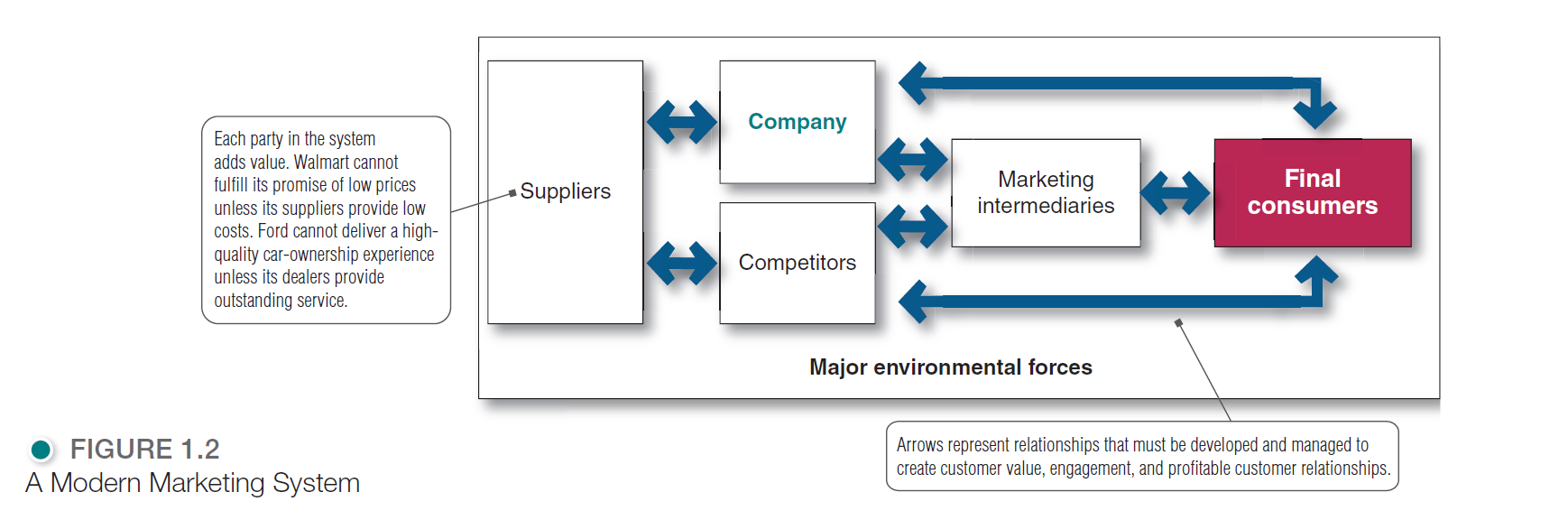
Partner Relationship Management (PRM) is the concept of working closely with partners in other company departments and outside the company to jointly bring greater value to customers.
PRM focuses on fostering effective relationships between a company and its partners, such as resellers, distributors, and other collaborators.
It involves strategies to enhance collaboration, communication, and alignment of goals between partners.
Key benefits include improved efficiency, better resource allocation, and increased sales through joint marketing and sales efforts.
Technology is often utilized to implement PRM systems that facilitate partner engagement, training, and performance tracking, ensuring that all partners are aligned with the company's objectives and can contribute to mutual success.
Creating Customer Loyalty and Retention
Good customer relationship management creates customer satisfaction.
Satisfied customers remain loyal and talk favorably to others about the company and its products.
Keeping customers loyal makes good economic sense.
Loyal customers spend more and stay around longer. Losing a customer means losing more than a single sale; it means losing the customer lifetime value—the value of the entire stream of purchases that the customer would make over a lifetime of patronage.
Growing Share of Customer
Good customer relationship management can help marketers increase their share of customer—the share they get of the customer’s purchasing in their product categories.
To increase share of customer, firms can offer greater variety to current customers or create programs to cross-sell and up-sell more products and services to existing customers.
Example: Amazon is highly skilled at leveraging relationships with its hundreds of millions of customers worldwide to increase its share of each customer’s spending budget.
Building Customer Equity
Customer equity is the total combined customer lifetime values of all the company’s current and potential customers.
Building the Right Relationships with the Right Customers
Companies should manage customer equity carefully. They should view customers as assets that need to be managed and maximized. But not all customers, not even all loyal customers, are good investments. Surprisingly, some loyal customers can be unprofitable, and some disloyal customers can be profitable. Which customers should the company acquire and retain?
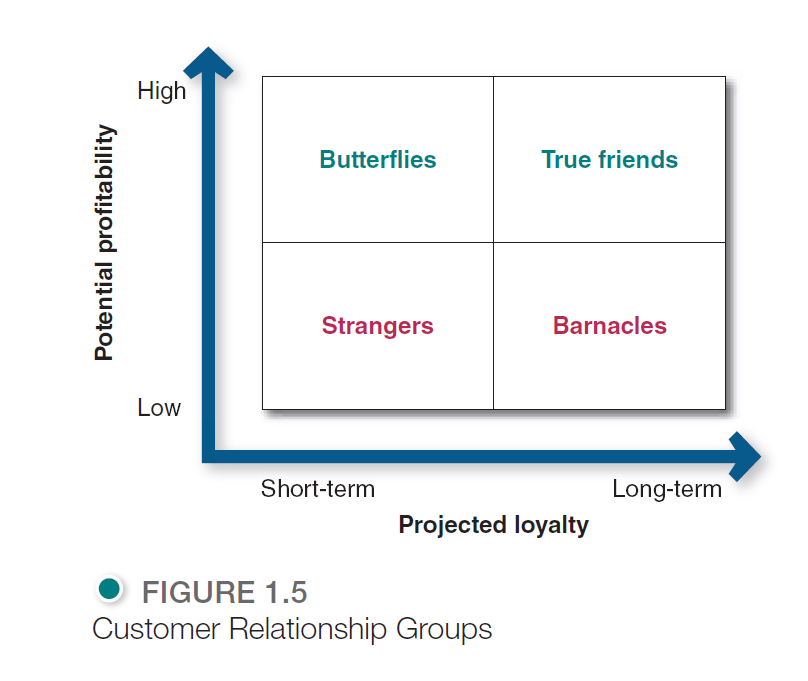
Customers are classified into four groups based on:
Potential profitability: How much profit they can generate for the company.
Projected loyalty: How long they are likely to stay loyal to the company.
The Four Customer Groups
Butterflies:
Characteristics: High profitability but short-term loyalty.
Strategy: Focus on satisfying their needs while they are actively engaged. Avoid over-investing in them once their loyalty fades.
Example: Stock market investors who trade frequently but don’t stick with a single brokerage firm.
True Friends:
Characteristics: High profitability and long-term loyalty.
Strategy: Nurture these relationships by continuously improving offerings, engaging them, and building trust. Convert them into "true believers" who advocate for the brand.
Example: Customers who repeatedly purchase and share positive experiences about the company.
Strangers:
Characteristics: Low profitability and short-term loyalty.
Strategy: Avoid investing resources in them as there is little alignment between their needs and the company’s offerings.
Example: Customers who make occasional purchases but do not fit the target market.
Barnacles:
Characteristics: Low profitability but long-term loyalty.
Strategy: Analyze whether they can be made profitable (e.g., through upselling or reducing service costs). If not, consider limiting investments in them.
Example: Bank customers who maintain accounts but generate minimal revenue.
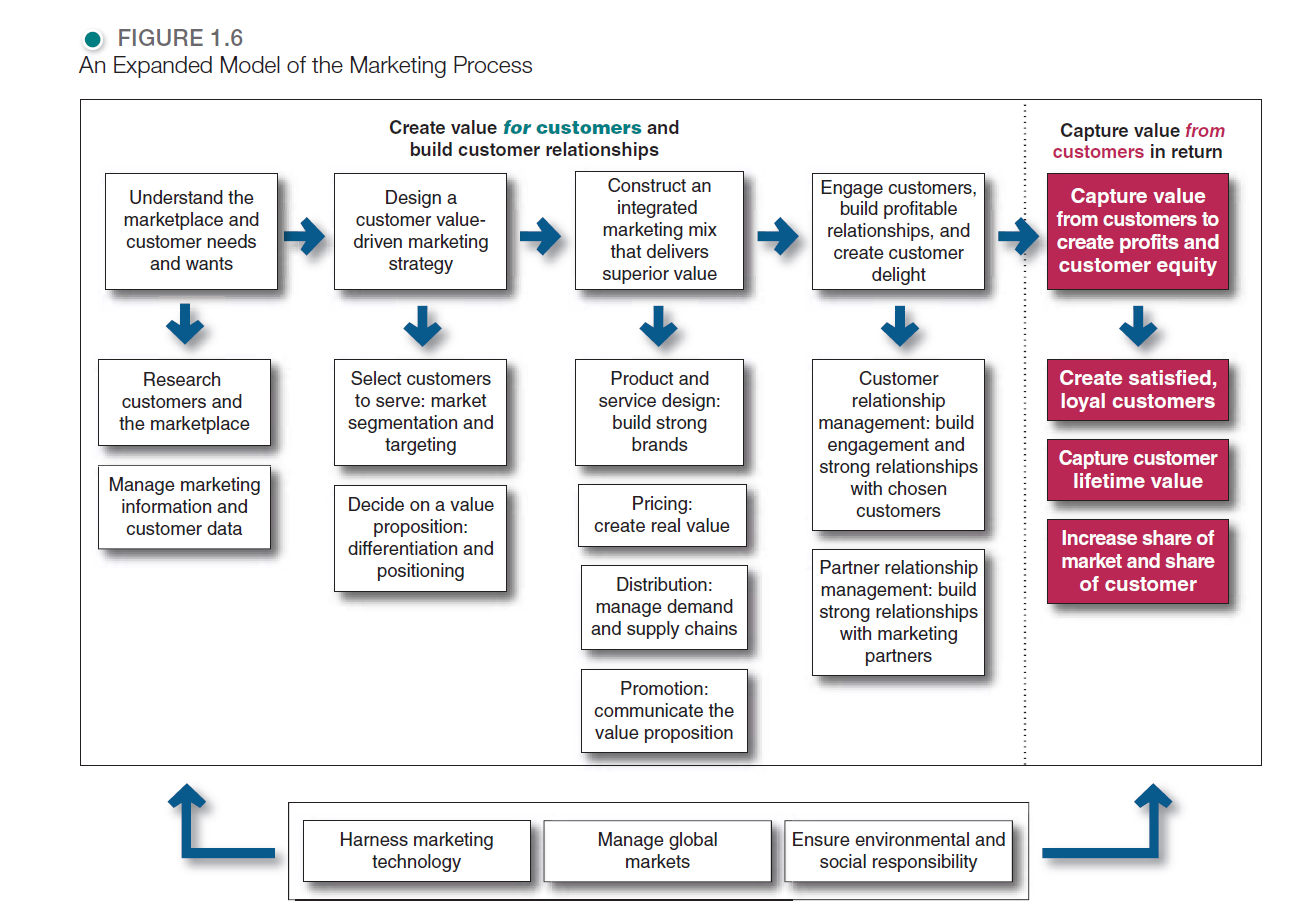
Putting It All Together
The first four steps of the marketing process focus on creating value for customers. The company first gains a full understanding of the marketplace by researching customer needs and managing marketing information. It then designs a customer value–driven marketing strategy based on the answers to two simple questions. The first question is “What consumers will we serve?” (market segmentation and targeting). Good marketing companies know that they cannot serve all customers in every way. Instead, they need to focus their resources on the customers they can serve best and most profitably. The second marketing strategy question is “How can we best serve targeted customers?” (differentiation and positioning). Here, the marketer outlines a value proposition that spells out what values the company will deliver to win target customers.
With its core marketing strategy chosen, the company now constructs an integrated marketing mix consisting of a blend of the four mix elements—the four Ps—that transforms the marketing strategy into real value for customers. The company develops product offerings and creates strong brand identities for them. It prices these offers to create real customer value. It distributes or places the offers to make them available to target consumers. Finally, the company designs promotion programs that engage target customers, communicate the value proposition, and persuade customers to act on the market offering.
Perhaps the most important step in the marketing process involves engaging target customers and building value-laden, profitable relationships with them. Throughout the process, marketers practice customer relationship management to create customer satisfaction and delight. They engage customers in the process of creating brand conversations, experiences, and community. In creating customer value and relationships, however, the company cannot go it alone. It must work closely with marketing partners both inside the company and throughout its marketing system. Thus, beyond practicing good customer relationship management and customer-engagement marketing, firms must also practice good partner relationship management.
The first four steps in the marketing process create value for customers. In the final step, the company reaps the rewards of its strong customer relationships by capturing value from customers. Delivering superior customer value creates highly satisfied customers who will buy more, buy again, and advocate for the brand. This helps the company capture customer lifetime value and a greater share of the customer’s spending. The result is increased long-term customer equity for the company.