Intro to Pharmacokinetics
ADME = absorption, distribution, metabolism and excretion
Absorption is how the drug travels from the site of administration to the site of action. Drugs administered by needle or infusion bag into the blood have no absorption phase.
Distribution is the passage of a drug through the bloodstream to different tissues in the body.
Metabolism is the activity which breaks down a drug, usually the liver.
Excretion is the elimination of a drug from the body.
Isolated tissues can be used to monitor the response when the drug is administered directly to the organ or cells of interest, however clinical use involves a whole organism so interaction with different organs needs to be considered.
Pharmacokinetics is how the drug is processed by the body and its concentration changes over time whereas pharmacodynamics concerns the effects of the drug on the body.
Concentration of drug in the body is usually measured by the blood/plasma concentrations as the blood is easier to access. This requires the assumption that there’s an equilibrium between the plasma and receptor concentration. Drug concentration is often higher at the kidney than at the plasma and receptor as the drug is being filtered in the kidney.
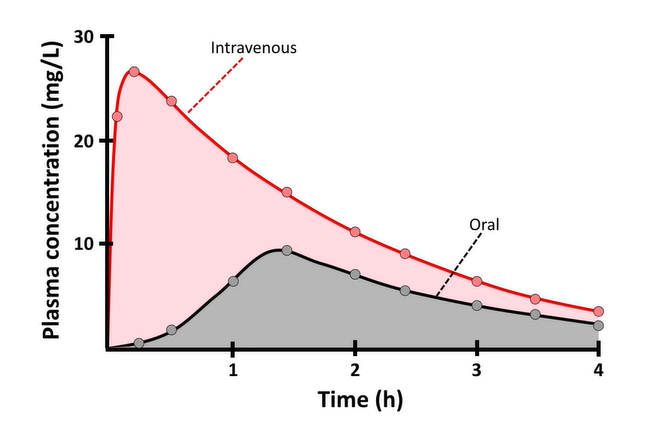
A typical PK profile is as seen below
 The in vitro pharmacological response is shown as a log concentration response curve (sigmoidal shape). A similar relationship in vivo is shown between log[dose] and effect.
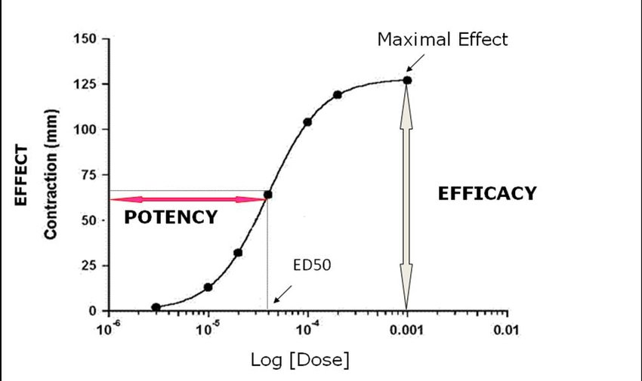 The ED50 is the dose required to achieve 50% of the desired response in 50% of the population.
TD50 is the median toxic dose of a substance in which toxicity occurs in 50% of the cases.
Drugs which are more toxic and have a narrow therapeutic index are given on the basis of mg/kg body weight. Many oncology medicines are given in this way.
A drug’s site of action can be defined on an anatomical, cellular or molecular basis.
Direct oral anticoagulants (DOACs) are small molecules which target the central plasma compartment. They occupy the catalytic site of either FXa or thrombin, preventing the molecules’ ability to cleave and activate their substrates.
Caffeine targets adenosine receptors which are easily accessed via the blood. Adenosine A2A receptor found mainly in brain, heart, lungs and spleen. Adenosine A2B mainly found in large intestine and bladder. Adenosine A3 receptor present in the lungs, liver, brain, testes and heart.
Temozolomide targets the DNA of brain tumour cells.