Carbohydrates
- What are the 3 types?
- Monosaccharides
- Disaccharides
- Polysaccharides
Monosaccharides
Monosaccharides are sugars that contain one sugar unit
- What is the general formula?
(CH_2O)_n
- What is Glucose's formula and what type for sugar is it?
C_6H_{12}O_6$, Hexose sugar
- What are the other sugar types?
Pentose, Triose
- What is a Hexose sugar?
Sugar containing 6 carbon atoms
- What is a pentose sugar?
sugar containing 5 carbon atoms
- What is a triose sugar?
Sugar containing 3 carbon atoms
- Draw and name the 2 forms of Glucose?
- Alpha Glucose
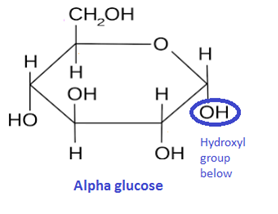
- Beta glucose
- Alpha Glucose
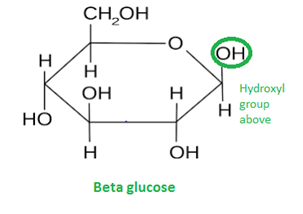
- Name 2 other mono saccharides?
Fructose and galactose
- How many carbons in Ribose?
5
- Draw and name the 2 Ribose forms?
- Ribose
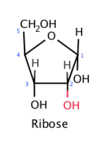 * Deoxyribose
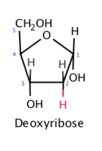
- Where is glucose found?
Fruit
- Where is fructose found?
Fruit and nectar
- Where is galactose found?
milk
Disaccharides
Disaccharides are sugars containing 2 sugar units joined together
- General formula?
$C_n(H_2O)_{n+1}$
- How are they formed?
In a condensation reaction
- What is a condensation reaction?
One where water is produced as a byproduct from the joining of 2 molecules
- What is the bond called between the 2 monosaccharides?
Glycosidic bond
- Draw this reaction?
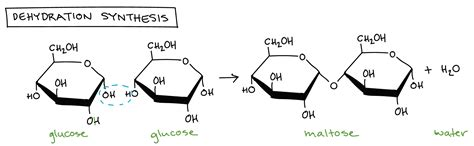
- How are they broken down?
By hydrolysis
Hydrolysis - the process of adding water to break a bond
- How are they hydrolyzed in the body?
By enzymes such as sucrase, maltase, lactase etc.
- How are they Hydrolyzed in a test tube?
By boiling with hydrochloric acid
- What monosaccharides make Sucrose?
Glucose and fructose
- What monosaccharides make Maltose
Glucose and Glucose
- What monosaccharides make Lactose
Glucose and Galactose
- Where is Maltose found
Germinating seeds
- Where is sucrose found?
phloem tissue, Fruit
- Where is lactose found?
Milk
Reducing Sugars
- What happens when boiled with Benedicts reagent?
Turns from blue to brick red reducing blue copper(II) to red copper(I)
- What is the reducing center?
The bit of the molecule that does the reducing
- When can it reduce?
Whenever it is not involved in a glycosidic bond
- Where is this in glucose?
On Carbon 1
- Where is this in fructose?
On Carbon 2
- Therefore which out of Maltose and Sucrose is reducing?
Maltose as it still has the $C_1$of the 2nd glucose un-bonded
Polysaccharides
Polysaccharides - Sugars with more than 2 sugar units bonded together normally forming long chains
Monomer - the base repeating unit of a polymer
- Name the 3 we need to learn?
- Starch
- What is it used for?
Plants energy store * What is it made up of? * Amylose * What is the monomer and how is it bonded?
alpha glucose bonded with 1,4 glyosidic bonds * What is it's structure?
Long unbranched chains that for a helical shape as weak hydrogen bonds form between the glucose * Why is it good for storage?
The shape makes it compact * Draw both the structure and the glucose arrangement? * Structure
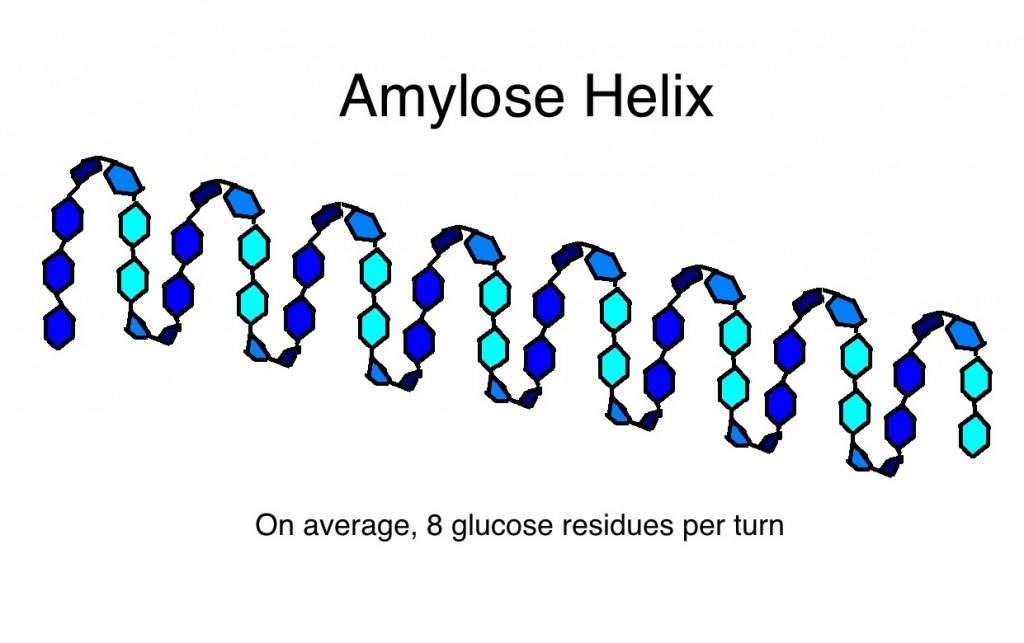 * Glucose arrangement
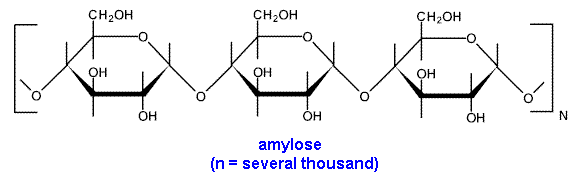 * Amylopectin
* What is the monomer and how is it bonded?
* Amylopectin
* What is the monomer and how is it bonded?
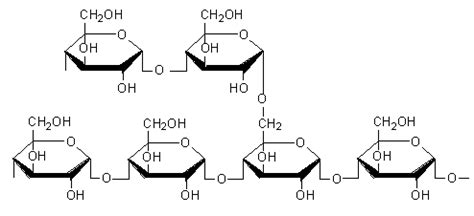
Alpha Glucose , 1,4 and 1,6 glycosidic bonds * How does the 1,6 bond affect the structure?
It makes it branched * Why do branches make it a good storage molecule?
Because it has more ends for the enzymes to access so it can be converted back to glucose quicker than amylose * Draw both it's structure and glucose arrangement? * Structure
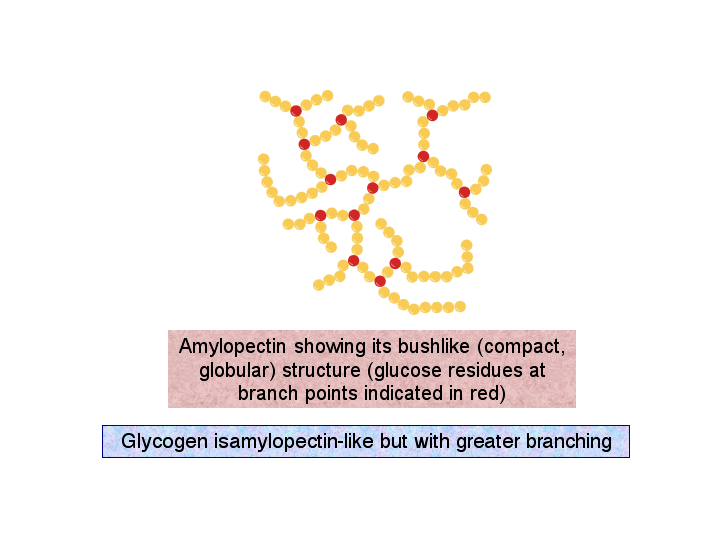 * Glucose arrangement
 * Name 3 Key features of starch?
Insoluble so does not affect water potential of the cell (does not affect osmosis)
Compact due to it's helical structure
Has branches allowing quick glucose release by amylase enzyme
- Glycogen
- What is it used for?
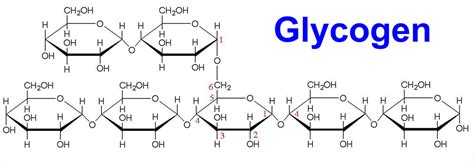
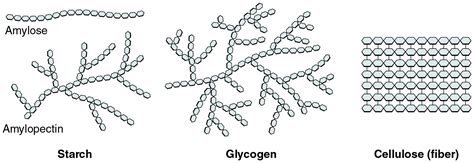
Animals energy store * Which molecule is it's structure the same as except one thing (name it)?
Amylopectin, but it has more 1,6 glycosidic bonds resulting in more branches * Why is this highly branched structure good for Animals?
It means enzymes can access the bonds easily to hydrolyze them to release the glucose faster as the animal is moving * What are the 3 key features? * Many branches (why?)
Results in fast hydrolysis for movement
Compact
Insoluble * Draw it
- Cellulose
- What is it used for?
Structure in the plant cell walls * What is the monomer?
Beta Glucose * What bonds form?
beta 1,4 glycosidic bonds * What structure does it have?
Long unbranched chains that are bundled together by hydrogen bonds to form microfibrils. These microfibrils are strong and bundle together to form strong fibers * Draw the structure and the arrangement of the glucose molecules for Cellulose? * Structure
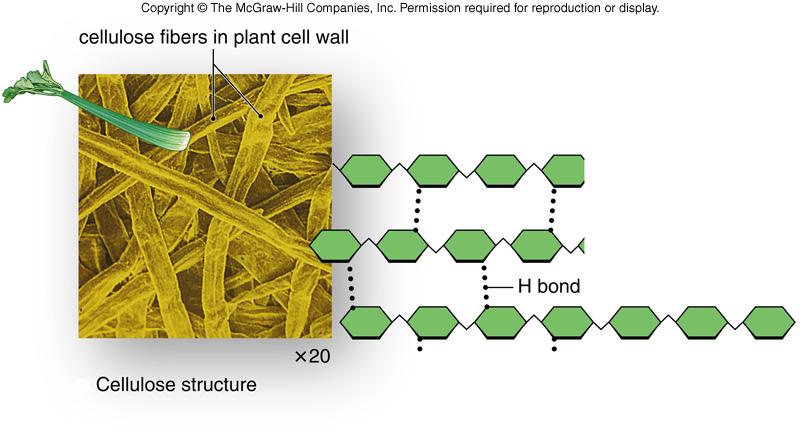 * Glucose arrangement
Notice the flipping Beta-Glucose
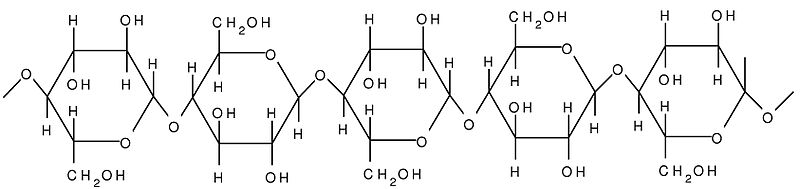 * 3 Key features
* Many Hydrogen bonds link the chains forming strong microfibrils (why are these good)
* 3 Key features
* Many Hydrogen bonds link the chains forming strong microfibrils (why are these good)
They have high tensile strength and give the plant cells strong walls to stop them exploding when they fill with water
Long unbranched Beta-Glucose chains
Insoluble
- Where is starch found?
Chloroplast stroma
- Where is glycogen found?
Muscle cells
- Where is cellulose found?
Plant cell wall's