Semester 1 Precalculus Review

Unit 1

Distance Formula: d=(x2−x1)2+(y2−y1)2d=\sqrt{\left(x_2-x_1\right)^2+\left(y_2-y_1\right)^2}^{} This formula is used to calculate the distance between two points (x1,y1)and(x2,y2)(x1, y1) and (x2, y2)

  • Midpoint Formula: M=(x1+x22,y1+y22)M = \left(\frac{x1 + x2}{2}, \frac{y1 + y2}{2}\right) This formula provides the coordinates of the midpoint between points (x1,y1)and(x2,y2)(x1, y1) and (x2, y2) .

  • Slope Formula: m=y2−y1x2−x1m = \frac{y2 - y1}{x2 - x1} This formula is essential for determining the slope of the line connecting two points, indicating the line's steepness and direction.

  • Quadratic Formula: x=−b±b2−4ac2ax = \frac{-b \pm \sqrt{b^2 - 4ac}}{2a} This formula is used to find the solutions (roots) of a quadratic equation in the form ax2+bx+c=0ax^2 + bx + c = 0, allowing us to determine the x-intercepts of the corresponding parabola.

How to find x and y-intercepts:

x-intercepts are the points where a graph crosses or touches the x-axis. At these points, the y-coordinate is always zero. To find the x-intercept(s) of an equation, set y=0y=0 and solve the equation for xx.

y-intercepts are the points where a graph crosses or touches the y-axis. At these points, the x-coordinate is always zero. To find the y-intercept(s) of an equation, set x=0 and solve the equation for y

Definitions of symmetry with respect to…

  • the x-axis: A graph is symmetric with respect to the x-axis if, for every point (x,y)(x,y) on the graph, the point (x,−y)(x,-y) is also on the graph. This means the x-axis acts as a mirror, reflecting the upper half of the graph onto the lower half, and vice versa.

    • To test for x-axis symmetry, replace yy with −y-y in the equation. If the resulting equation is equivalent to the original, then the graph is symmetric with respect to the x-axis.

  • the y-axis: A graph is symmetric with respect to the y-axis if, for every point (x,y)(x,y) on the graph, the point (−x,y)(-x,y) is also on the graph. This implies that the y-axis serves as a mirror, reflecting the left half of the graph onto the right half, and vice versa.

    • To test for y-axis symmetry, replace xx with −x-x in the equation. If the resulting equation is equivalent to the original, then the graph is symmetric with respect to the y-axis.

  • the origin: A graph is symmetric with respect to the origin if, for every point (x,y)(x,y) on the graph, the point (−x,−y)(-x,-y) is also on the graph. This type of symmetry means the graph remains unchanged after a 180180-degree rotation around the origin.

    • To test for origin symmetry, replace both xx with −x-x and yy with −y-y in the equation simultaneously. If the resulting equation is equivalent to the original, then the graph is symmetric with respect to the origin.

Perfect Square Trinomial:

A perfect square trinomial is a trinomial that results from squaring a binomial. There are two common forms:

  • (a+b)2=a2+2ab+b2(a+b)^2 = a^2+2ab+b^2

  • (a−b)2=a2−2ab+b2(a-b)^2 = a^2-2ab+b^2.

  • Example: (x+3)2=x2+2(x)(3)+32=x2+6x+9(x+3)^2 = x^2+2(x)(3)+3^2 = x^2+6x+9

Difference of Squares:

The difference of squares is a binomial that can be factored into two binomials, one being the sum of the square roots and the other being the difference of the square roots.

  • (a2−b2)=(a+b)(a−b)(a^2-b^2) = (a+b)(a-b)

  • Example: (x2−16)=(x+4)(x−4)(x^2-16) = (x+4)(x-4)


Lines:

  • Equations:

    • Slope Formula: m=y2−y1x2−x1m = \frac{y2 - y1}{x2 - x1}

    • Slope-Intercept Form: y=mx+by = mx + b

    • Point-Slope Form: y−y1=m(x−x1)y - y1 = m(x - x1) - This form is ideal when you know the slope mm of a line and a single point (x1,y1)(x1, y1) that the line passes through

    • General Form: Ax+By=CAx + By = C - In this form, AA, BB, and CC are real numbers, with AA and BB not both zero. This form can represent any straight line, including vertical lines, which cannot be represented in slope-intercept form.

  • Parallel Lines:

    • Two distinct lines are parallel if and only if they have the exact same slope (m1=m2m1 = m2) and different y-intercepts. This means they will never intersect.

  • Perpendicular Lines:

    • Two lines are perpendicular if and only if their slopes are opposite reciprocals of each other. If one line has a slope of mm, a line perpendicular to it will have a slope of −1m-\frac{1}{m} (provided m≠0m \neq 0). The product of their slopes is always −1-1. They intersect at a 9090-degree angle.

  • Horizontal and Vertical Lines:

    • Horizontal Lines:

      • Have a slope of zero (m=0m = 0). This indicates no vertical change for any horizontal change.

      • Their equation is always in the form y=ky = k, where kk is a constant representing the y-coordinate through which the line passes.

      • Example: y=2y = 2

    • Vertical Lines:

      • Have an undefined slope (x2−x1=0x2-x1=0). This is because there is no horizontal change, making the denominator of the slope formula zero, which is mathematically undefined.

      • Their equation is always in the form x=kx = k, where kk is a constant representing the x-coordinate through which the line passes.

      • Example: x=2x = 2

Circles:

  • Definition: A circle is a set of all points in a plane that are equidistant from a fixed point called the center (h,k)(h,k). This fixed distance is known as the radius (r)(r).

  • Standard Form of a Circle: (x−h)2+(y−k)2=r2(x-h)^2+(y-k)^2=r^2

    • (h,k)(h,k) represents the coordinates of the center of the circle, and rr represents the length of its radius

  • Unit Circle: x2+y2=1x^2+y^2=1

  • General Form of a Circle: x2+y2+Ax+By+C=0x^2+y^2+Ax+By+C=0

  • Going from General Form to Standard Form of a Circle:

    • The process involves completing the square for both the x and y terms.

    • Step 1: Group the x-terms and y-terms together, and move the constant term to the other side of the equation.

    • For example, if you have x2+y2+Ax+By+C=0x^2+y^2+Ax+By+C=0, rearrange it to (x2+Ax)+(y2+By)=−C(x^2+Ax) + (y^2+By) = -C.

    • Step 2: Complete the square for the x-terms and for the y-terms.

    • To complete the square for x2+Axx^2+Ax, add (A2)2(\frac{A}{2})^2 to both sides of the equation. This turns (x2+Ax+(A2)2)(x^2+Ax + (\frac{A}{2})^2) into (x+A2)2(x + \frac{A}{2})^2.

    • Similarly, for y2+Byy^2+By, add (B2)2(\frac{B}{2})^2 to both sides. This turns (y2+By+(B2)2)(y^2+By + (\frac{B}{2})^2) into (y+B2)2(y + \frac{B}{2})^2.

    • Step 3: Rewrite the expressions as perfect squares and simplify the constant on the right side to find r2r^2.

    • The equation will become (x+A2)2+(y+B2)2=−C+(A2)2+(B2)2(x + \frac{A}{2})^2 + (y + \frac{B}{2})^2 = -C + (\frac{A}{2})^2 + (\frac{B}{2})^2. From this, you can identify h=−A2h = -\frac{A}{2}, k=−B2k = -\frac{B}{2}, and r2=−C+(A2)2+(B2)2r^2 = -C + (\frac{A}{2})^2 + (\frac{B}{2})^2.

  • Going from Standard Form to General Form of a Circle:

    • This conversion is straightforward and involves expanding the squared binomials.

    • Step 1: Start with the standard form: (x−h)2+(y−k)2=r2(x-h)^2+(y-k)^2=r^2.

    • Step 2: Expand the binomials:

    • (x−h)2=x2−2hx+h2(x-h)^2 = x^2 - 2hx + h^2

    • (y−k)2=y2−2ky+k2(y-k)^2 = y^2 - 2ky + k^2

    • Step 3: Substitute the expanded terms back into the equation and move the r2r^2 term to the left side to set the equation to zero.

    • x2−2hx+h2+y2−2ky+k2−r2=0x^2 - 2hx + h^2 + y^2 - 2ky + k^2 - r^2 = 0

    • Step 4: Rearrange the terms to match the general form: x2+y2−2hx−2ky+(h2+k2−r2)=0x^2+y^2-2hx-2ky+(h^2+k^2-r^2)=0.

    • Here, A=−2hA = -2h, B=−2kB = -2k, and C=h2+k2−r2C = h^2+k^2-r^2.

  • Area of a circle: A=πr2A=\pi r^2

  • Circumference: C=2πrC=2\pi r

    • This formula calculates the distance around the circle (its perimeter), where rr is the radius.

  • How to find the area of a circumscribed square using the equation of a circle that surround the square???


Unit 2

Functions and their Graphs

  • Definition of Functions: let X & Y be two non-empty sets. A function from X into Y is a relation that associates each element of X with exactly one element of Y.

    • If y=f(x), than x is the independent variable (referred to as the [argument of f]) and y is the dependent variable (referred to as the [image of x])

  • Function Operations:

    • (f+g)(x)=f(x)+g(x)(f+g)(x) = f(x) + g(x)

    • (f−g)(x)=f(x)−g(x)(f-g)(x) = f(x) - g(x)

    • (f⋅\cdotg)(x) = f(x) ⋅\cdot g(x)

    • (f/g)(x)=f(x)/g(x)(f/g)(x) = f(x)/g(x) —> g(x) can’t equal 0

  • Difference Quotient:

    • f(x+h)−f(x)h\frac{\left.f\left(x+h\right)-f\left(x\right.\right)}{h}

      where h can’t equal zero

    • It is necessary to have a factor of h cancel out of the denominator

    • Step 1 - replace(x+h)(x+h) for xx in your equation for first part, plug in regular equation for f(x)f(x)

      • f(x)=2x2−3xf(x) = 2x²-3x —> (2(x+h)2−3(x+h))−2x2−3xh\frac{\left(2\left(x+h\right)^2-3\left(x+h\right)\right)-2x^2-3x}{h}

    • Step 2 - simplify

      • h(4x+2h−3)h\frac{h\left(4x+2h-3\right)}{h}

    • Step 3 - Get rid of the h downstairs

      • 4x+2h−34x+2h-3 (Difference quotient)

  • Finding the Domain of a Function:

    • f(x)=x2+5xf(x) = x²+5x —> domain is all reals

    • g(x) = 3xx2−4\frac{3x}{x^2-4} (when there’s a variable downstairs it can’t equal zero)

      • x2−4=(x+2)(x−2)x^2-4=\left(x+2\right)\left(x-2\right) —> domain: x can’t equal 2 or -2

    • h(t) = 4−3t\sqrt{4-3t}

      • radicand can’t be negative

      • 4−3t4-3t must be greater than or equal to 0 —> t has to be less than or equal to 4/3

  • Properties of Functions

    • Even Functions:

      • symmetric to the y-axis

      • f(−x)=f(x)f(-x)=f(x)

    • Odd Functions:

      • symmetric to the origin

      • f(−x)=−f(x)f(-x) = -f(x)

    • Intervals of Change:

      • As x increases…

        • an increasing interval gets larger values of f(x) if x1<x2, then f(x1)<f(x2)

        • a decreasing inte4rval gets smaller values of f(x) if x1<x2, then f(x1)>f(x2)

        • a constant interval retains the same value of f(x) if x1<x2, then f(x1)=f(x2)

    • Local Max/Min:

      • a function f has a local maximum at c if there is an open interval containing c so that f(c)f\left(c\right) is greater than or equal to f(x) for all x on the interval and vice versa for minimums

    • Absolute Max/Min:

      • a function F has an absolute maximum at u if f(u) is greater than or equal to f(x) for all x values in the domain of f

    • Extreme Value Theorem:

      • if a function f is continuous on a closed interval [a,b], then f has an absolute maximum and absolute minimum on [a,b]

      • Think of it like this: if you draw a continuous line on a piece of paper without lifting your pen, the highest and lowest points you reached on that line are guaranteed to exist

    • The Library of Functions:

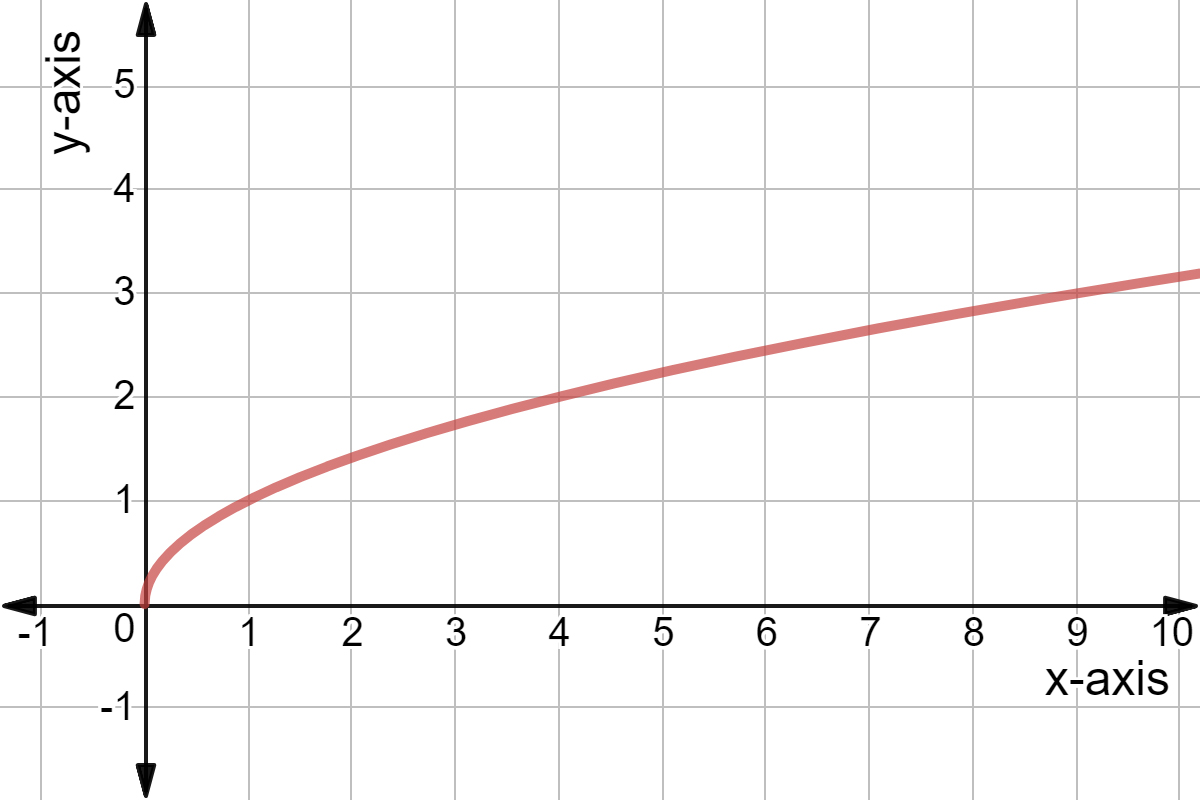
      • f(x)=xf\left(x\right)=\sqrt{x}

        Square Root Graphs - Definition - Expii
      • no local min/max

    • f(x)=3xf\left(x\right)=^3\sqrt{x}

      Cube Root Graph - Expii
      • no local min/max or extrema

    • f(x)=∣x∣f\left(x\right)=\left\vert x\right\vert

      Absolute value graph | Khan Academy
      • either an absolute max or min

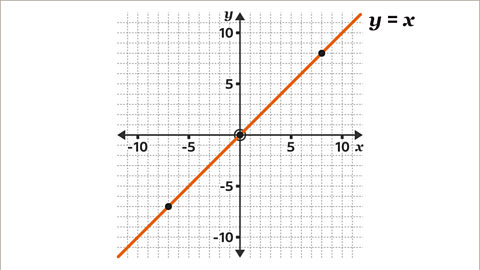
    • f(x)= x


    • How to plot a linear equation graph - BBC Bitesize
      • linear (identity function)

      • no local or absolutes

    • f(x) = x²

      Graph y=x^2 | Homework.Study.com
      • 1 absolute and local

    • f(x)=1xf\left(x\right)=\frac{1}{x}

      Study.com
      • x can never equal 0

      • symmetric to the origin

  • Graphing Transformations

    • Vertical shifts

      • y=f(x)y=f(x) —> y=f(x)+ay=f(x) + a

      • Adding to the OUTPUT (doesn’t go with x variable)

      • adding = up, subtracting = down

    • Horizontal shifts

      • y=f(x)y=f(x) —> y=f(x+a)y=f(x+a)

      • adding to the INPUT (goes with x variable)

      • adding = goes to the left, subtracting = goes to the right

    • Vertical stretch

      • y=f(x)y = f(x) —> y=af(x)y=af(x)

      • multiplying the OUTPUT (y values)

    • Vertical compression

      • y=f(x)y = f(x) —> y=af(x)y = af(x)

        • multiplying the output by 0<a<10<a<1

    • Horizontal stretch & compression

      • y=f(x)y = f(x) —> y=f(ax)y = f(ax)

      • multiplying the INPUT (x values) by a constant

  • Building Functions/Models

    • Given a linear function F and the initial value and rate of change, evaluate f(c)f\left(c\right) $ f©

      • 1 - determine the initial value and the slope

      • 2 - substitute the values into f(x) = mx + b

      • 3 - evaluate the function at x = c

    • Expressing the area as a function of x:

      • Area of a rectangle is A = xy

      • A(x) = x times whatever the given equation is

    • If you want to maximize area, substitute in the constraint (e.g. y=50-x)

Unit 3

3.1 —> easy, all about linear functions and their slopes (basic algebra)

  • know how to graph linear lines and write linear functions based off word problems

3.2 —> scatterplots (review how to input date into calc)

  • The correlation coefficient (r) measures the strength and direction of a linear relationship between two variables, and its value always falls between -1 and +1, inclusive, with 1 being perfect positive, -1 being perfect negative, and 0 meaning no linear correlation. 

3.3 + 3.4

  • A quadratic function is a function of the for f(x) = ax²+bx+c,whereadoesn’tequalzeroanda,b,careallrealnumbers</p></li><li><p>Revenuecanbecalculatedbymultiplyingtheamountofunitssoldbythepriceofeachunit(, where a doesn’t equal zero and a, b, c are all real numbers</p></li><li><p>Revenue can be calculated by multiplying the amount of units sold by the price of each unit (R=xp)</p></li><li><p>Vertexformofaquadratic:</p><ul><li><p>)</p></li><li><p>Vertex form of a quadratic:</p><ul><li><p>f\left(x\right)=a\left(x-h\right)^2+k</p><p>    (h,k)isthevertex</p></li><li><p>h=</p><p>    (h,k) is the vertex</p></li><li><p>h =\frac{-b}{2a} andk= and k =\frac{\left(4ac-b^2\right)}{4a}oryoucanpluginhandgetoutk</p></li></ul></li><li><p>Theaxisofsymmetryisor you can plug in h and get out k</p></li></ul></li><li><p>The axis of symmetry isx=\frac{-b}{2a}</p></li><li><p>Discriminantofquadraticequation=</p></li><li><p>Discriminant of quadratic equation =\sqrt{b^2-4ac}</p><ul><li><p>ifd<0—>norealsolutions</p></li><li><p>ifd>0—>twodifferentx−intercepts/solution</p></li><li><p>ifd=0—>onlyoneintercept/solution</p></li></ul></li><li><p>Towritetheequationofaparabola,youneedthevertexandsomeotherpoint</p><ul><li><p>Step1−pluginvertexintovertexform</p></li><li><p>Step2−pluginintercept/otherpointforxandf(x)</p></li><li><p>Step3−solvefora</p></li><li><p>Step4−pluginaand(h,k)intovertexformandsimplifytoaquadratic</p></li></ul></li><li><p>Aparabolaisconcaveupif<span>a>0</span>;thevertexistheminimumpoint.</p></li><li><p>Aparabolaisconcavedownif<span>a<0</span>;thevertexisthemaximumpoint.</p></li><li><p>Tofindmaximumheightofaprojectilemotionproblem—>pluginvertex,outputitmaxheight</p></li></ul><p>3.5</p><ul><li><p>QuadraticInequalities</p><ul><li><p>Tosolvetheinequality</p><ul><li><p>if d<0 —> no real solutions</p></li><li><p>if d>0 —> two different x-intercepts/solution</p></li><li><p>if d=0 —> only one intercept/solution</p></li></ul></li><li><p>To write the equation of a parabola, you need the vertex and some other point</p><ul><li><p>Step 1 - plug in vertex into vertex form</p></li><li><p>Step 2 - plug in intercept/other point for x and f(x)</p></li><li><p>Step 3 - solve for a</p></li><li><p>Step 4 - plug in a and (h,k) into vertex form and simplify to a quadratic</p></li></ul></li><li><p>A parabola is concave up if <span>a>0</span>; the vertex is the minimum point.</p></li><li><p>A parabola is concave down if <span>a<0</span>; the vertex is the maximum point.</p></li><li><p>To find maximum height of a projectile motion problem —> plug in vertex, output it max height</p></li></ul><p>3.5</p><ul><li><p>Quadratic Inequalities </p><ul><li><p>To solve the inequalityax^2+bx+c>0 —> graph the quadratic function and from the graph determine where the function is above the x-axis (where f(x)>0)

  • To solve:

    • Step 1 - find all intercepts and vertex

    • Step 2 - graph the function

    • Step 3 - identify which way the inequality sign is facing and identify where that is on the graph

    • Step 4 - write the interval for which makes the inequality true]

    • Note: look at concave up or down, if it’s above or below x-axis and sometimes it could result in an empty set if there is no graph in the section you identified

Unit 4

Polynomial and Rational Functions

  • 4.1 Polynomial Functions

    • A polynomial function in one variable is a function of the form: f\left(x\right)=a_{n}x^{n}+a_{n-1}x^{n-1}+\cdots+a_1x+a_0</p><p>where</p><p>wherea_{n},a_{n-1},\ldots,a_1,a_0areconstants,calledthecoefficientsofthepolynomial,nisgreaterthanorequalto0isaninteger,andxisavariable.Ifare constants, called the coefficients of the polynomial, n is greater than or equal to 0 is an integer, and x is a variable. Ifa_{n}doesn’tequal0,itiscalledtheleadingcoefficient,anddoesn’t equal 0, it is called the leading coefficient, andnisthedegreeofthepolynomial</p></li><li><p>Thedomainofapolynomialfunctionisthesetofallrealnumbers</p></li><li><p>Thegraphsofpolynomialsaresmoothandcontinuous</p></li><li><p>They−interceptisis the degree of the polynomial</p></li><li><p>The domain of a polynomial function is the set of all real numbers</p></li><li><p>The graphs of polynomials are smooth and continuous</p></li><li><p>The y-intercept isa_0</p></li></ul></li><li><p>PowerFunctions</p><ul><li><p>Apowerfunctionofdegree</p></li></ul></li><li><p>Power Functions</p><ul><li><p>A power function of degreenisamonomialfunctionoftheform:is a monomial function of the form:f\left(x\right)=ax^{n}whereaisarealnumber,doesn’tequal0andn>0isaninteger</p></li><li><p>Ifthepowerfunctionhasanevendegree,it’sendbehavioristhesameasaparabola</p></li><li><p>Ifthepowerfunctionhasanodddegree,it’sendbehavioristhesameaswhere a is a real number, doesn’t equal 0 and n>0 is an integer</p></li><li><p>If the power function has an even degree, it’s end behavior is the same as a parabola</p></li><li><p>If the power function has an odd degree, it’s end behavior is the same asx^3(asxgoestonegativeinfinityandinfinity,ydoesthesamething)</p></li></ul></li><li><p>Maximumnumberofturningpoints(localmax/mins)isn−1</p></li><li><p>Polynomialshavenon−negativeintegerexponentsassociatedwiththeirvariables—>novariableinthedenominator/radicals</p></li><li><p>Thefollowingstatementsareequivalent:</p><ul><li><p>risarealzeroofpolynomialf</p></li><li><p>risanx−interceptofthegraphoff</p></li><li><p>x−risafactorofpolynomialf</p></li><li><p>risarealsolutionoftheequationf(x)=0</p></li></ul></li><li><p>Polynomialfunctionswith(as x goes to negative infinity and infinity, y does the same thing)</p></li></ul></li><li><p>Maximum number of turning points (local max/mins) is n - 1</p></li><li><p>Polynomials have non-negative integer exponents associated with their variables —> no variable in the denominator/radicals</p></li><li><p>The following statements are equivalent:</p><ul><li><p>r is a real zero of polynomial f</p></li><li><p>r is an x-intercept of the graph of f</p></li><li><p>x - r is a factor of polynomial f</p></li><li><p>r is a real solution of the equation f(x) = 0</p></li></ul></li><li><p>Polynomial functions with\left(x-r\right)^{n} as a factor, have r as a real zero of multiplicity n

      • example: f(x) = (x+3)(x+4)³

        • real zeros: -3, -4 with multiplicity of 3

    • If n is even, the graph turns at the intercept (bounces off the x-axis)

    • If n is odd, the graph passes through the intercepts (crosses the x-axis)

    4.2 —> Graphing Polynomial Functions

    • Step 1 - identify the power function —> end behavior

    • Step 2 - identify the intercepts (x & y)

    • Step 3 - identify the real zeros and their multiplicity

    • Step 4 - Identify the possible number of turning points

    • Step 5 - Identify points on the graph both outside and between the x-intercepts

    • Note: If you have a calculator you can approximate the local max/min and the x-intercepts

    4.3 —> Properties of Rational Functions

    • A rational function takes the form of: R\left(x\right)=\frac{p\left(x\right)}{q\left(x\right)}wherepandqarepolynomialfunctions</p></li><li><p>ThedomainofRisallrealnumbersexceptthosethatmakethedenominator(q(x))=0(therealzerosofq)</p></li><li><p>VerticalAsymptotes:</p><ul><li><p>ThegraphmayNEVERcrossaverticalasymptote</p></li><li><p>Thezerosofthedenominatorofthefunctionfullyreduced,andthemultiplicitiesofthosezeroesaretheverticalasymptotes</p></li></ul></li><li><p>HorizontalAsymptotes</p><ul><li><p>Affecttheendbehaviorofthegraph</p></li><li><p>Thegraphcancrossahorizontalasymptoteifitisnotapproachingwhere p and q are polynomial functions</p></li><li><p>The domain of R is all real numbers except those that make the denominator (q(x)) = 0 (the real zeros of q)</p></li><li><p>Vertical Asymptotes:</p><ul><li><p>The graph may NEVER cross a vertical asymptote</p></li><li><p>The zeros of the denominator of the function fully reduced, and the multiplicities of those zeroes are the vertical asymptotes</p></li></ul></li><li><p>Horizontal Asymptotes</p><ul><li><p>Affect the end behavior of the graph </p></li><li><p>The graph can cross a horizontal asymptote if it is not approaching\pm\infty(SOMETIMES)</p></li><li><p>let(SOMETIMES)</p></li><li><p>letR\left(x\right)=\frac{p\left(x\right)}{q\left(x\right)}wherepisdegreen,qisdegreem</p><ul><li><p>ifn<mtheny=0istheasymptote</p></li><li><p>ifn=mtheny=theratiooftheleadingcoefficientsp/q</p></li><li><p>ifn=m+1theny=thequotientofpolynomials(oblique/slantasymptote)</p></li><li><p>ifnwhere p is degree n, q is degree m</p><ul><li><p>if n<m then y=0 is the asymptote</p></li><li><p>if n=m then y= the ratio of the leading coefficients p/q</p></li><li><p>if n=m+1 then y= the quotient of polynomials (oblique/slant asymptote)</p></li><li><p>if n\gem+2then<spanstyle="font−family:"GoogleSans",Roboto,Arial,sans−serif;"><span>thefunction′sendbehaviorwillresemblethegraphofapolynomial—>usepolynomiallongdivision(parabolaasymptote)</span></span></p></li></ul></li></ul></li><li><p>PolynomialLongDivision:</p><ul><li><p>1)dividefirstterminsidebyfirsttermoutsidethenputitontop</p></li><li><p>2)multiplytoptermbybothoutsideterms</p></li><li><p>3)repeatwithnewterms(divide,multiply,subtract)</p></li><li><p>Ifremainderputdivisorunderremainderandaddittoanswer</p></li></ul></li><li><p>GraphingRationalFunctions:</p><ul><li><p>Step1−Factortopandbottomandsettolowestterms(ifnecessary)</p></li><li><p>Step2−Findinterceptswithmultiplicities(DENOMINATOR)</p></li><li><p>Step3−Findverticalasymptotes(DENOMINATOR)</p></li><li><p>Step4−Findhorizontal/slantasymptotes(endbehavior)</p><ul><li><p>DEGREESOFNUMERATORANDDENOMINATOR</p></li></ul></li><li><p>Step5−Usex−interceptstocreateintervalstofindmorepoints</p></li><li><p>Step6−Checktoseeifthegraphcrosseshorizontalasymptote</p><ul><li><p>settheasymptote(y=a)equaltothefunctionandifyougeta“valid”x,thegraphcrossesat(x,a)</p></li></ul></li><li><p>HOLE:when(infullyfactoredform)thereisthesamefactoronthetopandbottom</p></li></ul></li><li><p>RealZerosofPolynomials</p><ul><li><p>TheRemainderTheorem:</p><ul><li><p>supposefisapolynomialfunction.iff(x)isdividedby(x−c),thentheremainderwithbem+2 then <span style="font-family: "Google Sans", Roboto, Arial, sans-serif;"><span>the function's end behavior will resemble the graph of a polynomial —> use polynomial long division (parabola asymptote)</span></span></p></li></ul></li></ul></li><li><p>Polynomial Long Division:</p><ul><li><p>1) divide first term inside by first term outside then put it on top</p></li><li><p>2) multiply top term by both outside terms</p></li><li><p>3) repeat with new terms (divide, multiply, subtract)</p></li><li><p>If remainder put divisor under remainder and add it to answer</p></li></ul></li><li><p>Graphing Rational Functions:</p><ul><li><p>Step 1 - Factor top and bottom and set to lowest terms (if necessary)</p></li><li><p>Step 2 - Find intercepts with multiplicities (DENOMINATOR)</p></li><li><p>Step 3 - Find vertical asymptotes (DENOMINATOR)</p></li><li><p>Step 4 - Find horizontal/slant asymptotes (end behavior)</p><ul><li><p>DEGREES OF NUMERATOR AND DENOMINATOR</p></li></ul></li><li><p>Step 5 - Use x-intercepts to create intervals to find more points</p></li><li><p>Step 6 - Check to see if the graph crosses horizontal asymptote</p><ul><li><p>set the asymptote (y=a) equal to the function and if you get a “valid” x, the graph crosses at (x,a)</p></li></ul></li><li><p>HOLE: when (in fully factored form) there is the same factor on the top and bottom</p></li></ul></li><li><p>Real Zeros of Polynomials</p><ul><li><p>The Remainder Theorem:</p><ul><li><p>suppose f is a polynomial function. if f(x) is divided by (x-c), then the remainder with bef\left(c\right)</p></li><li><p>Example:ifyoudivide</p></li><li><p>Example: if you dividex³-4x²-5bybyx-3,theremainderwillbe−14,so, the remainder will be -14, sof(3)=-14</p></li></ul></li><li><p>TheFactorTheorem:</p><ul><li><p>supposefisapolynomialfunction.Thenx−cisafactoroffifandonlyif</p></li></ul></li><li><p>The Factor Theorem:</p><ul><li><p>suppose f is a polynomial function. Then x-c is a factor of f if and only iff\left(c\right)=0</p></li></ul></li></ul></li><li><p><strong>Apolynomialfunctioncannothavemorerealzerosthanitsdegree</strong></p></li><li><p>Descarte’sRuleofSigns:</p><ul><li><p>supposefisapolynomialfunctionwritteninstandardform</p><ul><li><p>Thenumberofpositiverealzerosoffeitherequalsthenumberofsignchangesofnon−zerocoefficientsoranevennumberlessthanthatnumber(e.g.ifthere’s5signchanges,thenthereare5,3,or1positiverealzeros)</p></li><li><p>Thenumberofnegativerealzerosoffeitherequalsthenumberofsignchangesoff(−x)</p><ul><li><p>forf(−x),onlyfactorswithanoddexponentwillchangethesign</p></li></ul></li></ul></li></ul></li><li><p>RationalZerosTheorem</p><ul><li><p>letfbeapolynomialfunctionofdegree1orhigher:</p><ul><li><p>Ifp/q,inlowestterms,isarationalzerooff,thenpisafactoroftheconstant,aisafactorofleading</p><ul><li><p>essentiallyitsthefactorsoftheconstanttermoverthefactorsoftheleadingcoefficient(= 0</p></li></ul></li></ul></li><li><p><strong>A polynomial function cannot have more real zeros than its degree</strong></p></li><li><p>Descarte’s Rule of Signs:</p><ul><li><p>suppose f is a polynomial function written in standard form</p><ul><li><p>The number of positive real zeros of f either equals the number of sign changes of non-zero coefficients or an even number less than that number (e.g. if there’s 5 sign changes, then there are 5, 3, or 1 positive real zeros)</p></li><li><p>The number of negative real zeros of f either equals the number of sign changes of f(-x)</p><ul><li><p>for f(-x), only factors with an odd exponent will change the sign</p></li></ul></li></ul></li></ul></li><li><p>Rational Zeros Theorem</p><ul><li><p>let f be a polynomial function of degree 1 or higher:</p><ul><li><p>If p/q, in lowest terms, is a rational zero of f, then p is a factor of the constant, a is a factor of leading</p><ul><li><p>essentially its the factors of the constant term over the factors of the leading coefficient (\frac{p}{q} )

  • Every polynomial with real coefficients can be uniquely factored into a product of linear factors and/or irreducible factors

  • Upper and Lower Bounds of the Real Zeros of a Polynomial

    • If the third row of synthetic division contains…

      • only positive numbers and/or zeros, then the divisor is an upper bound (doesn’t turn around after that) for the polynomials real zeros (basically no real zeros greater than that divisor)

      • numbers that alternate positive (or zero) and negative (or zero), then the divisor is a lower bound for the polynomials real zeros

  • Intermediate Value Theorem

    • let f be a polynomial function:

      • if a<b and f(a) and f(b) are of opposite signs, then there is at least one real zero between them

  • 4.7 - Complex Zeros; The Fundamental Theorem of Algebra

    • Every polynomial with real coefficients can be factored into a product of linear factors and/or [irreducible quadratic factors]

    • A polynomial function of odd degree with real coefficients has at least one real zero

    • The Fundamental Theorem of Algebra

      • Every complex polynomial function of degree of 1 or more has at least on complex zero

      • A polynomial of degree n has n complex zeros (which includes reals)

    • Conjugate Pair Theorem

      • suppose f is a polynomial function with real coefficients:

        • If r = a + bi is a zero of f, then the complex conjugate is also a zero of f

        • Example: if -4+i is a zero of a function, -4-i also must be a zero

    Unit 5

    5.1

    • Composition of Functions

      • (fog)(x) = f(g(x))

        • (fog)(x) is not the same as (gof)(x)

          • not communitive

        • Domain of Composite Functions

          • Suppose (fog)(x) = f(g(x)):

            • Any x not in the domain of g is excluding from the domain of (fog) —> check the input function domain

          • Any x for which g(x) is not in the domain of f must also be excluded from the domain of (fog) —> check the resulting function of fog domain

        • Step by Step:

          • 1 - Find domain restrictions of inner function

          • 2 - Find composite function or set first step equal to inner function

          • 3 - Identify domain restrictions of composite function

          • 4 - Final domain includes both restrictions

    5.2 —> One-to-one functions; inverse functions

    • A function is one-to-one if any two different inputs in the domain corresponds to different outputs in the range (i.e. each element of the domain and of the range is unique)

    Understanding One-to-One and Inverse Functions
    • The Horizontal Line Test:

      • If any horizontal line intersects the graph of a function, in at most 1 place, then the function is a one-to-one function

    • Inverse Functions:

      • The functions that represents the correspondence from another functions’ range to its domain is the inverse function

      • suppose the domain of f is x and its range is y. then the domain of the inverse of f is y and its range is x (f^{-1})</p><ul><li><p>rangeof)</p><ul><li><p>range off^{-1}isdomainoffandviceversasoityouknowoneyouknowtheother</p></li></ul></li><li><p>Thegraphofis domain of f and vice versa so it you know one you know the other</p></li></ul></li><li><p>The graph off^{-1}\left(x\right)$$ is a reflection of f(x) across the line y=x (diagonal)

      • just switch the x and y and solve for y