Biology - 8 Photosynthesis - Required Practical 6: The Effect of Light Intensity on the Rate of Photosynthesis in Pondweed
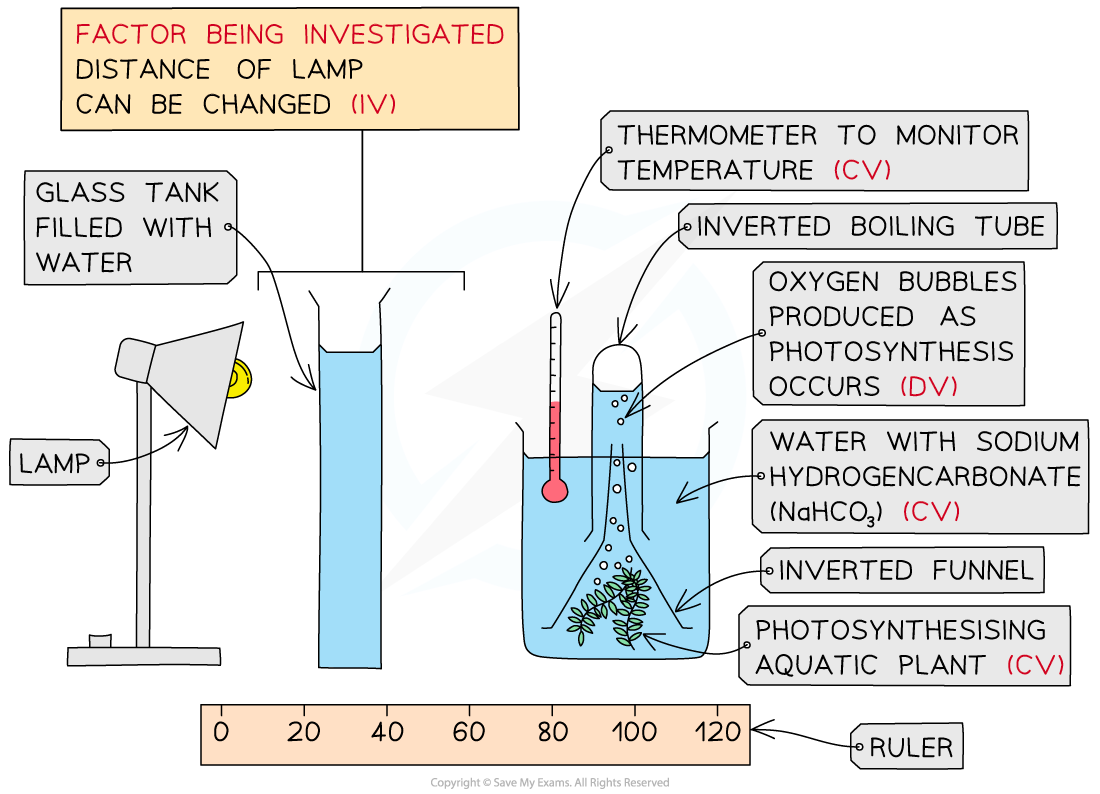
Aims:
to investigate how light intensity affects the rate of photosynthesis
Risk Assessment:
sodium hydrogen carbonate is an irritant
light can damage eyes
bench lamp bulb can become hot
Safety:
wear safety goggles and clean up any spills
do not look directly at the bulb for extended periods of time
do not touch the bench lamp bulb
Equipment:
bench lamp (preferably LED)
boiling tube
beaker
thermometer
water
tripod
metre rule
0.5% sodium hydrogen carbonate solution
pondweed
stopwatch
Control variables:
concentration of CO₂
temperature
volume of hydrogen carbonate solution
length of pondweed
Independent variable:
light intensity
Dependent variable:
number of oxygen bubbles per minute
Method:
Fill a boiling tube with 35cm² of 0.5% sodium hydrogen carbonate solution
Select a piece of pondweed approximately 5cm long
Insert the pondweed into the tube and cut the end of the submerged stem at an angle
Fill the beaker with water and stand the boiling tube inside. Insert the thermometer in the beaker. Place both on a tripod
Set up a bench lamp as close as possible to the pondweed. Set the metre rule at the pondweed.
Switch on the bench lamp and wait for 5 minutes for equilibriation. Constantly check the thermometer and keep a constant temperature
(Take three readings of this for each distance) Use the stopwatch to time 30 seconds and record the number of bubbles emitted from the stem in that time
Repeat steps 5-7 as many more times as possible, moving the bench lamp 5cm further away each time
Calculations/graphing:
Calculate light intensity using ‘light intensity = 1/d²’
Calculate the rate of photosynthesis in bubbles/minute
Plot a graph of light intensity against rate of photosynthesis
Alternatively, you can place a measuring cylinder and funnel on top of the pondweed and collect your data not in bubbles/minute (which leaves room for human error) but using the volume of oxygen produced.