Hormones, The Endocrine System & Internal Environments
Hormones in Reproduction/Menstrual Cycle
A hormone is a chemical messenger released into the blood and affect target cells.
The glands that produce these hormones are known collectively as the endocrine system.
The main male reproductive hormone is testosterone, which stimulates:
Sperm production
Growth of testes
Voice breaks
The main female reproductive hormone is oestrogen, which stimulates:
Widening of the hips
Breast development
Beginning of the menstrual cycle
However other hormones e.g. LH, FSH, and progesterone are also female reproductive hormones.
There are four main hormones involved in reproduction:
FSH - Produced in the pituitary gland, matures the egg for release during ovulation
Oestrogen - Produced in the ovaries, repairs the uterus lining
LH - Produced in the pituitary gland, stimulates ovulation (release of the egg)
Progesterone - Produced in the ovaries/yellow body, maintains uterus lining
To remember where the hormones are produced:
F (fsh)
O (oestrogen)
L (lh)
P (progesterone)
PIT (pit gland)
OV (ovaries)
PIT (pit gland)
OV (ovaries/yellow body)
The average menstrual cycle is 28 days
Once menstruation finishes, the uterus lining builds up
Ovulation occurs halfway through the cycle
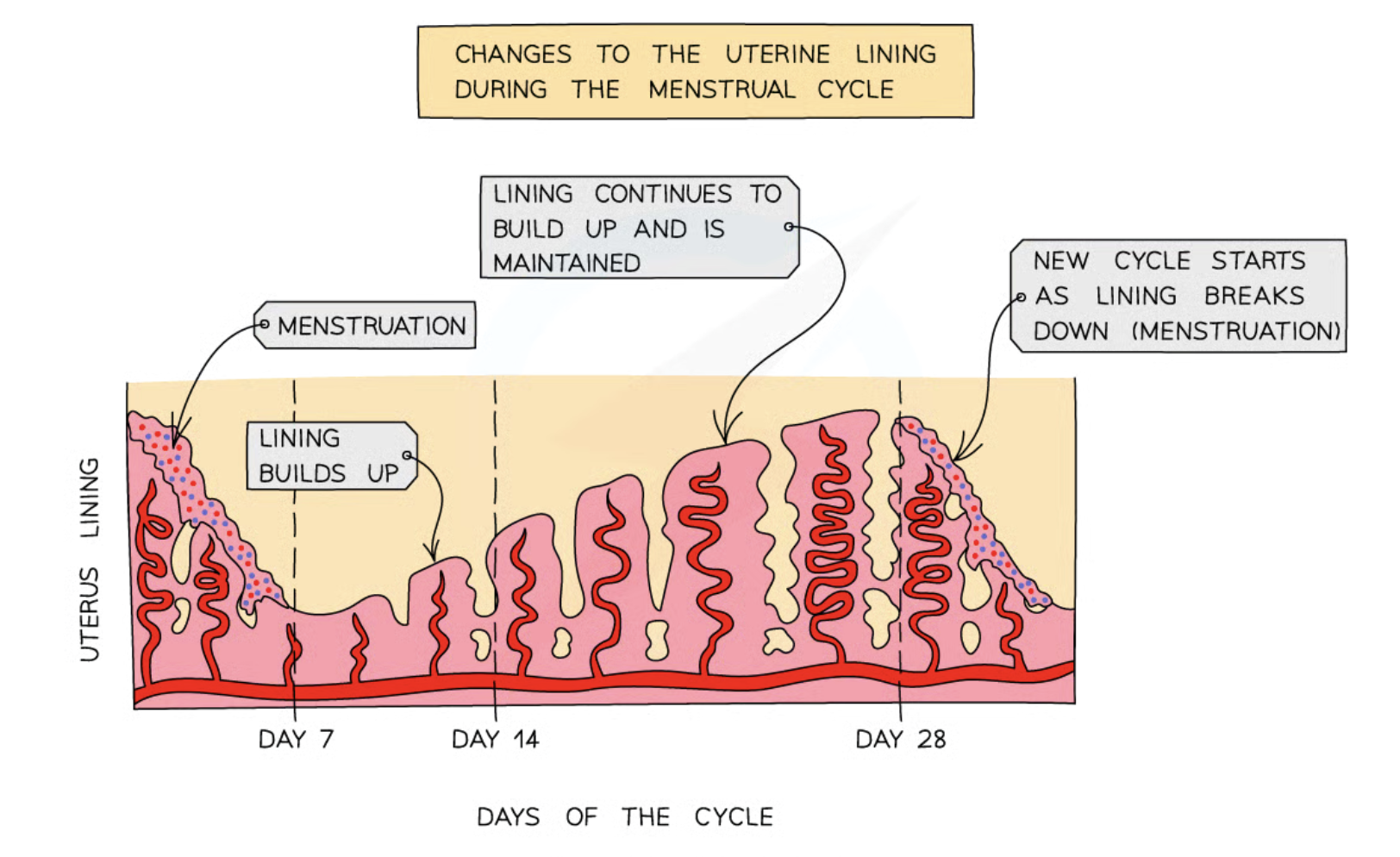
The stages of the menstrual cycle:
Begins after menstruation when FSH is produced to mature the egg
This stimulates oestrogen to be produced to repair the uterus lining, which then stimulates LH when it’s at a high enough level
The LH hormone causes ovulation at day 14 (approx)
The LH causes the yellow body to form, which produces progesterone to maintain the uterus lining
If the egg isn’t fertilised, progesterone levels drop and the yellow body breaks down, causing a period
If the egg is fertilised, progesterone continues to be produced to maintain the pregnancy (breakdown of uterus lining would prevent a pregnancy)
Contraception and Treating Infertility
Contraception is any method that prevents pregnancy (fertilisation of the egg).
Hormonal methods:
The Pill - Inhibits (restricts) the production of FSH and LH
Implants - Inserted on the inner side of the arm, beneath the skin
The Coil/IUDs - T-shaped piece of plastic inserted into the uterus
Non-hormonal methods:
Physical Barriers - Also prevent STis (e.g. condoms)
Natural Methods - Avoiding intercourse or withdrawal
The Coil/IUDs - T-shaped piece of plastic inserted into the uterus
Vasectomy - Removal of sperm ducts
Infertility (inability to reproduce naturally) can be treated with hormones.
FSH and LH can be injected to stimulate ovulation, which’ll help them fall pregnant
Low levels of FSH means no egg maturation, therefore no ovulation or pregnancy
FSH and LH are also given to women before egg collection for IVF to stimulate egg production.
Homeostasis
Homeostasis is maintaining a constant internal environment
This can include sugar concentration, water content, and body temperature
Homeostatic mechanisms use negative feedback to maintain a balance:
Negative feedback helps return systems to it’s ‘normal level’
This creates a negative feedback loop
Body temperature is controlled by the hypothalamus.
Our body responds to changes in temperatures:
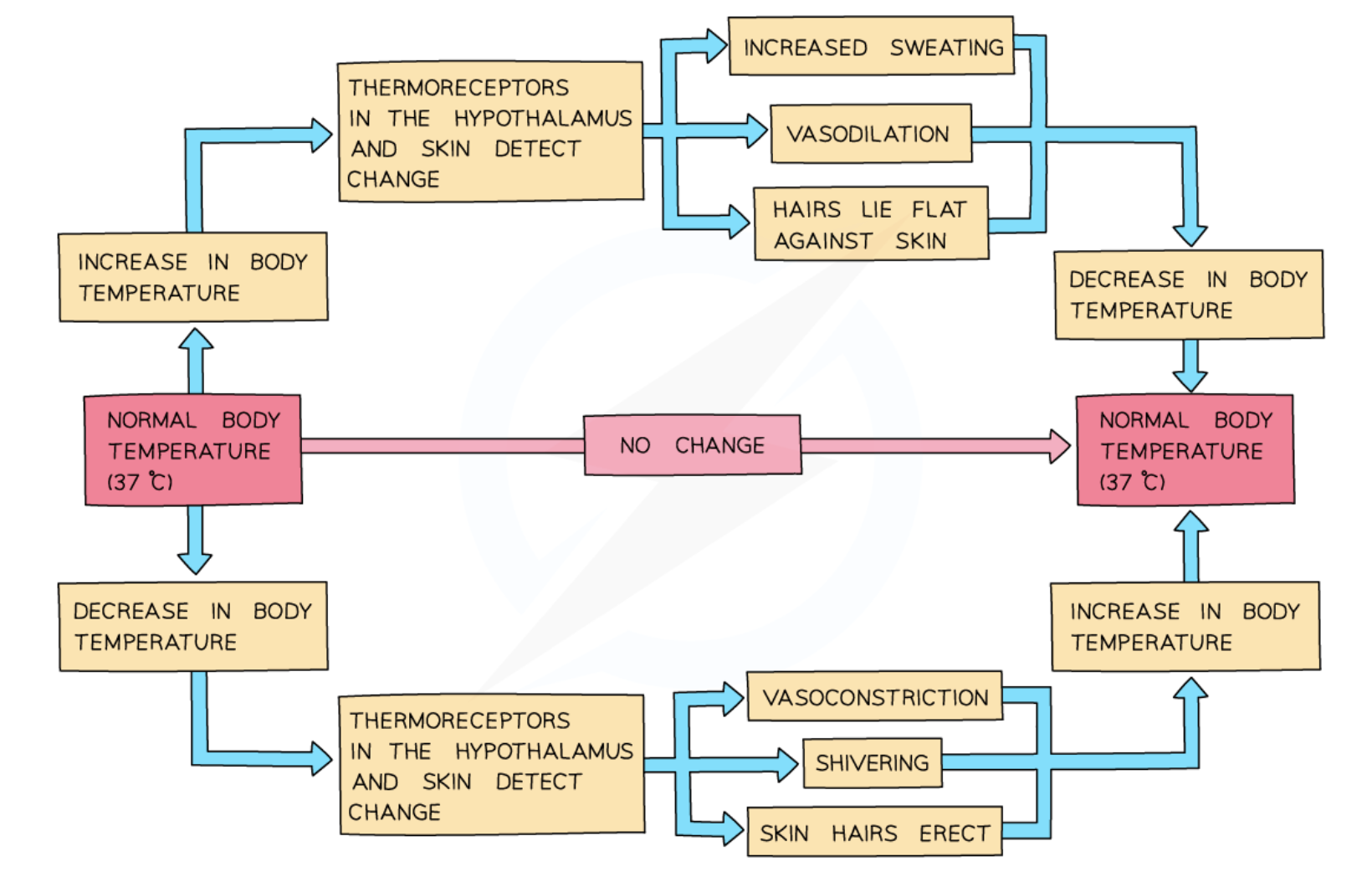
Vasoconstriction - Blood vessels contracting meaning less blood flows to the surface, transferring less energy to the surroundings. This warms you up.
Vasodilation - Blood vessels dilating meaning more blood flows to the surface, transferring more energy to the surroundings. This cools you down.
Your hairs stand up when you’re cold to act as insulators for warmth.
Insulin and glucagon control blood sugar levels in the pancreas:
Insulin - Converts glucose to glycogen
Glucagon - Converts glycogen to glucose
If glucose levels get too low:
The pancreas secretes glucagon into the blood
Glucagon causes the glycogen in the liver to be converted into glucose
Glucose is released into the blood
Glucose levels are increased
Normal level is reached
If glucose levels get too high:
The pancreas secretes insulin into the blood
Glucose moves from the blood into the liver and muscle cells
Insulin causes the glucose in the liver to be converted into glycogen
Glucose levels are decreased
Normal level is reached
Thyroxine & Adrenaline
Adrenaline is produced in the adrenal glands.
It’s known as the ‘fight or flight’ hormone since it is produced in dangerous situations.
The things that it can trigger includes:
Increasing heart and breathing rate
Increasing blood pressure
Dilating your pupils
Diverting blood flow away from non-essential parts of the body
Increasing blood glucose
Thyroxine is produced in the thyroid glands (located in the neck).
Thyroxine regulates your body’s metabolic rate, which is an example of a negative feedback mechanism.
Levels of thyroxine is controlled by TSH released from the pituitary gland.
TSH is inhibited when levels are too high, so less thyroxine is released.
Plant Hormones
Tropism: The growth responses made by a plant in response to light and gravity
Phototropism - Response to light
Gravitropism - Response to gravity
The tropism is positive if it grows towards the stimulus.
E.g. if a shoot grows upwards (away from gravity but towards light), it’s positively phototropic and negatively gravitropic.
An auxin is a plant growth regulator that coordinates phototropisms and gravitropisms.
They are produces in the tips of the shoots/roots and diffuse into the cells below.
Auxin stimulates cell elongation in shoots but inhibits cell elongation in roots.
Uneven distribution = uneven growth
Auxins and phototropism:
1) Light hits one side of the shoot.
2) Auxin moves to the shaded side, so cells here elongate.
3) The shaded side grows longer.
4) The shoot bends towards the light
This helps the plant get more light for photosynthesis.
5) This is positive.
1) Light hits one side of the root.
2) Auxin moves to the shaded side, which slows down cell elongation.
3) The lighter side grows longer.
4) The root bends away from the light.
5) This is negative.
Auxins and gravitropism:
1) Gravity causes auxins to accumulate on the lower side of the shoot.
2) This stimulates cell elongation, so the lower side grows more.
3) The shoot grows upwards, away from gravity.
4) This is negative.
1) Gravity causes auxins to accumulate on the lower side of the root.
2) This inhibits cell elongation, so the upper side grows more.
3) The root bends downwards towards gravity.
4) This is positive.
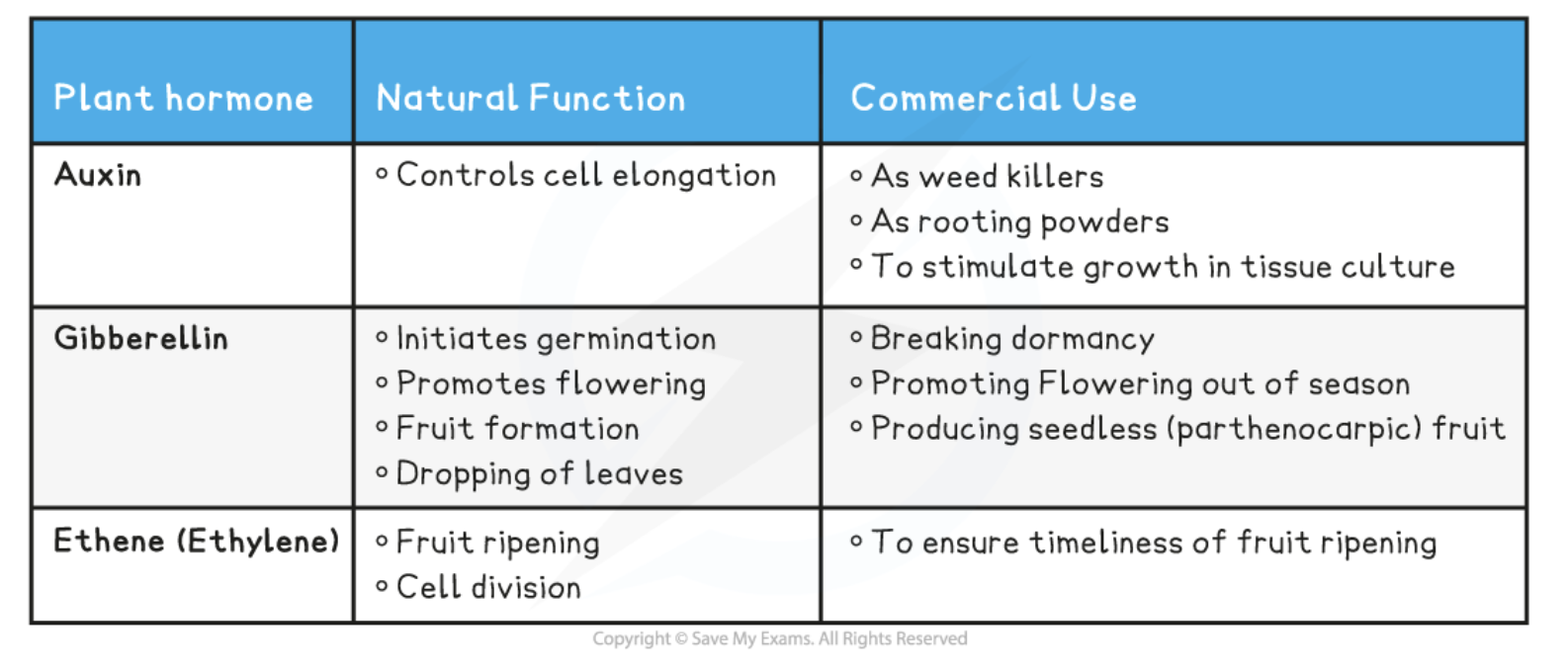
There are two more plant hormones that control other stages of the plant’s lifecycle.
Gibberellins: Germination and flowering.
Ethene: Fruit ripening and shredding of leaves.
However these hormones also have other commercial uses.
The Kidney & ADH
The kidney regulates water content of the blood, vital for maintaining blood pressure.
They excrete waste products (e.g. urea) and excess substances (e.g salt).

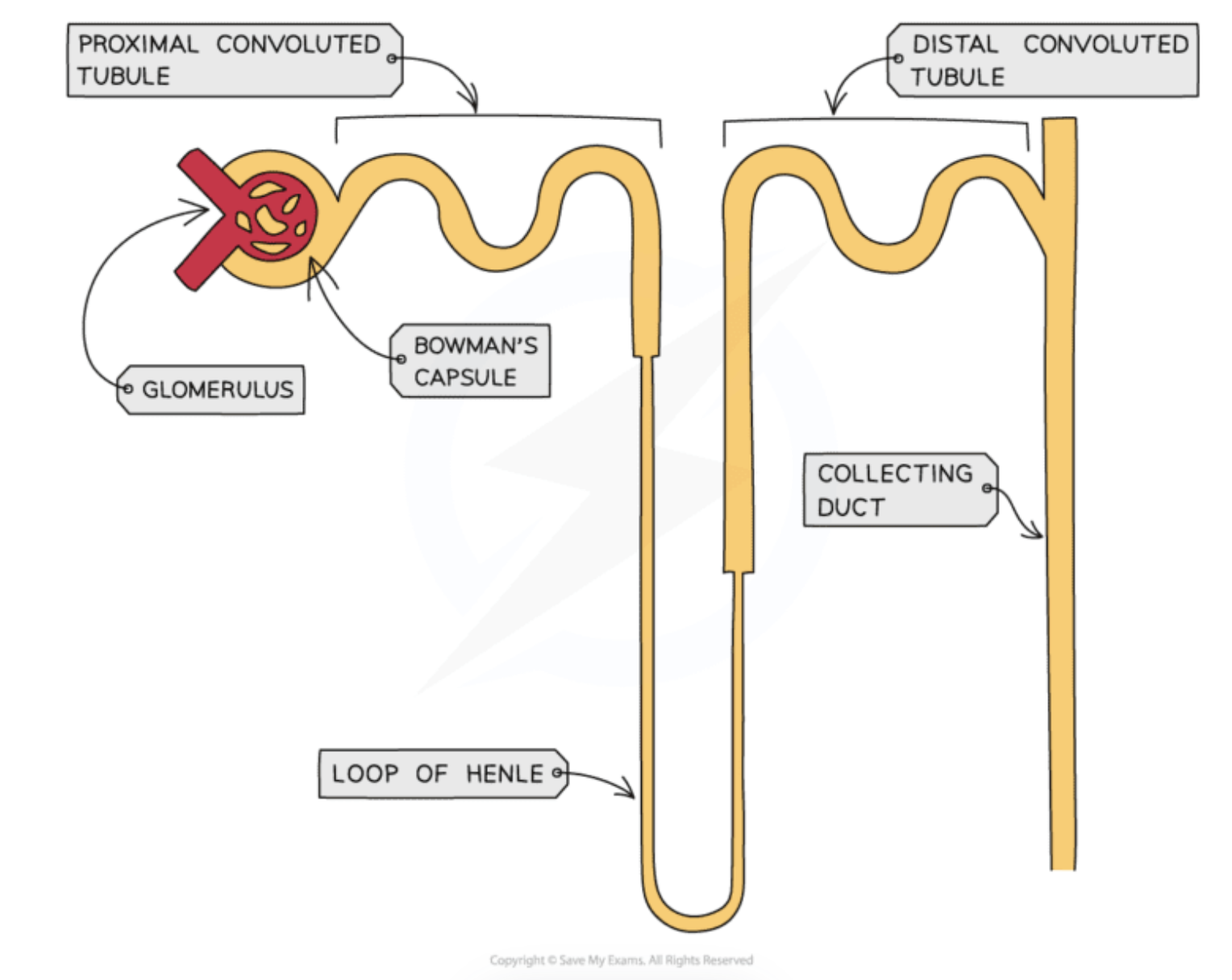
The kidney tubule has the role of filtering out waste products to be excreted through the urine.
It also ensures all required products are reabsorbed into the blood.
All of the above is shown in the step-by-step process below:
1) Ultra-filtration.
This happens in the glomerulus.
Blood is squeezed into the Bowman’s Capsule, which creates high pressure.
Small molecules are moved through the filter, however larger molecules (such as large proteins and blood cells) are not.
2) Re-absorption
This happens in the PCT and DCT.
Useful substances are reabsorbed into the blood, such as glucose for respiration, water, and minerals.
The remaining fluid in the collecting duct will form urine, and travels to the bladder via the ureter.
Water enters the body through food and as a product of aerobic respiration.
Water leaves the body through excretion of urine, exhalation, and sweat.
The volume of water lost through urine is controlled by the kidneys.
Therefore the kidneys are responsible for monitoring water levels in urine.
When water concentration in the blood is high:
Less water is re-absorbed in the PCT/Loop of Henle.
More water is sent through the collecting duct.
Large volumes of dilute urine is produced.
Urine is paler in colour.
This can happen when you intake less water.
When water concentration in the blood is low:
More water is re-absorbed in the PCT/Loop of Henle.
Less water is sent through the collecting duct.
Small volumes of concentrated urine is produced.
Urine is darker in colour.
This can happen when you are doing high amounts of exercise.
The control of water absorption is controlled by ADH (antidiuretic hormone).
This hormone is constantly released by the pituitary glands.
However how much of it is absorbed depends on how much water needs to be reabsorbed.
Too much water = Less ADH = Less concentrated (dilute) urine
This is an example of negative feedback.