Chapter 9 - Decision Making by Individuals and Firms:
I. Costs, Benefits, and Profits
A. Explicit versus implicit costs
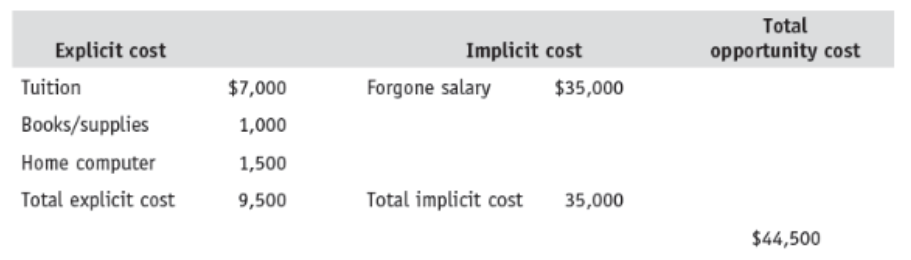
1. The true cost of anything (its opportunity cost) is what you must give up to get it. Opportunity cost can be divided into explicit costs and implicit costs.
2. An explicit cost is a cost that requires an outlay of money.
3. An implicit cost does not require an outlay of money; it is measured by the value, in dollar terms, of the benefits that are forgone.
4. In considering the cost of an activity, you should include the cost of using any of your own resources for that activity. Cost of going to college:
B. Accounting profit versus economic profit
1. Companies report their accounting, which is not necessarily equal to their economic profit.
2. Accounting profit is equal to revenue minus explicit cost.
3. Economic profit is equal to revenue minus the economic cost of resources used. It is often less than the accounting profit.
4. Capital is the total value of assets owned by an individual or firm—physical assets plus
financial assets.
5. The implicit cost of capital is the opportunity cost of the capital used by a business—the
income the owner could have realized from that capital if it had been used in its nex best alternative way.
6. Forgone interest earnings from financial assets are used to illustrate implicit cost of capital.
Real life example:
C. Making either-or decisions
1. An either-or decision requires you to choose between two projects.
2. The principle of either-or decision making says that when faced with an either-or decision between two projects, you should choose the one with the positive economic profit.
II.Making “How Much” Decisions: The Role of Marginal Analysis
A. Marginal analysis involves comparing the benefit of doing a little bit more of some activity (marginal benifit) with the cost of doing a little bit more of that activity (marginal cost).
B. Marginal cost
1. The marginal cost of producing a good or service is the additional cost of producing one more unit of that good or service.
2. Production of a good has increasing marginal cost when each additional unit costs more to produce than the previous unit.
3. The marginal cost curve shows how the cost of producing one more unit depends on the quantity that has already been produced.
4. For the production of some goods, the shape of the marginal cost curve changes as more output is produced. Marginal cost may first decrease, then become constant, then increase.
5. The simple case is to assume increasing marginal cost.
C. Marginal benefit
1. The marginal benefit of a good or service is the additional benefit derived from producing one more unit of the good or service.
2. There is decreasing marginal benefit when each additional unit produced results in less benefit than the previous unit.
3. The marginal benefit curve shows how the benefit from producing one more unit depends on the quantity that has already been produced.
4. In some cases marginal benefit is constant, such as when the perfectly competitive firm takes market price as given. Each unit sold yields the same price, or marginal benefit.
D. Marginal analysis
1. The profit of an activity is the difference between the marginal benefit and the marginal cost. Profit can be calculated for each unit of a good produced.
2. The Optimal quantity is the quantity that generates the highest possible profit.
3. Total profit is the sum of the profit earned in each individual year for the schooling example, or for all of the units of the good produced.
4. The following graph illustrates the optimal quantity as the quantity whose marginal benefit is equal to marginal cost. Please calculate total profits at different quantities.
On the graph, please mark the difference between marginal benefits and marginal cost at different
quantity levels. Why is the optimal quantity at where marginal benefits equal to marginal cost?
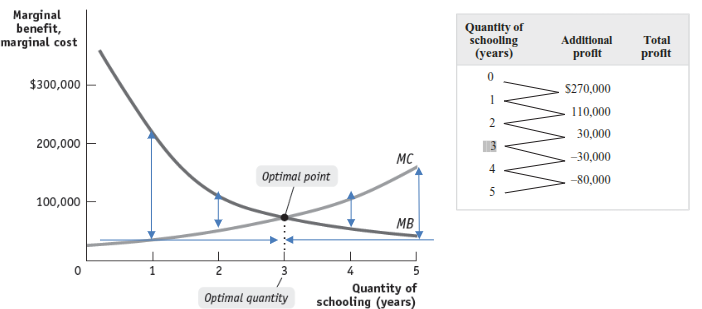
5. According to the profit-maximizing principle of marginal analysis, when faced with a
profit-maximizing “how much” decision, the optimal quantity is the largest quantity at
which the marginal benefit is greater than or equal to marginal cost.
E. A principle with many uses
1. The principle of marginal analysis can be applied to a variety of “how much” decisions, including those whose benefits and costs are not measured in dollars.
2. Some examples:
a. A consumer has to decide how to allocate a weekly budget between restaurant meals and
mocha lattes.
b. A producer has to decide on the size of a new store.
Your own application, such as how to apply it on optimal hours spending on shopping/playing games.
III. Sunk Costs
A. A sunk cost is a cost that has already been incurred and is non-recoverable. A sunk cost should be ignored in decisions about future actions.
B. Example of Sunk Cost:
IV. Behavioral Economics
A. Behavioral economics studies why it is rational for people to sometimes make less-than-perfect choices.
B. Rational, but human too
1. A rational decision maker chooses the available option that leads to the outcome he most prefers.
2. People sometimes make less-than-optimal choices because they are concerned about
fairness.
Real life example: have you ever donated your money/time to someone?
3. A decision maker operating with bounded rationality makes a choice that is close to but not exactly he one that leads to the best possible economic outcome. A person makes a less-than-perfect choice because the effort of finding the best payoff is too costly.
During the exam time, have you ever handed in the paper before using up all your time?
Are you trying to get your grades as high as possible or happy with a “good enough” grades?
4. Risk aversion is the willingness to sacrifice some economic payoff in order to avoid a potential loss.
In finance, we always care about the trade-off between expected returns and risk.
C. Irrationality: an economist’s view
1. An irrational decision maker chooses an option that leaves him worse off than if he had
chosen another available option.