Physics Year 7
Changes in an object's motion are caused by unbalanced forces such as friction, gravitational, magnetic, and electrostatic forces, measured in newtons (N). Simple machines like levers, inclined planes, and wheels provide mechanical advantages in force, distance, and speed. Key concepts include:
Unbalanced vs. balanced forces.
Net force calculation using diagrams.
Gravitational force and Newton’s laws.
Distinguishing between contact and non-contact forces.
Pressure calculations based on area and force.
Magnetic and electrostatic forces.
Friction opposing motion.
Characteristics and advantages of simple machines.
Conducting investigations and interpreting scientific data effectively
Learning Outcomes
Identify unbalanced forces as those causing changes in an object's motion
Explain that balanced forces result in no change in motion, using Newton’s 1st Law
State that force is measured in Newtons (N) and explain the meaning of this unit
Explain that balanced forces result in no change in motion, using Newton’s 1st Law
State that force is measured in Newtons (N) and explain the meaning of this unit
Use appropriate instruments to measure force
Calculate net force when two or more forces act in the same or opposite direction (using simple diagrams)
Describe and give examples of gravitational force acting on objects, incorporating Newton’s 2nd Law of Motion
Identify forces acting on objects
Perform simple pressure calculations to investigate how P = F divided by A
Describe magnetic force and how they can attract or repel objects
Describe electrostatic forces and their effects on objects
Describe electromagnetic forces that occur between charged particles causing motion
What is a Force?
A force is a push, a pull, or a twist. A force can also be defined as anything that causes a change in an object’s speed, direction or shape. There are contact and non-contact forces, a contact force being one that must physically touch another object to interact with it like a physical push or pull as well as air resistance while a non-contact force doesn’t need physically touch to interact like gravity and magnetism.
A balanced force occurs when forces acting in OPPOSITE directions on an object also have the same MAGNITUDE (strength), while an unbalanced force occurs when the two forces are either acting in the same direction, with different magnitudes or both. In the case of an unbalanced force, it will change the objects speed, shape or direction.
This can be explained by Newton’s 1st Law (the law of INERTIA) which states “If something is not moving it will stay that way unless an unbalanced force acts upon it and if something is moving it will continue moving at the same speed and direction unless an unbalanced force acts upon it.”
When a force is balanced the NET FORCE is zero. To calculate net force, you must add all forces going in the same direction then subtract the total of the added forces going in opposite directions.
Diagram Ex.1
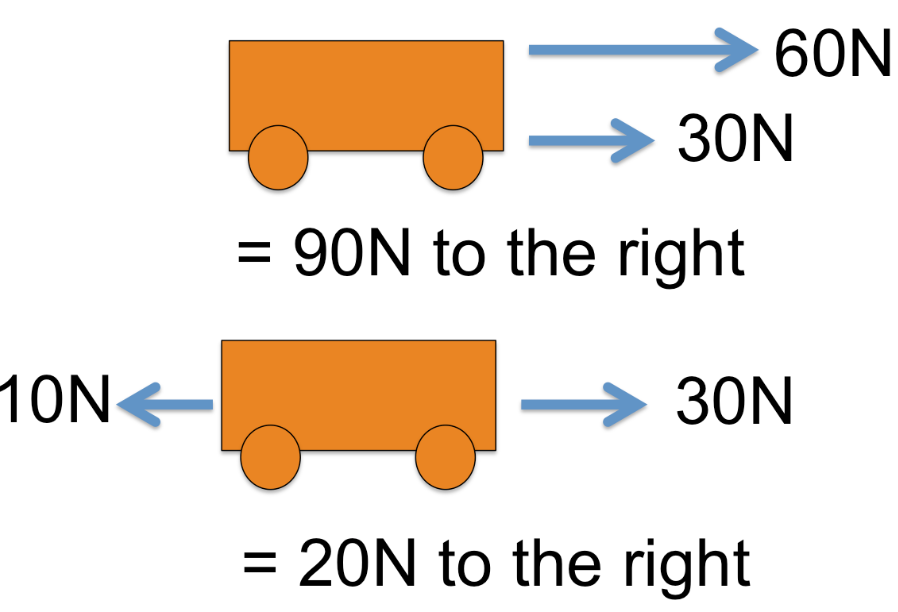
IMPORTANT NOTE
Having difficulty understanding inertia, here is a clearer guide:
Things like to keep doing what they’re doing, Newton’s 1st Law. Inertia is the QUALITY of objects to keep doing what they’re doing. This is why seatbelts are important, as when you are in a car, you are moving. Because of your inertia, since you are moving as the car moves, if the car abruptly stops moving, you don’t and go flying.
Gravity
When you jump, you are pulled right back down to the ground, and this is because of gravitational force. Newton’s 2nd law states F = ma (Force = mass x acceleration) m is measured in kg and acceleration in meters per second squared (m/s²). Because of this, if we assume your mass is said, 40kg, you times the force of gravity which is approx. 9.8kg, you get 392. This means the force pulling you back down is around 392N.