5.6 Production Planning (HL)
The local and global supply chain process
At a local level - It involves establishing relationships with suppliers and intermediaries located within a close geographical area
At a global level - Involves establishing relationships with suppliers and intermediaries of materials, products, and services worldwide. (More complex as it involves understanding the different regulatory and economic environments of different countries and the impact of international trade)
The difference between JIT and JIC
JIT - Having access to local and reliable suppliers is essential; A modern method of stock control avoids holding stock by being able to get supplies only when necessary.
Advantages | Disadvantages |
The cost of stock management is reduced → Profitability | Complete reliance on third-party suppliers |
Improving cash flow and working capital | Administrative and implementation costs are high |
Foster’s lean production and productive efficiency | Inability to meet unexpected changes in demand |
Suppliers can charge premium prices for urgent deliveries of stocks |
JIC - A traditional method of stock control that holds raw materials and finished products in case of a sudden increase in demand
Advantages | Disadvantages |
Flexibility to meet any unexpected rise in consumer demand | Higher costs for the stock control system |
Enables production to continue if there’s a delay in deliveries from suppliers | Risk of large volumes of stocks becoming obsolete (out of date) |
Customer satisfaction is maintained as they don’t have to wait for stocks to arrive | Not all stocks may be sold (wastage) |
Prevents potential loss of customers | Liquidity issues |
Economies of scale (bulk buying) |
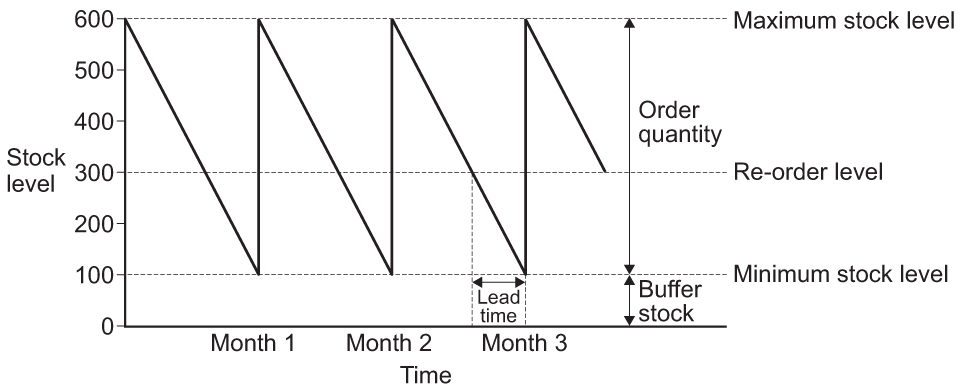
Stock control charts (lead time, buffer stock, reorder level, and reorder quantity)
A stock control chart - A graphical representation of the quantity of stock held by a business at different periods
 Capacity utilization rate
= Actual output/ Productive capacity x 100%
Measures the extent to which a firm is operating at its maximum potential level.
How much the business is using in its available sources?
To identify if the business can accept new orders in the future. (Should they accept new orders)
Advantages of full CU | Disadvantages of full CU |
Average costs are likely to be at their lowest (maximum efficiency) | Employees can become overworked and stressed |
Economies of scale will likely lead to higher profits | Machinery and equipment are likely to be damaged at a faster pace (replacement cost) |
Defect rate
= Defective items/ Total items produced x 100%
Measures the number of faculty items as a percentage of the total number of items produced.
Helps businesses to identify any problems in quality control and quality assurance (5.3), because high defect rates are costly.
Labor productivity, capital productivity, productivity rate, operating leverage
Productivity - A measure of the efficiency of production
Labor productivity = Output per period (units)/ Number of employees at work
A measure of the efficiency of workers in an organization.
Capital productivity = Total output/ Capital input
Measures how efficiently a firm’s non-current assets generate output for the business.
Productivity rate = Total output/ Total input x 100%
Measures the amount of output generated per unit of input.
Need to be compared with itself or other competitors.
Lower is bad - wasting resources, not being efficient and profitable
Higher is better – The manager could try to make it better (there’s always room for improvement)
Operating leverage = (Sales - Variable costs)/ Profits
A measure of how an increase in a firm’s sales volume will affect its operating profit (before interest and tax)
Cost to buy (CTB) and cost to make (CTM)
A make or buy decision - A management decision that involves choosing whether to manufacture a product or to purchase it from an external supplier.
CTM = Fixed costs + variable costs x Quantity (total variable costs)
CTB = Price x Quantity
If CTM > CTB, it makes financial sense for the business to buy the product instead of producing it.
It’s only from the financial perspective. (Brand value, quality guarantee, extra values)
More control if they make, have to establish their brand value, consume resources. (Non-core)