Mental Images
Definition (#f7aeae)
Important (#edcae9)
Extra (#fffe9d)
How can we study mental representatios:
Introspective approach: Asking people what do they see in their minds.
Rationalist approach: Try to deduce logically how people represent knowledge.
2 types of rationalist approach:
Declarative knowldege: Stating facts. (knowing that)
Procedural knowledge: Knowledge of procedures. (Knowing how)
Mental imagery:
Imagery: The mental representation of things that are not currently seen or sensed by the sense organs.
Our mind however have images for objects, events, and settings.
Used in guided imagery therapy and in occupational therapy.
Dual-code theory:
We use both pictorial (images) and verbal codes for representing information.
Mental images are analog codes (Paivio).
Analog codes resemble the objects they are representing.
As the movements of the hands on an analog clock are analogous to time, the mental images we form in our minds are related to the physical stimuli we observe.
Our mental representations for words chiefly are represented in a symbolic code.
Symbolic code: Form of knowledge representation that has been chosen arbitrarily to stand for something that does not perceptually resemble what is being represented.
A symbol may be anything that is arbitrarily designated to stand for something other than itself.
Are words and pictures coded differently:
According to the dual-code theory, verbal information is processed differently than pictorial information.
Paivio:
Participants were shown both a rapid sequence of pictures and a sequence of words.
Method: They were asked to recall the words or the pictures in one of 2 ways.
One way was at random, so that they recalled as many items as possible, regardless of the order in which the items were presented.
The other way was in the correct sequence.
Results:
Participants more easily recalled the pictures when they were allowed to do so in any order.
But they more readily recalled the sequence in which the words were presented than the sequence for the pictures.
Suggests the possibility of 2 different systems for recall of words versus pictures.
Propositional theory:
Suggests that we do not store mental representations in the form of images or mere words.
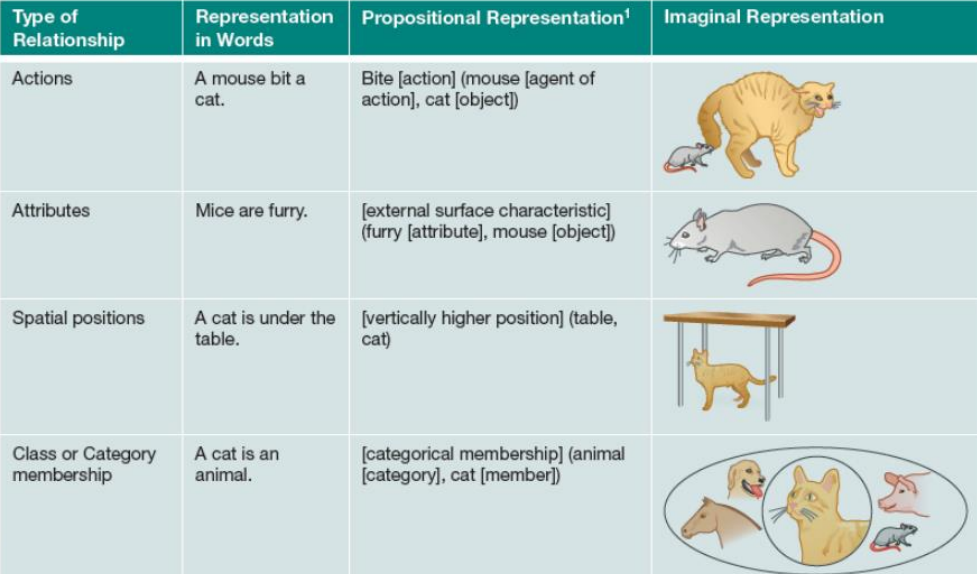
Proposition is the meaning underlying a particular relationship among concepts.
Both images and words are mentally represented in terms of their deep meanings.
Both pictorial and verbal information is encoded and stored as propositions.
When we wish to retrieve the information from storage, the propositional representation is retrieved.
Propositional representations of underlying meaning:
We may use propositions to represent any kind of relationship, including actions, attributes, spatial positions or almost any other conceivable relationship.
The possibility for combining propositions into complex propositional representational relationships makes the use of such representations highly flexible and widely applicable.
Mental image representations:
According to the functional equivalence hypothesis, although visual imagery is not identical to visual perception, it is functionally equivalent to it.
Know through neuroimaging studies.
Principles of visual imagery:
Principle | Possible questions |
Our mental transformations of images and our mental movements across images corresponf to those of physical objects and percepts. | Do our mental images follow the same laws of motion that are observed in the physcial percepts? |
The spatial relations among elements of a visual image are analogous to those relations in actual physical spaces. | Are the characteristics of mental images analogous to the characteristics of percepts? |
Mental images can be used to generate information that was not explicitly stored during encoding. | After participants have been asked to form a mental image, can they answer questions that require them to infer information based on the image that was not specifically encoded at the time they created the image? |
The construction of mental images is analogous to the construction of visuallly perceptible figures. | Does it take more time mentally to construct a larger or more complex mental image than a simpler one? |
Visual imagery is functionally equivalent to visual perception in terms of the processes of the visual system for each. | Are the same regions of the brain involved in manipulating mental imagery aas are involved in manipulating visual perceptions? |
Mental rotations:
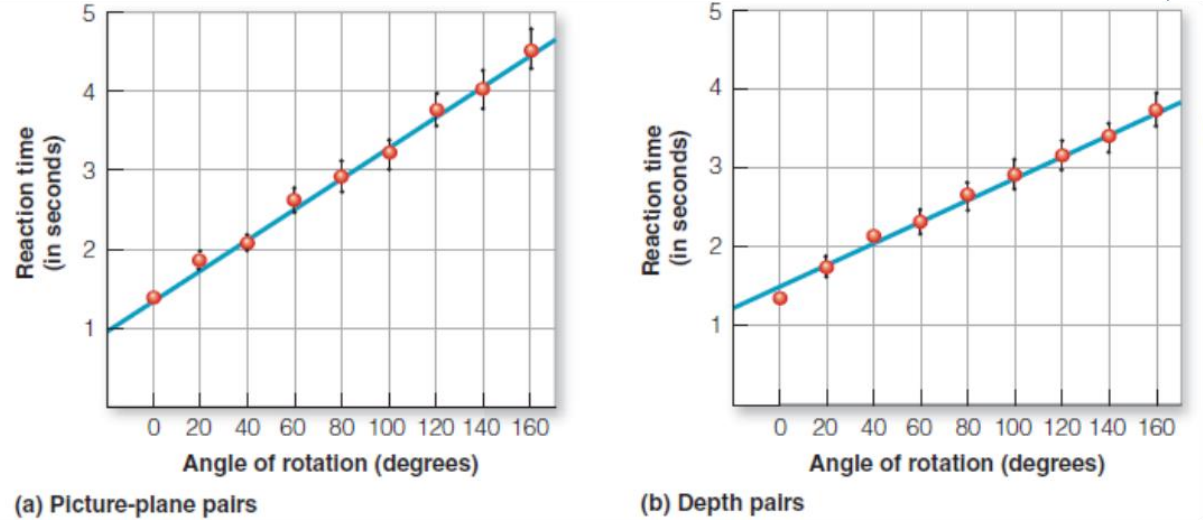
Involves rotationally transforming an object’s visual mental image.

Reaction time (RT) of mental rotation time:
The response times for answering the questions about the rotation of the figures formed a linear function.
These findings are functionally equivalent to what we might expect if the participants had been rotating physical objects in space.
Gender differences in mental rotation:
Young children: no gender difference exists.
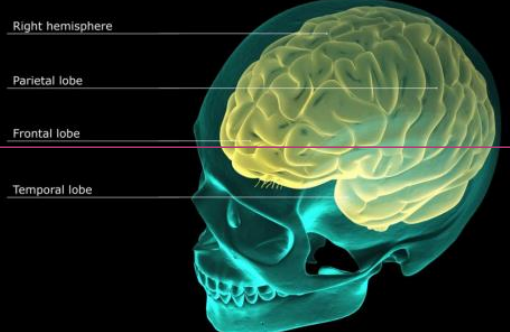
Differences in the activation of the parietal regions between men and women.
Less parietal activation for women than for men completing the same mental rotation task.
Women exhibit additional inferior frontal activation.
Which means that men and women use different strategies to solve mental rotation problems.
Training causes the gender difference to decrease or disappear.
Zooming and image scaling:
It takes longer to describe the details of smaller objects than to describe the details of the larger objects.
Kosslyn (1975): Participants imagine four pairs of animals
Elephant and a rabbit.
Rabbit and a fly.
Rabbit and an elephant-sized fly.
Rabbit and a fly-sized elephant.
Representational neglect:
Spatial neglect: A person ignores half of their visual field.
Representational neglect: A person asked to imagine a scene and then describe it ignores half of the imagined scene.
Spatial cognition and Cognitive maps:
Spatial cognition: Deals with the acquisition, organization and use of knowledge about objects and actions in 2-D and 3-D space.
Cognitive maps: Internal representations of our physical environment, particularly centering on spatial relationships.
Using this internal representation of physical space, we could get to the goal by knowing where it is in a complex of environmental features.
Shortcuts and changeable routes are possible with this model.
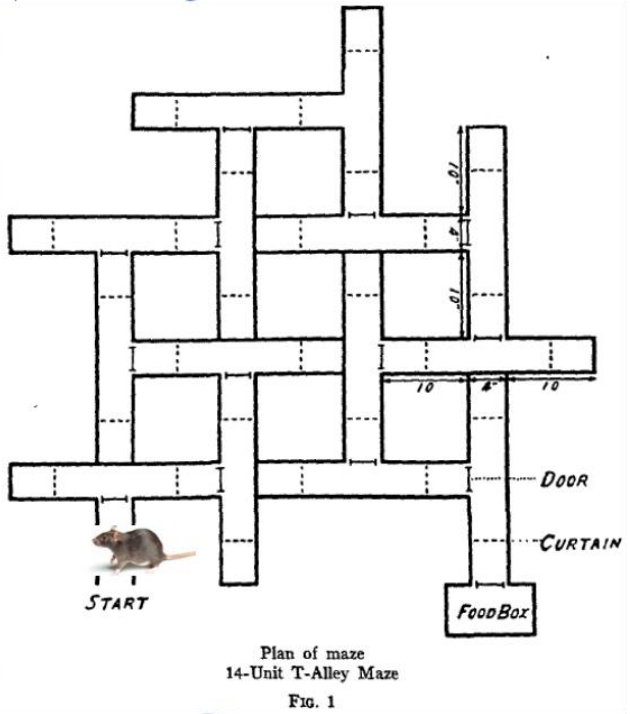
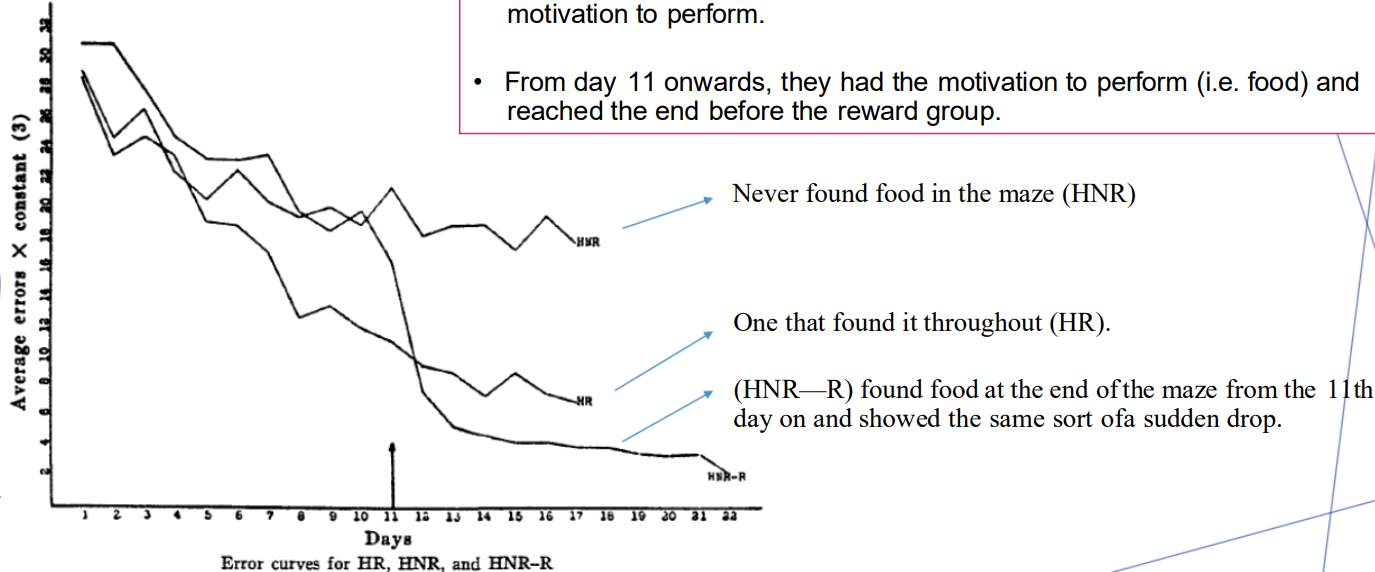
Study consists of 3 groups of rats:
Group 1: Got rewarded every time when they got to the end.
Group 2: first 10 days, the rats were taken out every time when they got to the end. No reward. Day 11 to 17, they received food every time they got to the end.
Group 3: No reward group.
Results:
The delayed reward group learned the maze on days 1 to 10 and formed a cognitive map of the maze.
They took longer to reach the end of the maze because there was no motivation to perform.
From day 11 onwards, they had the motivation to perform (food) and reached the end before the reward group.
What about humans:
Humans seem to use 3 types of knowledge when forming and using cognitive map:
Landmark knowledge: Information about particular features at a location. May be based on both imaginal and propositional representations.
Route-road knowledge: Involves specific pathways for moving from one location to another. May be based on both procedural knowledge and declarative knowledge.
Survey knowledge: Involves estimated distances between landmarks, much as they might appear on survey maps. It may be represented imaginally or propositionally (numerically specified distances).
Not just a theory:
Research have identified specific cells in our brains that allows use to form cognitive maps.
O’Keefe nobel prize winner.
Founder of place cells.