Opioid Agonists and Antagonists
Opioid Agonists and Antagonists
The opioid agonists and antagonists will be classified based on the structural classification.
Structural Classification of Opioid Agonists
There are eight classifications:
4,5-epoxymorphinans
Morphinans
Benzomorphans
4-phenylpiperidines
4-anilidopyridines
Diphenylheptanes
Miscellaneous opioid agonists
Mixed agonist or antagonist
Four-Five Epoxymorphinans
These are the basic opioids. Structure-activity relationship will be discussed.
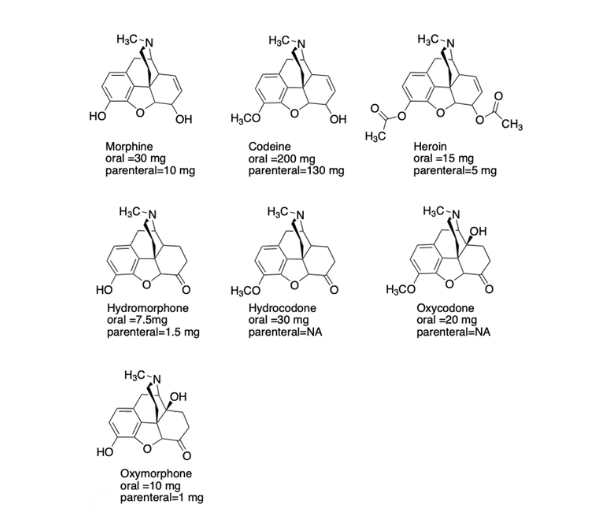
Examples: Morphine, Codeine, Heroin, Oxycodone, Hydrocodone, Oxymorphone, Hydromorphone
Key structural features:
Aromatic ring (typically phenyl group) crucial for receptor binding.
Tertiary amine nitrogen: essential for activity; usually protonated at physiological pH, allowing ionic interactions with the receptor.
Quaternary carbon: contributes to the molecule's three-dimensional shape and interaction with the receptor.
Hydroxyl groups: presence and position affect potency and receptor selectivity. For instance, morphine has two hydroxyl groups.
carbon number 17 are bulky, specifically cyclopentane and cyclopropane
morphine has 5 rings
Morphine
prototype u-receptor agonist
contains 5 chiral centers and 16 optical isomers
isolated by: Serturner
isolated from: opium poppy
Natural opium derivatives:
morphine
codeine
thebaine
papaverine
noscapine
MORPHINE
standard, why? because it is a drug to which all other u-agonists are compared
since morphine is a standard, if there is a new drug it will be compared to morphine, it is called as equivalent analgesic effect: oral dose must be 3x the IV dose to account for the morphine lost to first-pass metabolism
oral dose: 30 mg, parenteral dose: 10 mg
Codeine oral dose:200 mg, Parenteral dose: 130 mg. This demonstrates that codeine is less potent as an analgesic than morphine, as it requires a higher oral dose to achieve comparable analgesic effects.
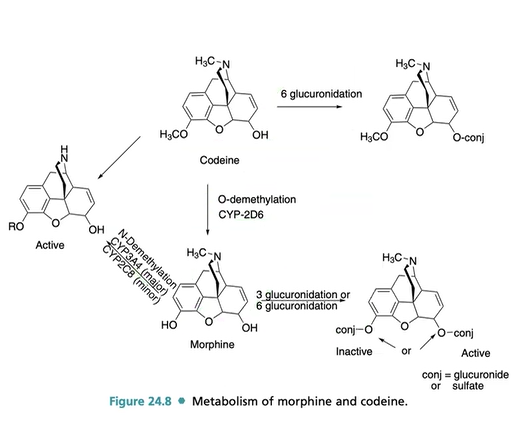
Metabolism of morphine is extensively metabolized via phase ii conjugation
3 metabolites
- morphine-3-glucuronide- morphine-6-glucuronide
- N-demethylated metabolite
Clinical use of Morphine: introduces in the WHO stepladder when pain is severe, and no relief is obtained from NSAIDS or a combi of NSAIDs and a less potent opioid.
MORPHINE AND OTHER NARCOTIC ANALGESIC SHOULD ONLY BE USE FOR SEVERE PAIN
PHARMACOKINETICS
monoacidic base
readily forms water-soluble salts w most acids
sulfate salt: PO, IV, suppository
usual dose (adults): 2.5 to 5mg q4h
PO: IR( IMMEDIATE RELEASE) q4h, SR(SUSTAINED RELEASE) q12h
CODEINE
naturally occurs in opium
prepared from Morphine: methylation
not used as an analgesic it is primarily used as antitussive agent or cough suppressant
Cohcrane evidence based rev.: it is no more effective than placebo for acute cough in children or adults.
decreased analgesic potency vs. morphine: lower addiction potential
AE: respi. depression, miosis, constipation, nausea, itching, dry mouth, and drowsiness
but what stands out in AE of opioid analgesics: constipation, miosis, dry mouth n respi depression (if there is an opioid poisoning or intoxication)
SAR; difference bn codeine n morphineC is in carbon no. 3 bc of methylation= methoxy
METABOLISM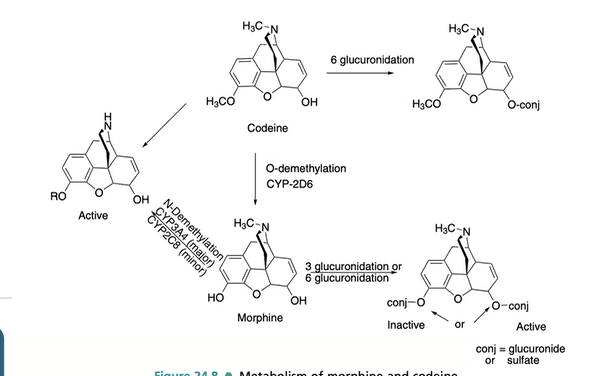
HEROIN
HISTORY
1st commercially synthesized in 18998 by Bayer (Germany)
purpose: alternate analgesic to morphine
structure: 3,6-diacetylated form of Morphine
carbon 3 n 6, may acetylation
researchers believed that it would be an effective analgesic with no addictive properties.
“HEROIN” why is it called
it made the test sub., including some chemists, feel heroic
however they didn’t realize that heroin would became part of the opioid epidemic crisis in the U.S
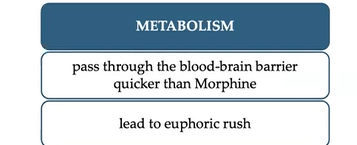
(euphoric rush- kaya addictive lalo na pag IV)
metabolized to: 3-acetylmorphine, 6-acetlymorphine (si 6 is 2 to 3x more potent than morphine, so even heroin is already metabolized, it is also activated to it’s active metabolite which is si 6 chuchu)
brand name: Dilaudid®
• synthetic derivative of morphine
• catalytic hydrogenation and dehydrogenation of morphine
• Structure
• oxidation of 6-OH: decrease of potency
disappearance of double bond= dehydrogenation
• reducing 7-8 double bond: increase flexibility of hydromorphone bc nagkaroon ng enhanced binding at the mew receptor, which makes hydromorphone 5x potent as morphine
• available as IR tablet, liquid, or suppository
STRUCTURE
3-methoxy version of Hydromorphone - better brain penetration
loss of 3-OH group
4-5x less potent than Hydromorphone
7-8-dihydro-6-keto C ring
- no pure hydrocodone
- products anti-tussive agent
Combination Products
Hydrocodone + Homatropine(anticholinergic agents): Tussionex® (antitussive agent)
Hydrocodone + paracetamol: Vicodin®, Lortab
Hydrocodone + Aspirin: Lortab ASA
Structure-Activity Relationship (SAR)
Modification Effects:
N-substitution:
Small alkyl groups (e.g., methyl) generally retain agonist activity.
Larger groups can lead to mixed agonist-antagonist or pure antagonist activity (e.g., naloxone).
3-OH substitution:
Methylation (e.g., codeine) reduces potency compared to morphine due to decreased receptor binding affinity.
Acetylation at both 3- and 6-OH positions (e.g., heroin) increases lipophilicity, leading to faster entry into the brain and a more rapid onset of action.
6-OH substitution:
Oxidation to a ketone (e.g., oxymorphone, naloxone) can increase potency or alter activity profile.
Saturation of 7,8-double bond:
Saturation generally increases receptor binding affinity and analgesic potency (e.g., hydromorphone).
Removal of the N-methyl group:
Results in a significant decrease in analgesic activity.
C14 substitution:
The introduction of a hydroxyl group at the C14 position (e.g., oxymorphone) enhances analgesic activity.