French tenses
Past Tenses
Passé Composé
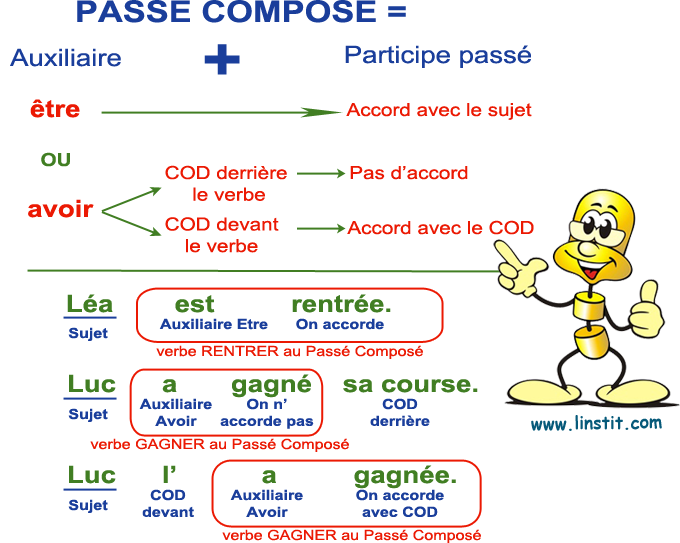
Verbs conjugated in the Passé Composé, start with either the verb être or avoir (the ‘auxiliaire’). This depends on the type of verb it is. Verbs conjugated with être are reflexive verbs (e.g. se doucher) and 17 other verbs, listed below. We can use the acronym Dr. & Mrs. Vandertrampp to remember them.
%%Descendre%%
%%Retourner%%
%%&%%
%%Monter%%
%%Rester%%
%%Sortir%%
%%Venir%%
%%Aller%%
%%Naître%%
%%Devenir%%
%%Entrer%%
%%Revenir%%
%%Tomber%%
%%Rentrer%%
%%Arriver%%
%%Mourir%%
%%Partir%%
%%Passer (par)%%
All the other verbs use avoir.
We conjugate the auxilary like we normally would in the present tense.
Être
Je suis
Tu es
Il/elle est
Nous sommes
Vous êtes
Ils/elles sont
Avoir
J’ai
Tu as
Il/elle a
Nous avons
Vous avez
Ils/elles ont
Then, we get the unconjugated verb and we remove the last two letters and add another one, depending on the suffix. -er verbs therefore end in -é, -ir verbs end in -i and -re verbs end in u. These remain the same no matter who the subject of the sentence is.
However, there are quite a few irregulars. Here are a few commonly used ones:
Avoir → eu, Être → été, Dire → dit, Ecrire → ecrit, Mettre → mis, Permettre → permis, Prendre → pris, Comprendre → compris, Apprendre → appris, Croire → cru, Voir → vu, Boire → bu, Devoir → dû, Pouvoir → pu, Lire → lu, Recevoir → reçu, Vivre → vécu, Vouloir → voulu, Connaître → connu, Courir → couru, Faire → fait, Rire → ri, Ouvrir → ouvert, Savoir → su, Mourir → mort, Naître → né.
If a verb has the auxilary of être, the verb must be accorded with the subject of the sentence.
Je (if female), +e to the end of the verb
Tu (if female), +e to the end of the verb
Elle, +e to the end of the verb
Nous, +s to the end of the verb, (if all female) +es to the end of the verb
Vous, +s to the end of the verb, (if all female) +es to the end of the verb
Ils, +s to the end of the verb
Elles, +es to the end of the verb
L’imparfait
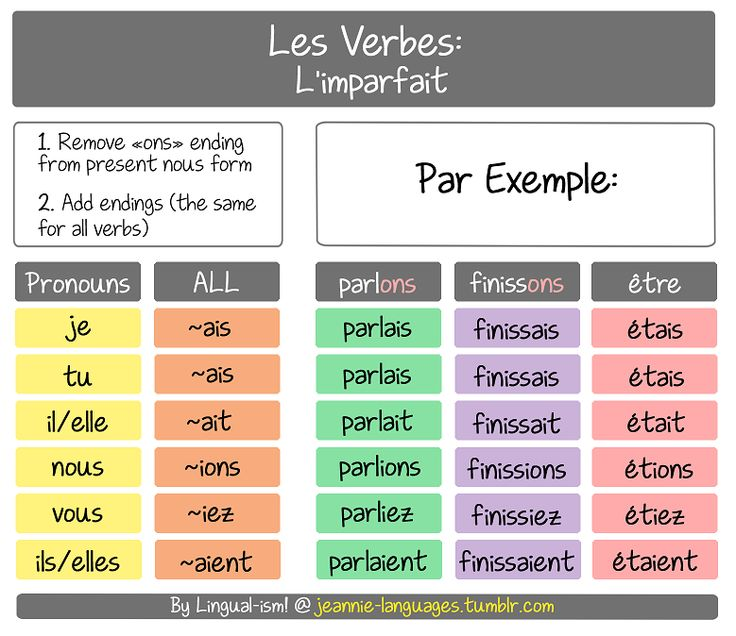
We use the present tense in nous of a verb and then remove the -ons from this. Then, we add the following endings.
Je: -ais
Tu: -ais
Il/Elle: -ait
Nous: -ions
Vous: -iez
Ils/Elles: -aient
Present Tense
The conjugation of each verb is reliant on its suffix and the subject of the sentence.
-ER verbs
Je: -e
Tu: -es
Il/Elle: -e