Lý thuyết task 1
A tăng B tăng => A rose from … to … Similarly / Likewise, B increased …
A tăng B giảm => A rose from … to … In contrast, B decreased …
Dùng đúng thì chưa? => normally (quá khứ)
Subject-verb agreement chưa? (It has hay It have ?)
Danh từ đếm được / không đếm được / dạng số nhiều (plural form) (a lot of people hay a lot of person)
=> the number of + N_countable
=> the amount of + N_uncountable
=> the quantity of + N_countable / uncountable
Student < 10: children, Student > 15: teenagers, 17: senior high school students>18: university students
Statistics = figure = data
Số liệu cụ thể => how many + SV (không dùng cho %) => GR
=> The table illustrates how many people paid a visit to / visited six distinct World Heritage areas in Australia every two years from 1996 to 2000.
Visit (v) + N
Visit (n) + to N => pay a visit to
Access (v) + N
Access (n) + to N => get / have access to
Cả số lẫn % => how + SV (varied: thay đổi = changed)
=> The table illustrates how the number of visitors to six different World Heritage areas in Australia varied every two years from 1996 to 2000.
1st có đứng đầu ở tất cả các năm hay không: G
=> consistently + V (liên tục)
Khoảng cách giữa 1st và 2nd có cách xa nhau không: G => C
=> rất xa => by far + SO SÁNH NHẤT (cách xa)
Cụm từ hay:
over the given period / throughout the given timeframe
Notably / Remarkably
the most significant change / the most pronounced growth
surge (tăng mạnh) >< plunged ( giảm mạnh)
followed by / prior to (theo sau bởi)
a similar upward trend, but / albeit to a lesser extent.
popularity / prevalence
hovering around 330
Remain in / maintain (its) + (first / second / third …) position / place (không mạo từ)
(be) rank(ed) first / second / third (không mạo từ)
Remain in the bottom position
(Due to/Owing to (bởi vì) / Despite/Notwithstanding (mặc dù) (dịch nghĩa)
a pullback / reduction / return (=reduction: sự kéo về) to nearly its initial level … (tăng lên, giảm trở lại)
Pull back (v)
recovering / rebounding (v: phục hồi, tăng trở lại)
accounted for / comprised / constituted
started with equal / comparable / similar allocations
with the exception of / except for / LEAVING ASIDE + N
were relatively similar / were relatively comparable / were almost even (gần như tương đồng)
rendering / making
Case 1: A tăng B tăng C giảm D giảm
body 1: A và B tăng (cùng xu hướng tăng)
A increased from … to … A (mạo từ) similar increasing/upward/ascending trend was witnessed in B. B rose … (nối mượt hơn, có yếu tố so sánh)
body 2: C và D giảm (cùng xu hướng giảm)
C … Likewise, D also saw a decreasing trend. D …
Case 2: A tăng B tăng C tăng D giảm
body 1: A tăng mạnh B tăng nhẹ (cùng xu hướng / khác mức độ)
A … B also experienced an upward trend, but / though / albeit to a lesser extent / but at a slower pace. B …
body 2: C tăng D giảm (đối xu hướng)
C … D exhibited an opposite/reverse trend, decreasing from … to …=> Connectors among groups:
A similar trend >< an opposite trend/a reverse trend was witnessed in …
Subject + exhibited/registered/saw/witnessed/experienced (chứng kiến) a similar trend >< an opposite trend/reverse trend
LINKING WORDSConversely/In contrast/By contrast, S V >< Similarly/Likewise, S V
A increased ... Conversely/In contrast/By contrast, B decreased from … to …
A increased .... Similarly/Likewise, B increased from … to …
The change in/of … mirrored/contrasted with that in/of …
A tăng mạnh B tăng mạnh (cùng xu hướng, cùng mức độ)
=> A tăng như thế nào. The change of B mirrored (v: sao chép) that of A. B …
A tăng B giảm => The change of B contrasted (v) with that of A
=> LINKING DEVICES
Cặp từ the former - the latter (refer lại danh từ đằng trước) => 01 lần
Regarding the population of the Philippines and China, the former …, while the latter (China) …
the figure for (statistics / data): đơn vị thay thế (không dùng intro / overview / câu mở đoạn của mỗi body) => đừng lạm dụng (1-2 lần)
The number of A increased to … Similarly, the figure for B rose to … (sau khi đã nêu measurement chính thức)
=> A and B witnessed an increase in their number of visitors … (sau nhìn lại trước)
=> reach a peak (n) of => reach its peak of …
A increased and reached its peak of …
Reach a peak at => sai => reach a peak of
=> peak (v) at => A increased and peaked at …
NORTH OF (trên mức) / SOUTH OF (dưới mức) (1-2 LẦN, tượng hình) ex: The temperature of Dubai increased to over / to north of 35oC in August.
to south of = to under = to shy of (bỏ mạo từ)
to north of = to over (at north of / at south of)
trajectory: quỹ đạo => From January to August, the temperature of Dubai experienced/followed an upward trend/trajectory. => line graph / bar chart (nhiều mốc thời gian)
Overall, the usage rates for all types of transportation showed an increase by varying degrees over the given period, except for/with the exception of (NGOẠI TRỪ) air travel, which experienced a gradual decline. Notably, the rail surpassed/overtook/ outnumbered/exceeded/outpaced cars around 2006 to emerge as the most popular / the leading mode of transportation by the conclusion of the period.
A surpassed B to become / emerge as … / to claim the highest …
FUTURE:
Tương lai đơn: will V
Cấu trúc tương lai: be expected to / be anticipated to / be projected to / be forecasted to V
Overall/In general, if all projections are correct, SV
Overall, if all predictions hold true, SV (tương lai) (compulsory)
Chữa bài task 1:
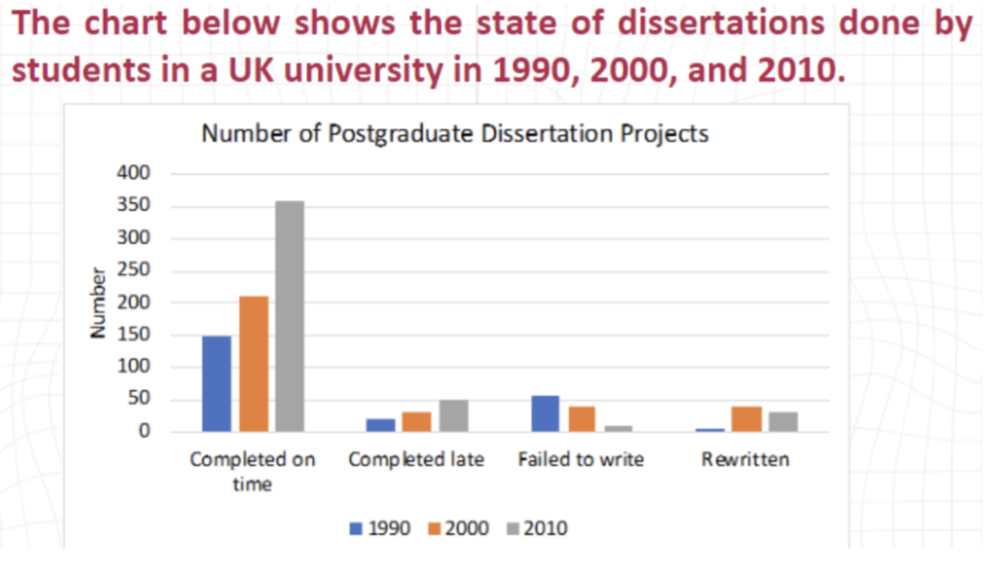
The chart illustrate the status of dissertations done by UK university students across three different years, likely 1990, 2000 and 2010
Overall, the number of postgraduate dissertation projects completed on time and completed late experienced an upward trend over the period. the opposite was true for failing to write. its rewritten was low and sustainable. there was a marked increase in the timely completion of dissertations over the years.
=> thiếu phần order cho bài nè, toàn những câu đơn. Đây là bản nâng cấp
overall, the numbers of projects in all states increased by varying degress, leaving aside a considerable decline in the rate of disserations which students failed to complete. Notably, the quantity of projects finished on time remain by far the highest and saw the most pronounced growth in the surveyed university throughout the given period.
The number of projects completed on time was highlighting a considerable improvement in punctual dissertation submissions.The quantity lity of dissertations completed on time embarked on 150 dissertations, which then considerably went up more than double dissertations, standing at 350 in 2010.While the number of late, failed, and rewritten projects remained low, pointing to an overall positive trend in dissertation completion at the university. The figure for completed late rose slightly over the period, despite its remaining under 50 dissertations. The number of students who failed to write exhibited a reverse trend, decreasing from over 50 to merely 5 projects. Specifically, the count of rewritten dissertations was highest in 2000, at approximately 45 and decreased gradually across the years.
=> không có lỗi sai về ngữ pháp nhưng body 1 dài loằng ngoằng, chia chưa cân xứng, thiếu comment về rank. Tham khảo thêm bài như sauDuring the specified timeframe, the number of dissertations submitted punctually ( đúng hạn) far exceeded those in the other categories. initially, the figure topped the chart at 150 in 1990, gradually increasing to over 200 by 2000, and then experencing a significant rise to more then 350 by the end of period, more than doubling its starting point. A similar upward trajectory, albeit at a slower pace, was obsevered in the category of late submissions, which commenced ( đã bắt đầu) at around 20 in 1990 and steadily rose to exactly 50 by 2010. This progressive increase allowed the “ completed late” category to secure the second position by the conclusion of the period.
In constrast, the number of postgraduates who failed to write their dissertations gradually declined from approximately 50 in 1990 to around 10 in 2010, positioning it at the bottom by the end of the surveyed period. Unlike the “ fail to write” category, rewritten dissertation projects exhibited a more erratic trend. Starting from a modest number, the figure increased to nearly 50, before rettracting to approximately 40 by the end of the period.
từ vựng hay
1. During the specified timeframe - Trong khoảng thời gian được chỉ định
2. Punctually far exceeded - Vượt xa đúng hạn
3. A similar upward trajectory, albeit at a slower pace, - Một xu hướng tăng tương tự, mặc dù với tốc độ chậm hơn
4. Secure the second position - Đảm bảo vị trí thứ hai
5. Positioning it at the bottom by the end of the surveyed period - Đưa nó xuống vị trí cuối cùng vào cuối giai đoạn khảo sát
6. Exhibited a more erratic trend, retracting - Thể hiện một xu hướng thất thường hơn, thu hẹp
Lesson 3: static chart
BICYCLE
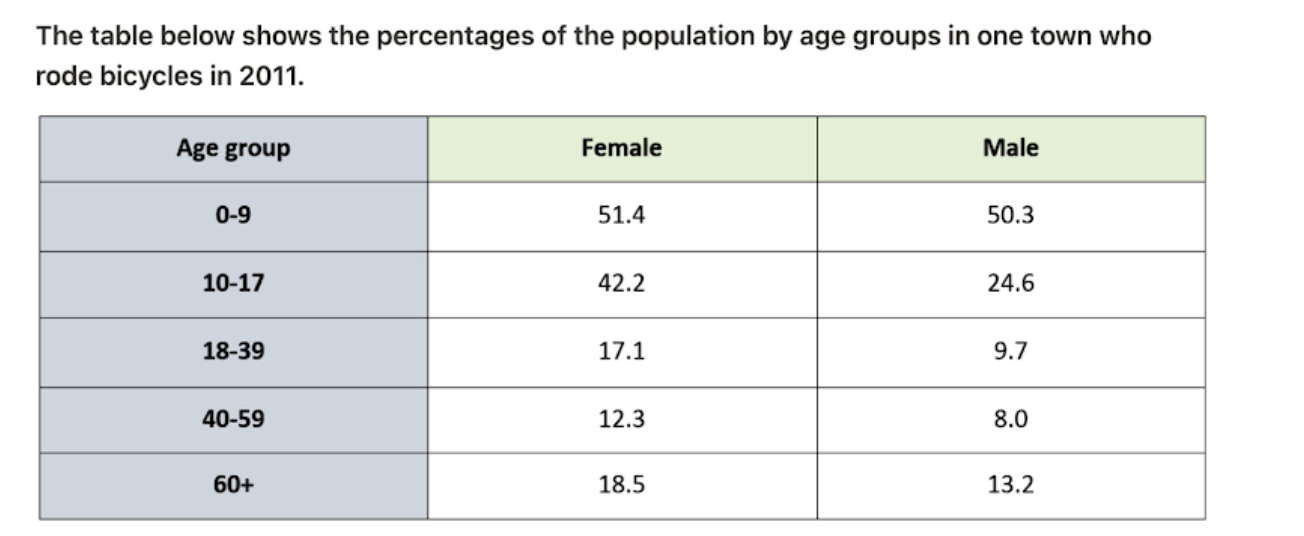
INTRODUCTION: the table illustrates the proportions of cyclists/ bike users in a particular town broken down by age and gender, in 2011C1: khảo sát mấy tiêu chí => higher / highest cho từng tiêu chí (ưu tiên đặt higher trước highest)
Gender: f>m (tất cả các nhóm tuổi) => higher
Age: 0-9 => highest
=> Overall, the cycling rate of females was higher than that of males across all the surveyed age groups / brackets / cohorts. Notably, the 0-9 age group had / registered / boasted the highest bicycle usage rate among the five examined brackets.
Boast (v): tự hào vì có cái gì (dùng cho ngữ cảnh (+), không dùng cho (-) và trung lập)
BODY 1: 0-9 / 10-17 (cùng đặc điểm - cùng cao // list/compare - focus on the highest)
Option 1: nêu tên: Looking first at the cycling rates of the 0-9 and 10-17 age groups, …
Looking first at the cycling rates of younger age groups, …
C2: ĐỘ TUỔI ĐANG TĂNG DẦN LÊN / tăng tiến => CÓ THỂ COI LÀ “DYNAMIC”
Độ tuổi càng tăng lên / càng về già => tỉ lệ đi xe đạp giảm xuống / mng càng đi xe đạp ít hơn, ngoại trừ nhóm 60 tuổi, chứng kiến sự tăng trở lại => giữ nguyên câu gender, viết lại câu age
=> Overall, the cycling rate of females was higher than that of males in / across all the surveyed age groups. As age increased / advanced (v), the cycling rates of both genders decreased, with the exception of / leaving aside the over-60 age group, which saw a recovery / rebound. (tăng trở lại, phục hồi)
=> Overall, the cycling rates of females were higher than those of males across all the surveyed age groups. As/when people/individuals grew older, they were less inclined to use their bicycles, with the exception of / leaving aside the over-60 age group, which saw a recovery/rebound. (phục hồi)
tend to => be inclined to: có xu hướng
Be more iinclined to: làm nhiều hơn >< be less inclined to: làm ít đi
Body 1: The proportions of cyclists aged 0-9 and 10-17 were much / significantly higher than those of the remaining age groups.
=> The proportions of cyclists aged 0-9 and 10-17 far surpassed those of the remaining age groups. Among/Within these groups, the 0-9 age group exhibited a minor difference in cycling rates between girls and boys, at 51.4% and 50.3%, respectively. // … boys, slightly exceeding / surpassing 50% for both genders. (This also marked the highest rates recorded in the whole chart.) Conversely, a wide disparity was witnessed in the case of individuals falling within the 10-17 age range, where (+ SV) females accounted for / constituted 42.2%, nearly/almost doubling the proportion of males / male counterparts, at 24.6%.
Body 2: Moving on to the remaining regions, ….
The remaining age groups witnessed a starkly different scenario, with much lower cycling rates. Females aged 18-39 and 40-59 accounted for 17.1% and 12.3% respectively, exceeding/surpassing (which were higher than) the corresponding/respective figures for males, at 9.7% and 8%. Notably, when / as individuals reached 60 and over, they rode their bicycles more often, with 18.5% for females and 13.2% for males.
CÁCH NÊU CÁC NHÓM TUỔI:
The age group 10-17 witnessed a notable increase in the number of participants.
There was a notable increase in the proportion of young people falling within the 10-17 age range.
The 10-17 age category/bracket/cohort/group saw a substantial growth in the number of attendees.
Participants in the age range of 10-17 experienced a pronounced increase.
The number of individuals aged (đạt mấy tuổi) 10-17 who took part in the event showed a significant upward trend.
Danh từ chỉ người + aged (không cần who, không viết là aging)
There was a noticeable upward trend in the participation of those/people aged between 10 and 17/FROM 10 TO 17.
The age group spanning from 10 to 17 observed a marked rise in participation
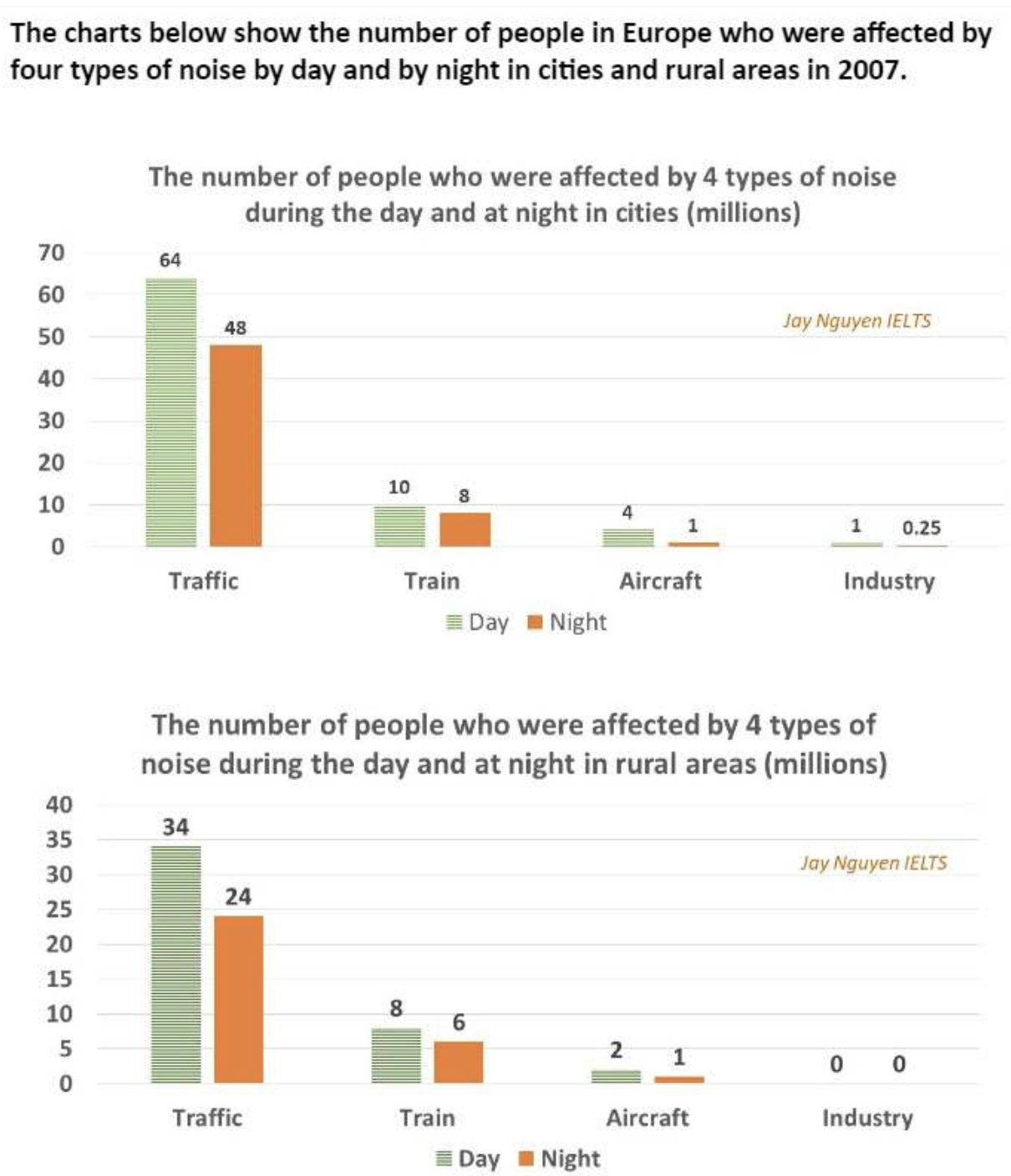
The bar charts illustrate the number of / How many European people impacted / affected by four types of noise in the daytime and in the nighttime in urban and rural areas / settings in 2007, measured in millions.
=> Overall, noise levels were higher during the day and urban residents were more impacted compared with their rural counterparts. Notably, traffic was the most disturbing noise among the four surveyed types.=> Traffic and trains had / exerted a greater impact on both city and rural residents. Among/Within these types, the former impacted / had an impact on / distracted 64 million city residents during the day and 48 million at night. The figure for the latter lagged behind, with 10 million affected in the daytime and 8 million in the nighttime. The problem/issue of noise pollution in rural areas was less pronounced / serious. The number of individuals living in the countryside affected by traffic was half that of cities, amounting to / totalling (v) 34 million during the day and 24 million at night. Meanwhile, trains had a minimal impact on 8 million in the daytime and 6 million in the nighttime. // The number of individuals impacted by trains in the countryside was 2 million lower than that in cities, at 8 million in the daytime and 6 million in the nighttime.
Turning to the impact of aircraft and industrial noise on urban and rural populations, these factors had a less significant effect compared to other sources. In urban areas, aircraft noise affected 4 million residents during the day, which was four times the number affected at night. In contrast, rural areas experienced half the impact, with only 2 million people exposed to aircraft noise during the day, while nighttime exposure remained consistent in both settings at 1 million people. In terms of industrial noise, it had the least impact among all categories examined. In cities, 1 million people were affected during the day, dropping to just 0.25 million at night. Notably, in rural areas, there were no recorded cases of individuals being affected by industrial noise.
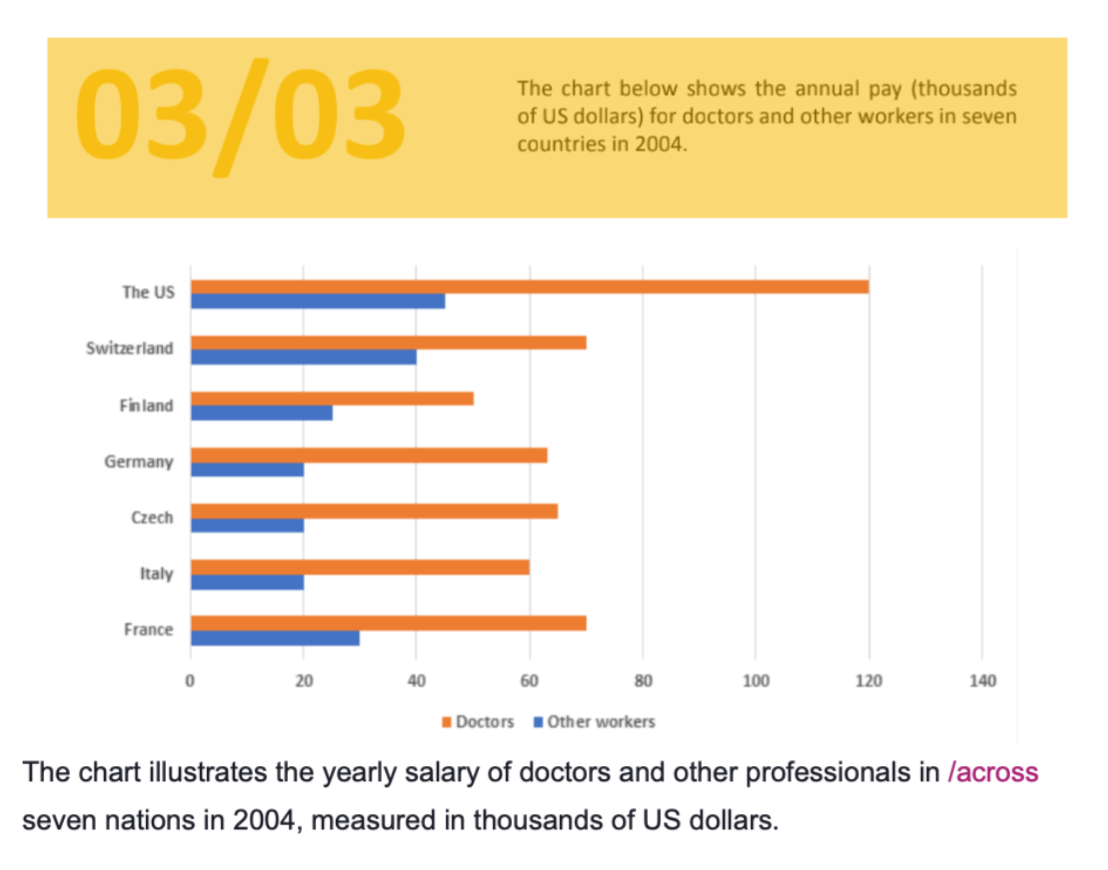
Overall, doctoers consistently earned significantly more than other professionals, with the US leading in compensation for both occupations.
American workers earned significantly more than their European counterparts regardless of their jobs, at $120000 for doctors and around 45,00 for othe jobs. Switzerland and France also offered high salaries for doctors, with figures hovering around $70,000, while salaries for other professions were $40,000 and $30,000, respectively.
At the lower end of the spectrum, Italy, the Czech Republic, and Germany had the lowest annual salaries for non-medical professionals, each at $20,000. Doctores in these countries typically earned aroung $60,000, which was a common range across Europe. Remarkably, Finland offered the lowest salary for doctors, at nearly $50,000. while other careers earned more than three aforemetioned countries, at roughly $50,000.
More people are becoming seriously overweight. Some people think that the government should increase the price of fattening foods to address this issue. to what extent do you agree or disagree with this statement
In recent years, the issue of obesity has become increasingly prevalent. there is a common belief that increasing the prices of fattening food can be an effective solution. While understanding the reasons for this sentiment, i would contend that simply increasing prices is not a comprehensive approach.
Granted, it is reasonable why some believe that increasing the price of these unhealthy foods can combat obesity rates. The logic here is that as these foods become more expensive, people may opt for healthier, more affordable alternatives, thereby reducing obesity rates and related health problems. For instance, individuals might choose a balanced meal for 30,000 VND over a single piece of fried chicken from a popular fast-food chain. Furthermore, an increase in taxes on fattening foods could generate additional government revenue, which could then be allocated toward improving healthcare systems or funding public health initiatives. Such funds could be utilized to combat obesity, cancer, and other lifestyle-related diseases, as well as to promote nutrition education programs.
However, it is essential to note that merely raising prices would be sufficient to change eating habits. without complementary educational campaigns or addtional incentives, it is unlikely that people will significantly alter their food choices. It is important to remember that of people want to eat fast food, they will find a way to do so no matter what.
Therefore, instead of foucsing solely on restricting access to fast food, we should encourage them to combine it with regular excercise to reduce the negative effects that fattening food can have on health. in other words, government intervention in personal dietary choices may not be the most effective appoarch. Personal freedom includes the right to choose what to eat, and raising prices may be seen as infringement on individual rights and choices. Instead of using price controls, a more balanced strategy of promoting awareness about healthy eating habits and encouraging a lifestyles that balances calorie intake with physical activity would likely be more effective
In conclusion, while there are valid reasons for the belief that increasing the price of fattening foods can curb obesity rates i would contend that a holistic appoach focusing on calorie balance and lifestyle changes would be more beneficial than merely raising prices,
1. Compensation for both occupations - Bồi thường cho cả hai nghề nghiệp.
2. Aforementioned - Đã đề cập trước đó.
3. Not a comprehensive approach - Không phải là một cách tiếp cận toàn diện.
4. May opt for - Có thể chọn.
5. Generate additional government revenue - Tạo thêm nguồn thu cho chính phủ.
6. Be utilized to combat - Được sử dụng để chống lại.
7. Sufficient to change - Đủ để thay đổi.
8. Find a way to do so no matter what - Tìm cách thực hiện bất kể điều gì xảy ra.
9. Solely on restricting access to fast food - Chỉ tập trung vào việc hạn chế tiếp cận đồ ăn nhanh.
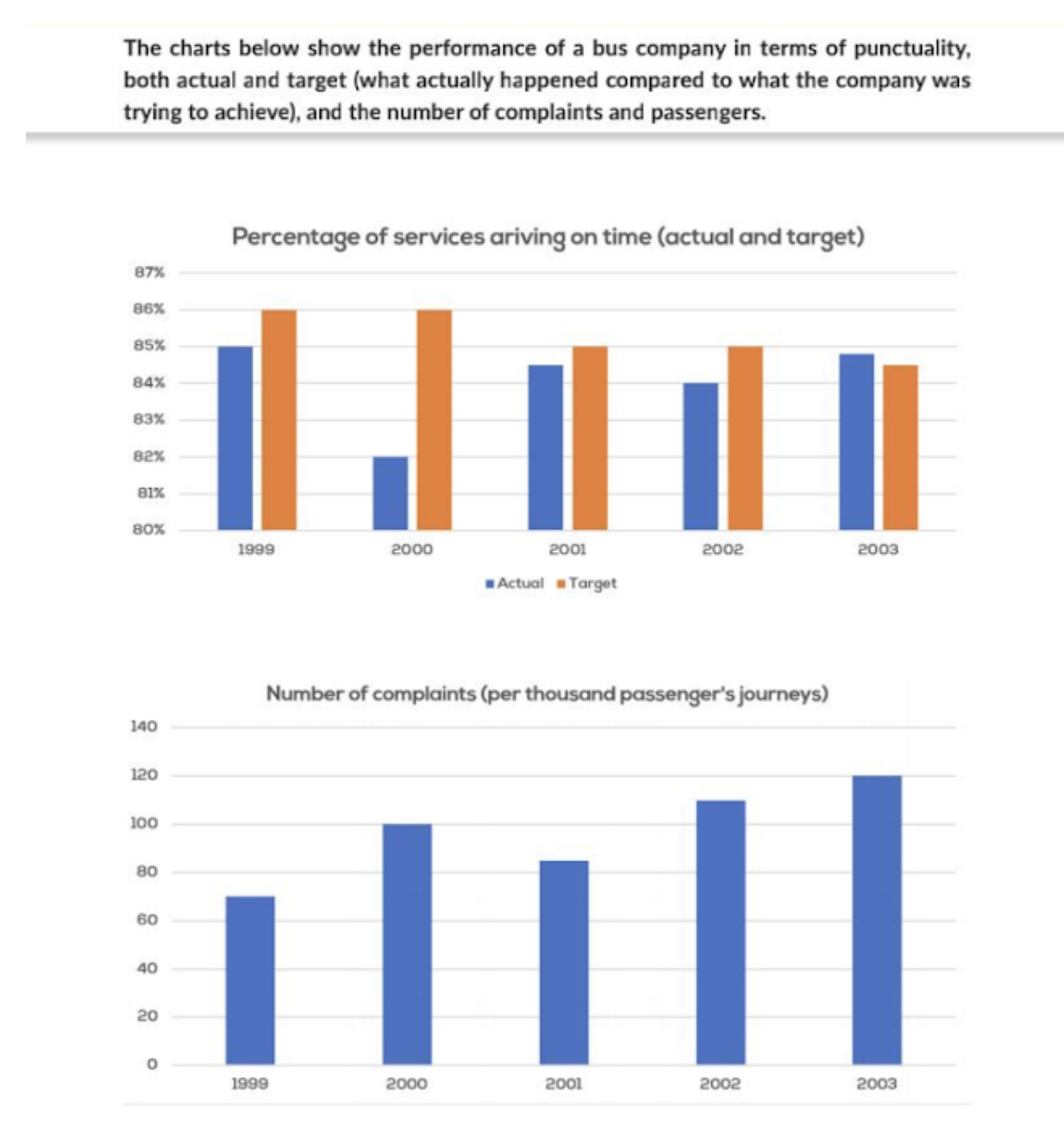
The first bar chart depicts the actual percentage of punctual buses, compated with the set target of bus company, while the second one chart demonstrates the quantity of complaints received by this company.
Overall, the on-time performance target for bus services gradually decreased over the given period, along with sharp fluctuations of the actual rates. Despite the decrease in the set target, the actual rates consistently fell short of this target in most years, except for the year 2003. Furthermore, the number of complaints filed saw a general increase trend, with the highest figure recorded in 2003.
Looking first at the proportion of buses arriving on time, the actual rates did not achieve this target in the first year, standing at 85% lower than as much as 1% for the target. While the on-time performance target for bus services remained steady at 85% in 2000, the actual rates significantly declined to 82%.Then this rebounded and closely followed the target around 85%. Despite a slight decrease in the proportion of actual on-time bus services in 2002 to 84%, there was a maintained position in this target. The year 2003 marked the very first time the actual surpassed the target, at roughly 84.8% and 84.5% respectively
Moving to on the number of complaints received by this bus company, this figure was the lowest in the first year, at about 70 per thousand passenger journeys. However, this number surged dramatically to reach 100 complaints per thousand journeys in 2000, before declining in 2001. in 2002 and 2003, the number of complaints rose again, peaking at appoximately 110 and 120 per thousand passenger journeys in order.
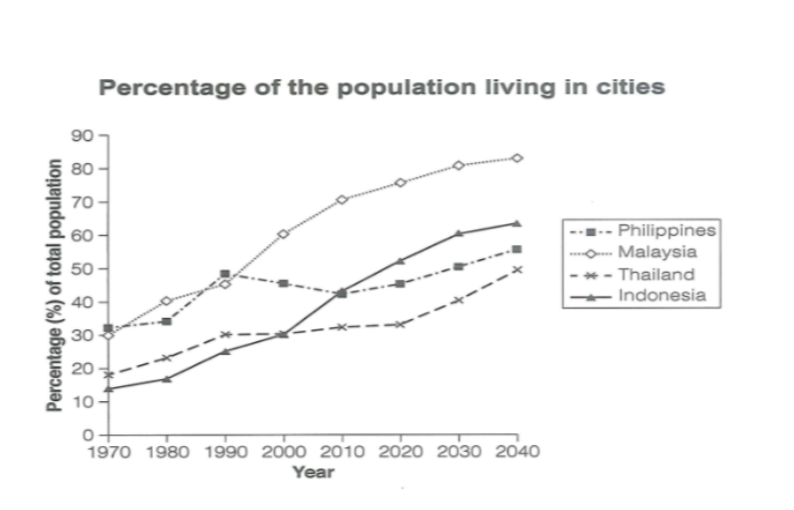
the line graph illustrates the proportion of city dwelers in fout different Asian countries since 1970, as well as gives projections until to 2040.
overall, if all projections hold true, all surveyed countries will register an increase to varying extents in their city population rates, with the growth of Indonesia being the most pronounced. Notably, Malaysia officially surpassed the Philippines to claim / achieve the highest proportion of urban residents from around 1991 onwards
Looking first at the Philippines and Malaysia, in 1970, the former commenced with the highest urban population rate, at 31%, slightly ahead of the latter, at 30%. Thereafter, the percentage of city dwellers in the Philippines rose modestly (khiêm tốn) to around 32% in 1980 before surging to nearly / almost 50% in 1990. The figure then fell back to / returned to / reverted to over 40% in 2010, followed by a gradual recovery, ultimately (cuối cùng) being expected to achieve a new peak of 55% in 2040. These changes will propel the city population rate of this country to / into third position by the end / conclusion of the period. The urbanization rate of Malaysia will witness a similar upward trend, but in a more consistent manner. IT grew to around 45% in 1990 and is projected to reach about 85% in 2040, far outpacing / surpassing the rates of the other countries.
Shifting our focus to Thailand and Indonesia, in 1970, the former commenced at around 19% of urban population rate, WHILE the latter started with the lowest at roughly 12%. Thereafter, the percentage of city dwellers in Thailand rose modestly to around 30% in 2020 and then surged to nearly more than 45% at the end of the period. Despite this upward trend, Thailand's urban population rate is projected to remain the lowest among the four countries in 2040. Indonesia’s urban residents, on the other hand, urban residents dramatically rose and officially surpassed Thailand from 2000 onwards. Despite starting with the lowest position, this country will witness the most significant growth to achieve the second-highest position, standing at more than 60% in 2040
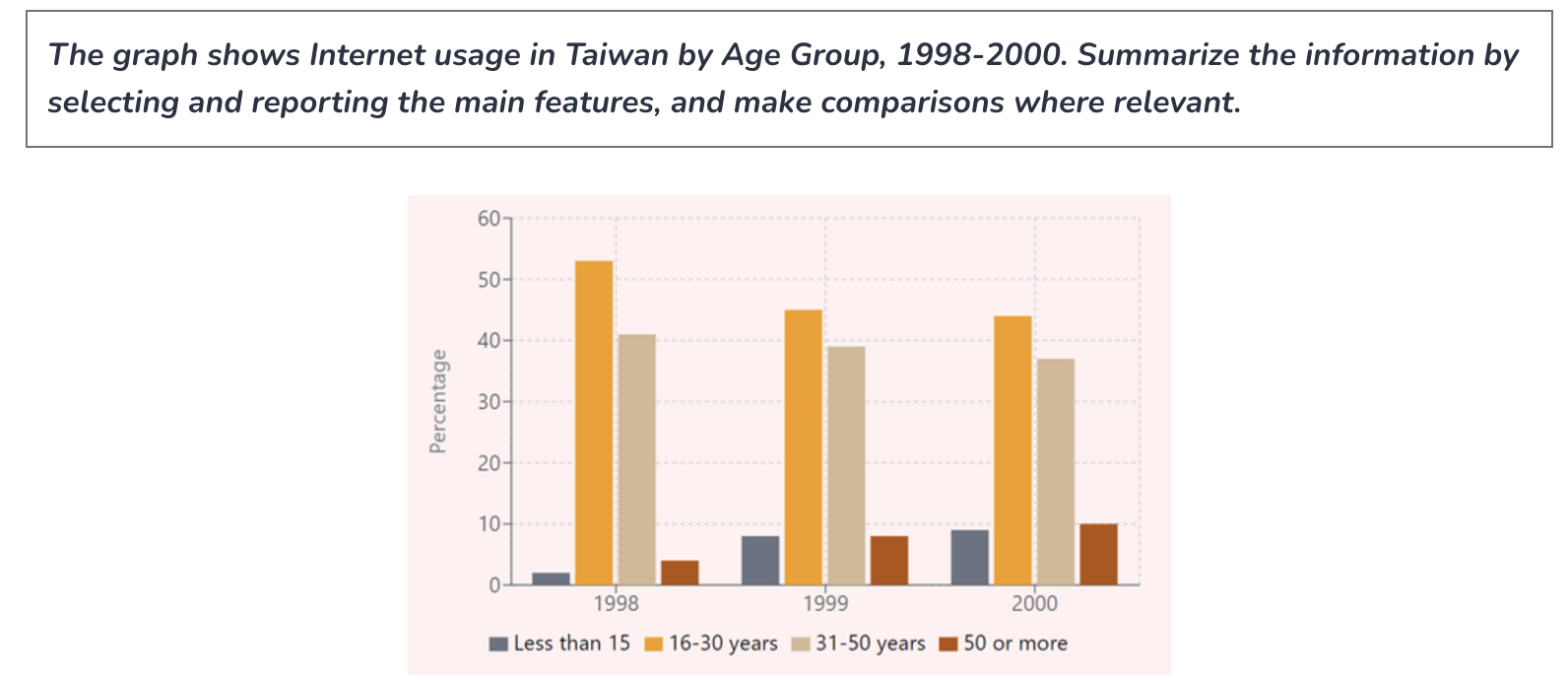
The bar chart compares the percentage of Internet usage among four different age groups in Taiwan over a three-year period from 1998 to 2000.
Overall, there were contrasting trends among the age groups, with Internet usage increasing for the youngest and oldest groups, while decreasing for the middle-aged groups. Throughout the period, the 16-30 age group consistently had the highest percentage of Internet users, followed by the 31-50 age group. The most significant changes were observed in the under-15 and over-50 age groups, which showed substantial increases in Internet usage over the three years.
The two middle-aged groups, 16-30 and 31-50, consistently had the highest percentages of Internet users throughout the period, although both experienced a decline. The 16-30 age group started with the highest percentage at 53% in 1998, but this dropped to 45% in 1999 and further to 44% in 2000. Similarly, the 31-50 age group saw a gradual decrease from 41% in 1998 to 39% in 1999, and then to 37% in 2000. Despite these declines, these two groups maintained their positions as the top two Internet-using age groups throughout the three years, with the 16-30 group consistently outperforming ( sự vượt trội) the 31-50 group by a significant margin.
In contrast to the middle-aged groups, both the youngest (under 15) and oldest (50 or more) age groups showed significant increases in Internet usage over the three-year period. The under-15 group experienced the most dramatic growth, starting from a mere 2% in 1998, quadrupling to 8% in 1999, and then slightly increasing to 9% in 2000. The 50 or more age group also saw substantial growth, beginning at 4% in 1998, doubling to 8% in 1999, and reaching 10% by 2000. Interestingly, while both groups started with the lowest percentages in 1998, the over-50 group surpassed the under-15 group by the end of the period. Despite their growth, these two groups still had considerably lower Internet usage compared to the middle-aged groups throughout the three years.
EX2: the best way to solve the traffic and transportation problems is to encourage people to live in cities rather than suburbs or countryside. Do you agree or disagree ?
One school of thought holds that encouraging people to live in cities rather than suburbs or countryside is the best way to adress traffc and transportation challenges. While acknowledging the reasons behind the sentiment, i would contend that there are many alternative measures which would be better than urban migration.
One the one hand, it is understanable why some belive that recolating residents to cities can effectively combat traffic and transportation problems. cities often provide access to public transportation systems hat are advanced and cuttingedge so that it can encourage people to use public transportation more. A a result, Using public transportation can be dealt with traffic and transportation, such as reducing air pollution and traffic jams in rush hour. Ha Noi, for example, Government provides skytrain and many bus routes, which is better for dweller cities to commute to workplaces and schools and reduce reliance on their private vehicles. It helps minimize the environmental and logistical impact of urban traffic. . However, it is essential to note that an influx of residents to cities could exacerbate existing problems in cites, such as unemployment, housing shortage, and costs of living. Considering these factors, the belief that living in cities to solve the traffic and transportation problems is the best way lacks a solid foundation.
my Teach => Admittedly, it is understandable why some belive that relocating residents to cities can mitigate traffic and transportation issues. Cities often have advanced and cutting-edge public transportation systems, which can alleviate issues such as air pollution and traffic congestion during peak hours. For instance, in Ha Noi, the government has introduced skytrains and expaned bus routes making commuting to workplaces and schools more efficient while reducing dependence on private vehicles. This shift helps minimize the environmental and logistical impact of urban traffic. However, it is essential to note that encouraging people to move to cities can exacerbate existing urban problems such as unemployment, housing shortages, and rising living costs.
Given the above mentioned concerns, i am firmly convinced that there are many better alternatives than encouraging people to live in cities. First, Government should prioritize investing in public transportation systems to improve the quality of rural residentts, rather than forcing tthem to relcorate to cities. By enhancing public transportation, people in rural areas can more easily access job opportunities, healthcare, and education in urban centers without needing to move. This approach not only helps reduce housing and unemploment pressures in cities but also contributes to sustainable development in rural areas.
In conclusion, while encouraging people to live in cities offers certain advantages in addressing transportation challenges, I firmly believe that alternative solutions, such as improving rural public transport and investing in education, are more sustainable and beneficial in the long run
1. "relocating residents to cities can effectively combat traffic, reduce reliance on their private vehicles, minimize the environmental and logistical impact of urban" - "việc di chuyển cư dân đến các thành phố có thể hiệu quả trong việc giảm tắc nghẽn giao thông, giảm sự phụ thuộc vào phương tiện cá nhân của họ, và giảm thiểu tác động môi trường và hậu cần của đô thị"
2. "an influx of residents to cities could exacerbate existing problems in cities" - "sự gia tăng cư dân đến các thành phố có thể làm trầm trọng thêm các vấn đề hiện có ở các thành phố"
3. "lacks a solid foundation" - "thiếu một nền tảng vững chắc"
4. "relocating residents to cities can mitigate traffic and transportation issues" - "việc di chuyển cư dân đến các thành phố có thể giảm thiểu các vấn đề giao thông và vận tải"
5. "exacerbate existing urban problems" - "làm trầm trọng thêm các vấn đề đô thị hiện có"
6. "prioritize investing in public transportation systems to improve the quality of rural residents, rather than forcing them to relocate to cities" - "ưu tiên đầu tư vào các hệ thống giao thông công cộng để cải thiện chất lượng cuộc sống của cư dân nông thôn, thay vì buộc họ phải di chuyển đến các thành phố"
7. "This approach not only" - "Cách tiếp cận này không chỉ"
B7: Some people think that governments should ban dangerous sports, while others think people should have freedom to do any sports or activity. Discuss both views and give your own opinion.
One school of thought holds that a ban on dangerous sports should be implemented by governments, while others are adamant that people are allowed to be given the leeway to do any activity and sport. This essay will closely examine both viewpoints before concluding that I agree with the latter.
On the one hand, it can be argued that governments should impose strict regulations or even bans on dangerous sports. This is primarily due to the significant risks these activities pose, iincluding severe injuries and fatalities. Restricting such sports could lead to a reduction in death rates and contribute to a healthier population overall. For instance, extreme activities like bungee jumping involve participants leaping from considerable heights, which inherently endangers their lives. However, enforcing such restrictions could potentially lead to public resentment, as individuals might view these measures as an infringement on personal freedom. Over time, this discontent could escalate into broader social dissatisfaction.
On the other hand, i firmly believe that individuals should have the freedom to pursue their favorite sports. First and foremost, people have the right to make their own choices about how they engage with physical activities. As long as safety measures are place, individuals should be allowed to enjoy the sports they love, as it promotes physical well-being, mental health, and personal satisfaction. Additionally, allowing individuals to choose their own sports can foster a sense of personal responsibility and autonomy. When people are empowered to follow their passions, they are more likely to remain committed and motivated, which can lead to long-tem health benefits and a higher quality of life. Therefore, instead of imposing strict bans, it is essential to prioritize safety, education, and personal choice in encouraging active participation in sports.
In conclusion, despite the immediate benefits of banning dangerous activity, i am more convinced that people should be given total freedom to do any sports
B8: In some countries, many children are becoming overweight and unhealthy. Some people say it is the responsibility of governments to solve this problem. To what extent do you argee or disagree with this statement ?
In recent years, overweight children have become a pressing issue worldwide. Some people believe that in order to tackle the problem of childhood obesity, it is important to consider the roles of governments. While acknoledging the reasons behind this sentiment, i would contend that relying solely on the government to tackle this problem is impractical and insufficient.
On the one hand, there are compelling arguments for government intervention in combating childhood obsesity. Governments bear a responsibility to safeguard public health, and obesity in children is closely linked to severe health issues such as diabetes, heart disease, and mental health disorders. Consequently, government action is essential to reduce these disease rates. For instance, governments can launch nationwide health campains to raise awareness, encourage nutritious eating, and promote physical activity. Free workshops for parents and educatiors on nutrition and meal planning could equip caregivers with the knowledge needed to provide balanced diets for children. As a result, children would receive proper nourishment from those directly responsible for their care.
However, it is essential to recognize that while governments and communities can offer support, the influence of families plays a decisive role in shaping children’s eating habits and lifestyle choices. While governments can implement guidelines and policies, it is families who make day-to-day decisions about children’s diets and physical activities. For instance, parents and teachers should encourage healthy habits and ensure their children are getting balanced meals and exercise, especially during formative years. In additon, the government should not interfere too much in personal choices, due to if these implemented diets and habits, it would breed resentment among residents gradually escalating into social discontentment because of the difference in standing appearance. A collaborative appoarch that empowers families while leveraging government support is far more effective in achieving lasting change.
In conclusion, while government involvement is vital in addressing childhood obesity, it should form part of a broader, collaborative effort involving families, educators, and communities. only through shared responsibility and engagement can this issue be effectively mitigated, fostering healthier lifestyles for future generations.
1. implemented by - được thực hiện bởi
2. allowed to be given the leeway to do any activity and sport - được phép tự do tham gia bất kỳ hoạt động và môn thể thao nào
3. impose strict regulations - áp đặt các quy định nghiêm ngặt
4. bungee jumping - nhảy bungee
5. leaping from - nhảy từ
6. inherently endangers their lives - vốn dĩ gây nguy hiểm đến tính mạng của họ
7. enforcing such restrictions could potentially lead to public resentment - việc thực thi các hạn chế như vậy có thể dẫn đến sự bất mãn của công chúng
8. this discontent could escalate into broader social dissatisfaction - sự bất mãn này có thể leo thang thành sự bất mãn xã hội rộng lớn hơn
9. pursue their favorite sports - theo đuổi các môn thể thao yêu thích của họ
10. foster a sense of personal responsibility and autonomy - thúc đẩy ý thức trách nhiệm cá nhân và quyền tự chủ
11. empowered to follow their passions - được trao quyền để theo đuổi đam mê của mình
12. it is essential to prioritize - điều quan trọng là phải ưu tiên
13. a pressing issue worldwide - một vấn đề cấp bách trên toàn cầu
14. relying solely on - chỉ dựa vào
15. intervention in combating - sự can thiệp trong việc giải quyết
16. impractical and insufficient - không thực tế và không đủ
17. bear a responsibility to safeguard public health - gánh vác trách nhiệm bảo vệ sức khỏe cộng đồng
18. mental health disorders - các rối loạn sức khỏe tâm thần
19. equip caregivers with the knowledge needed to - trang bị cho người chăm sóc kiến thức cần thiết để
20. plays a decisive role - đóng vai trò quyết định
21. implement guidelines and policies - thực hiện các hướng dẫn và chính sách
22. not interfere too much in personal choices - không can thiệp quá nhiều vào lựa chọn cá nhân
23. it would breed resentment among residents gradually escalating into social discontentment - điều này sẽ gây ra sự oán giận giữa người dân, dần dần leo thang thành sự bất mãn xã hội
24. A collaborative approach - Một cách tiếp cận hợp tác
25. empowers families - trao quyền cho các gia đình
26. leveraging government support is far more effective in achieving lasting change - tận dụng sự hỗ trợ của chính phủ hiệu quả hơn nhiều trong việc đạt được thay đổi bền vững
27. effectively mitigated - được giảm thiểu hiệu quả
28. fostering healthier lifestyles for future generations - thúc đẩy lối sống lành mạnh hơn cho các thế hệ tương lai
B9: Some people think that young people should be required to do unpaid work helping people in the community. Do the advantages outweigh the disadvantages? (cons > pros, nên chèn counter)
The idea of requiring young people to do unpaid work helping their community is becoming more popular in many countries. While this has admittedly certain benefits, i would contend that these are overshadowed by the drawbacks.
On the one hand, volunteering can offer certain advantages for young people. A significant benefit is that it allows students to develop esential skills such as teamwork, communication, and problem-sloving. These experiences can contribute to both personal and professional growth, as schools oftern do not provide opportunities to teach these soft skills in a formal setting. For example, students studying nursing or medicine may gain valuable experience by caring for elderly people or infants in orphanages. However, this viewpoint. oversimplifies the situation. Volunteering without compensation can negatively affect participants motivation and quality of work. If the work is mandatory, young people may appoarch it with resentment or perform the tasks with minimal effort, undermining the goal of fostering genuine empathy and responsibility.
Another benefit of community work is that it exposes young people to societal issues, fostering empathy and a sense of social responsibility. As a result, they may develop greater appreciation for their own lives and feel more connected to their communities. For instance, in Vietnam, AIESEC organizes volunteer programs in remote areas such as Sapa and Lang Son, where university students engage in activities that help improve the quality of life for local communities. This allows volunteers to learn, contribute, and grow. However, mandatory community work can interfere with student’s academic and personal commitments. Many young people already face pressure from school, extracurricular activities, and part-time jobs, and adding unpaid work could lead to burnout. Additionally, for students from lower-income backgrounds, mandatory volunteering may deprive them of valuable relaxation time, further increasing their stress levels. Futhermore, there are many other ways to understand societal issues without engaging in community work.
In conclusion, despite certain benefits of engaging in volunteers, i am adamant that its drawbacks are far more glaring.
B10: More and more students at university today are not choosing to study science.
Why is this happening? What are the effects of this? (Causes - Effects /
Problems)
Recent years have witnessed a noticeable decline in the number of students choosing to study science. This essay attempts to outline the underlying reasons behind this phenomenon before proposing some viable/workable negative effect to alleviate it.
The decline in students opting for science can be attributed to two key factors. The first is the perceived difficulty of science subjects, which often leads to a lack of motivation and confidence among students. Science requires not only the understanding of complex theories but also the ability to apply intricate formulas to solve problems. For instance, university students studying science often spend hours mastering formulas and applying them to calculate stress on materials, which can be daunting compared to other subjects. Additionally, the limited career propects associated with a science degree contribute to the decreasing interest. many students view science careers as either difficult to enter or as offering limited financial rewards compared to more lucrative fields like business, law, or the arts. Science graduates often face lengthy academic journeys, including postgraduate studies and research, before enterung the job market. This can seem less appealing when compared to the quicker employment opportunities available in other sectors. For example, the medical profession in Vietnam not only come with increasing tuition fees but also offers relatively low starting salaries, around 5 million VND per month, which pales in comparision to the effort and years of study required.
The consequences of fewer students choosing to study science are far reaching. One primary concern is that a reduction in the number of science graduates can lead to shortage of skilled workers in critical STEM areas such as research, engineering, medicine and environmental science. This can hinder technological innovation and scientific progress, limiting the ability to tackle global challenges like climate change, health crises, and energy . This is further compound by its impacts on the economy . the gobal economy increasingly depends on technological advancements and innovations, much of which is driven by scientific research and development. A decline in science graduates may result in fewer breakthroughs, putting economies at a competitive disadvantage, especially in industries such as pharmaceuticals, engineering and biotechnology.
In conclusion, the decline in the number of students choosing to study science is driven by the perceived difficulty of the subjects and the limited job market prospects. This trend poses a significant threat to talent in STEM fields and could have a negative impact on economic progress and innovation.
B10: In some countries, people spend long hours at work. Why does this happen?
Is it positive or negative development
recent years witinessed the increasing amount of time spent working among workers. This essay attempts to outline the underlying reasons behind this phenimenon before concluding that this trend is predominantly negative for both individuals and the society.
spending long hours at work can be attributed to two pivotal factors. Firstly, there is a strong societal emphasis on work on work ethic and career success, leading people to work longer hours to meet expectations of employers or society. A culture has developed where long working hours are seen as a symbol of dedication and commitment. If they do not follow suit, they will be replaced by others because of financial pressure. They are forced to sacrifice their health and family time to work to make money. For example, countries like Japan and South Korea are know for their intense work culture, where long working are seen as a sign of dedication and loyalty. Another factor is the rising cost of living, particularly in major cities or their surrounding areas. The salary for work does not meet their personal needs, so they are forced work to work overtime. Hours to earn more income to have a more comforable and stable life, especially house prices are increasing very rapidly even though it takes people 20 to 30 years to be able to afford them. For example, if the income of people from 10 millions to 20 millions VND/months, with these salaey they spent 10- 20 years to save money to buy only small house in the outside of Ha Noi.
=> There are two key factors that contribute to the rise in long working hours. First, there is a strong societal emphasis on work ethic and career success, which drives individuals to extend their work hours in order to meet the expectations of employers or society. A culture has developed where long working hours are seen as a symbol of dedication and commitment. Those who fail to adhere to this expectation risk being replaced by others, driven by financial pressures and the need to maintain a stable lifestyle. For example, countries such as Japan and South Korea are renowned for their intense work cultures, where long hours are considered a mark of loyalty and diligence. The second factor is the rising cost of living, particularly in major cities or their surrounding areas. In many cases, wages fail to cover personal expenses, compelling individuals to work overtime in order to supplement their income and secure a more comfortable and stable life. The soaring cost of housing, especially in urban areas, exacerbates this issue
although it is argued that longer working hours can boost economic growth and productivity, i believe this trend has significant drawbacks. Prolonged work hours can lead to serious physical and mental health problems, such as stress, anxiety, depression, burnout, and chronic illnesses. In Japan, for example, it is common to see people exhibiting signs of stress and discomfort on the streets after work hours. The country also has one of highest death rates in Asia due to the extreme work intensity, which severely impacts workers health and well-being. Additionally, spending excessive time at work often means sacrificing personal activities, family time, and social interactions. This can result in a poor work-life balance, strained relationships, and a lower quality of life. it may also lead to social isolation and diminished overall happiness.
In conclusion, the growing trend of working long hours can primarily be attributed to economic pressures and the pursuit of career opportunities. While there may be certain benefits, suc as increased productivity, this trend is ultimately detrimental, as it contributes to health issues, a reduced quality of life, and less innovation and creativity in the workplace.
VOB:
Personal and professional growth: Phát triển cá nhân và nghề nghiệp.
Gain valuable experience by caring for elderly people or infants in orphanages: Có được kinh nghiệm quý giá thông qua việc chăm sóc người già hoặc trẻ sơ sinh trong các trại trẻ mồ côi.
Volunteering without compensation: Làm tình nguyện mà không có thù lao
If the work is mandatory, approach it with resentment or perform the tasks with minimal effort, undermining the goal of fostering genuine empathy and responsibility: Nếu công việc là bắt buộc, người tham gia có thể tiếp cận nó với sự miễn cưỡng hoặc thực hiện công việc với nỗ lực tối thiểu, làm suy giảm mục tiêu nuôi dưỡng sự đồng cảm và trách nhiệm thực sự.
Develop greater appreciation: Phát triển sự trân trọng sâu sắc hơn.
Interfere with students' academic and personal commitments: Gây cản trở đối với các cam kết học tập và cá nhân của học sinh.
Extracurricular activities: Các hoạt động ngoại khóa.
This essay attempts to outline the underlying reasons behind this phenomenon before proposing some viable/workable negative effect to alleviate it:
Bài luận này cố gắng trình bày các lý do cơ bản đằng sau hiện tượng này trước khi đề xuất một số tác động tiêu cực khả thi/có thể áp dụng để giảm bớt nó.The perceived difficulty of:
Độ khó được cảm nhận của...The ability to apply intricate formulas to solve problems:
Khả năng áp dụng các công thức phức tạp để giải quyết vấn đề.Daunting compared to other subjects:
Gây nản lòng khi so sánh với các môn học khác.Lucrative fields:
Các lĩnh vực mang lại lợi nhuận cao.Before entering the job market:
Trước khi bước vào thị trường lao động.This can seem less appealing:
Điều này có thể trở nên kém hấp dẫn hơn.Employment opportunities available in:
Các cơ hội việc làm có sẵn trong...Shortage of skilled workers in critical STEM:
Tình trạng thiếu lao động có tay nghề cao trong các ngành STEM quan trọng.This is further compounded by:
Điều này càng trở nên trầm trọng hơn bởi...Technological advancements and innovations:
Những tiến bộ và đổi mới về công nghệ.Dưới đây là các câu được viết lại đúng với yêu cầu: tiếng Anh trước - tiếng Việt sau dấu hai chấm.
1. This essay attempts to outline the underlying reasons behind this phenomenon before concluding that this trend is predominantly negative for both individuals and the society:
Bài luận này cố gắng trình bày các lý do cơ bản đằng sau hiện tượng này trước khi kết luận rằng xu hướng này chủ yếu mang lại tác động tiêu cực cho cả cá nhân và xã hội.
2. A strong societal emphasis on work ethic and career success, leading people to work longer hours to meet expectations of employers or society:
Sự nhấn mạnh mạnh mẽ của xã hội vào đạo đức nghề nghiệp và thành công sự nghiệp, khiến mọi người làm việc nhiều giờ hơn để đáp ứng kỳ vọng của nhà tuyển dụng hoặc xã hội.
3. A culture has developed where long working hours are seen as a symbol of dedication and commitment: Một nền văn hóa đã phát triển nơi mà làm việc nhiều giờ được xem như biểu tượng của sự cống hiến và tận tâm.
4. Replaced by others because of financial pressure: Bị thay thế bởi người khác do áp lực tài chính.
5. Their intense work culture: Văn hóa làm việc cường độ cao của họ.
6. Sign of dedication and loyalty: Dấu hiệu của sự cống hiến và trung thành.
7. Forced to work overtime: Bị buộc phải làm thêm giờ.
8. Exacerbates this issue: Làm trầm trọng thêm vấn đề này.
9. Serious physical and mental health problems: Các vấn đề nghiêm trọng về sức khỏe thể chất và tinh thần.
10. A mark of loyalty and diligence: Dấu ấn của sự trung thành và siêng năng.
11. A poor work-life balance, strained relationships, and a lower quality of life: Sự cân bằng công việc và cuộc sống kém, các mối quan hệ căng thẳng, và chất lượng cuộc sống thấp hơn.
Some people think that mobile phones should be banned in public places like libraries, shops and on public transport. To what extent do you agree or disagree?
In recent years, there has been considerable debate over whether mobile phones should be banned in public places, such as libraries, shops, and on public transport. While some people argue that banning phones in these spaces would reduce disturbances and improve the atmosphere, I believe that people should have the freedom to use their mobile phones in public places, provided they do so responsibly.
On the one hand, there are valid reasons for the argument in favor of banning mobile phones in certain public spaces. In places like libraries or quiet zones in shops, mobile phones can disrupt the peace and concentration of others. Loud conversations or the constant ringing of phones can create distractions, making it difficult for people to focus on their work or studies. Additionally, the use of mobile phones on public transport can sometimes lead to issues such as overcrowding in certain areas where people stand too close together while texting or playing music aloud. In these contexts, a ban on phones could contribute to a more peaceful and orderly environment.
On the other hand, I strongly believe that banning mobile phones in public places is not the best solution. Mobile phones have become an essential part of daily life, offering numerous benefits. They are vital tools for communication, navigation, and accessing important information. In situations where people may need help or guidance, such as when someone gets lost or encounters an emergency, mobile phones provide a quick and convenient way to reach out for assistance. Moreover, in modern public transport systems, mobile phones are often used to track travel times, check schedules, and make payments, making them indispensable for many passengers.
Furthermore, a complete ban on mobile phones may not be necessary, as there are alternatives to ensuring a balance between maintaining peace and allowing people to use their devices. For example, public spaces could implement guidelines that encourage responsible phone use, such as keeping phones on silent or vibrate mode and stepping aside if a phone call is needed. This would allow people to continue using their phones for necessary tasks while minimizing disruptions to others.
In conclusion, while I acknowledge the potential benefits of limiting mobile phone use in certain public places, I believe that the freedom to use mobile phones should be preserved. A more balanced approach, encouraging responsible use rather than a complete ban, would better serve both individual needs and public order.