Texas Revolution
pages 275-280
- in 1823, ^^Stephen Austin^^ was granted land with the promise that he would bring 300 American Families to the area * new settlers pledged to be Roman Catholic * Stephen Austin did this to finish the job of his father, ^^Moses Austin.^^ Anglos soon outnumbered the tejanos 10 to 1
- Many Texan-Americans disliked the Mexican soldier presence
- G.T.T. = “gone to Texas”, slang to mean they went to Texas to avoid being persecuted in America
- ^^Sam Houston^^****: former governor of Tennessee, named “Big Drunk” by Arkansas Indians
- Mexico had emancipated slaves in 1830 and prohibited importing slaves into Texas, but Texans ignored these laws
- ^^Stephen Austin^^ went to negotiate with the Mexican Government, but the Mexican dictator put him in prison for 8 months
- in 1835, Santa Anna got rid of local’s rights and started to raise an army to suppress Texans
- in 1836, Texans declared independence and made their Lone Star flag
- Sam Houston is named commander in chief
- led and trapped almost ^^200 Texans^^ at the Alamo in San Antonio * after a 30 day seige, he killed them * ^^Colonel W. B. Travis^^, the commander, said “I shall never surrender nor repeat. Victory or Death.”
- killed the American Volunteers at Goliad
- ^^Jim Bowie^^ (made the “Arkansas Toothpick” knife) and ^^Davy Crockett^^ were well-known in life but legendary in death
- ^^General Sam Houston^^ and his 900 men retreated east to lure Santa Anna and his 1,300 to San Jacinto
- on April 21, 1836, ^^Houston^^ took advantage of the “siesta” (midday nap) and and forced him to sign two treaties * agreed to withdraw Mexican troops and recognize the Rio Grande as the extreme southwestern boundary of Texas * these treaties were not legally binding since he was under duress
- many tejanos fought for Texan independence * 7 tejanos died at the Alamo * many signed the Texas Declaration of Indepedence, like ^^Jose Antonio Navarro^^ and ^^Francisco Ruiz^^ * ^^Lorenzo de Zavala^^ was the Texas Republic’s vice president
- Texas wanted union with the United States
- The northern United States thought union with Texas was a conspiracy to bring new slaves, making union with Texas a slippery issue in the upcoming elections
- Martin Van Buren was renominated into presidency in 1840 by the democrats
- the whigs got behind one candidate, William Henry Harrison, nicknamed “Old Tippecanoe” * Harrison was known for his success in the Battles of Tippecanoe and Thames
pages 287-300
- Andrew Jackson was the first president from beyond the Appalachian Mountains
- most pioneer families were underfed, ill-clad, had poor houses and were victims to disease, depression and premature death
- women suffered extreme loneliness
- “No-holds-barred” wrestling was popular entertainment (dog fighting for humans)
- pioneers often exhausted the land in tobacco regions
- “Kentucky Bluegrass” (European bluegrass) was good pasture for livestock
- by the 1820s, fur trapping was based on a “rendezvous” system * fur trading killed the local beaver and buffalo populations, and nearly killed the sea-otter * called “Ecological Imperialism”
- George Catlin was one of the first to advocate the preservation of nature as a national policy. He proposed the idea of a national park. * Yellowstone Park was the first national park since 1872
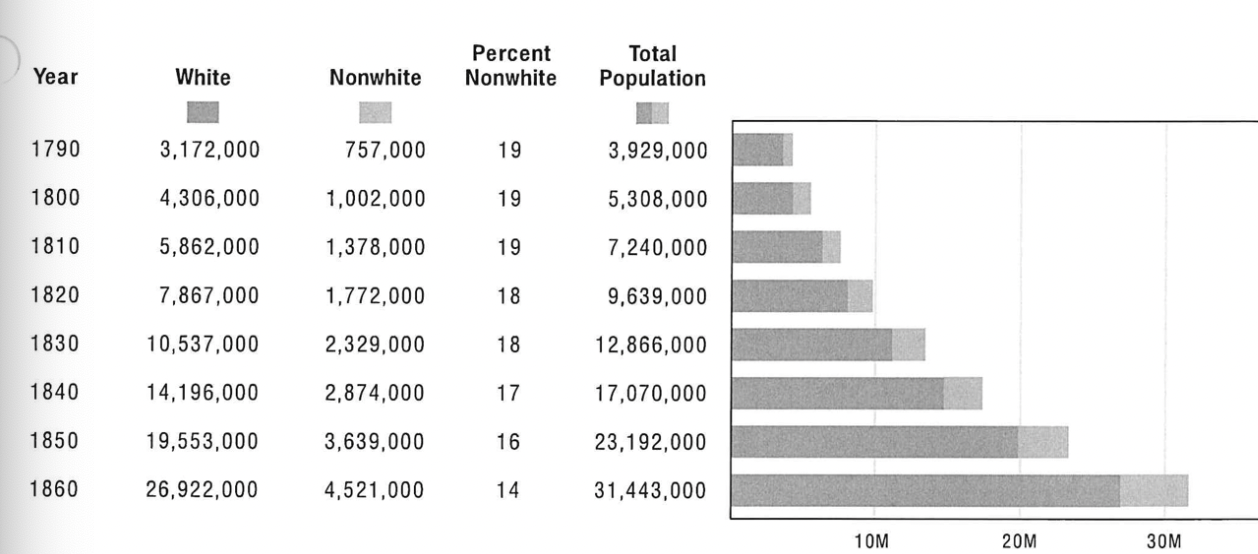
- by 1860, there were 33 American states * the USA was the 4th most populated country of the time, only behind Russia, France, and Austria.
- In 1790, only Philadelphia and New York had populations of 20,000+ * By 1860, there were 43 cities with over 20,000+
- Europe seemed to be running out of room since the population of the Old World more than doubled in the 19th century
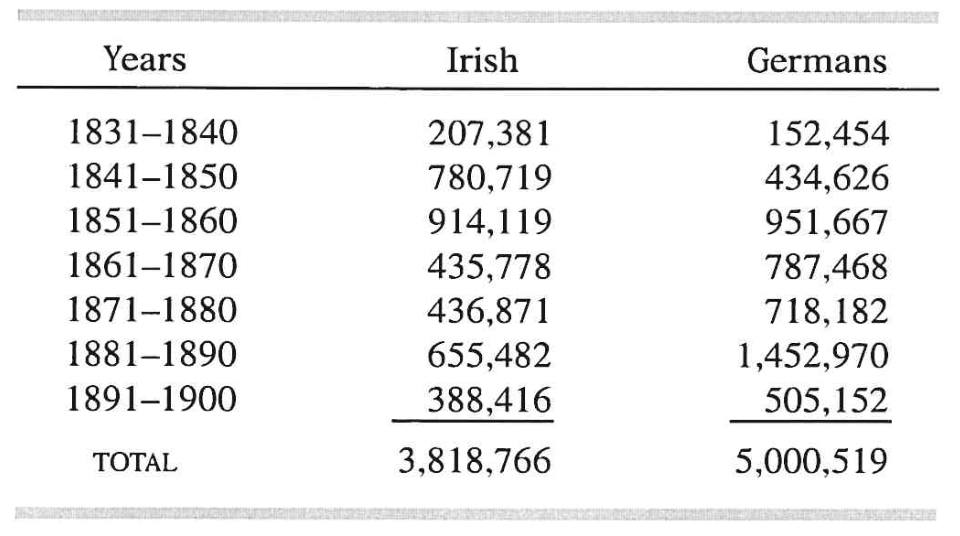
- America was called the “land of freedom and opportunity”
- transoceanic steamships meant that immigrants could come to America in 10-12 days
- about 2 million Irish people died in the potato famine, nearly 1/4 of the country’s population * Irish immigrants came to America in the “Black Forties”
- Irish were hated by native workers due to an employment scarcity, signs reading “No Irish Need Apply” (NINA) were common around factories
- The Ancient Order of Hibernians was a group of Irish founded to fight greedy landlords and later a miners’ union
- Germans tended to like Carl Schurz, a politician who hated slavery
- Germans were well educated and supported public schooling and kindergarten was their idea
- Influx of the Germans and Irish allowed Catholics to become a powerful religious group, had the goal of a separate Catholic education system
- Order of the Star Spangled Banner turned into the Know Nothing Party, nativists who wanted to deport immigrants
- Philadelphia was nicknamed The City of Brotherly Love
- Protestants and Catholics often fought
- The Amish took their name from their founder and leader, Jacob Amman
- Samuel Slater = “Father of the Factory System”. He won favor from Moses Brown (a quaker capitalist from Rhode Island). He made the first American machine for spinning cotton thread
- Eli Whitney = went to Yale, journeyed to Georgia working as a tutor and studying law, in 10 days he built a machine that separated seed from cotton fiber. Then built the cotton gin.
\