PCL WEEK 1
Lecture 1: (week 1)
What are we choosing to call unmet medical need?
In 2024 50 drugs were approved by FDA
Drug development is an expensive process
How diseases are basically particular protein where we aim our drugs to fight
Lecture 2: (week 1)
Unmet Medical Needs:
3.4 billion prescription/ year in the US
75% of visiting doctors involve prescribing medicine
Since 2000, 900 new drugs have been put over 8000 drugs are in development
First in class drug, or pioneer drugs which target protein that hasn't been targeted before
DRUG DEVELOPMENT PIPELINE (the process)
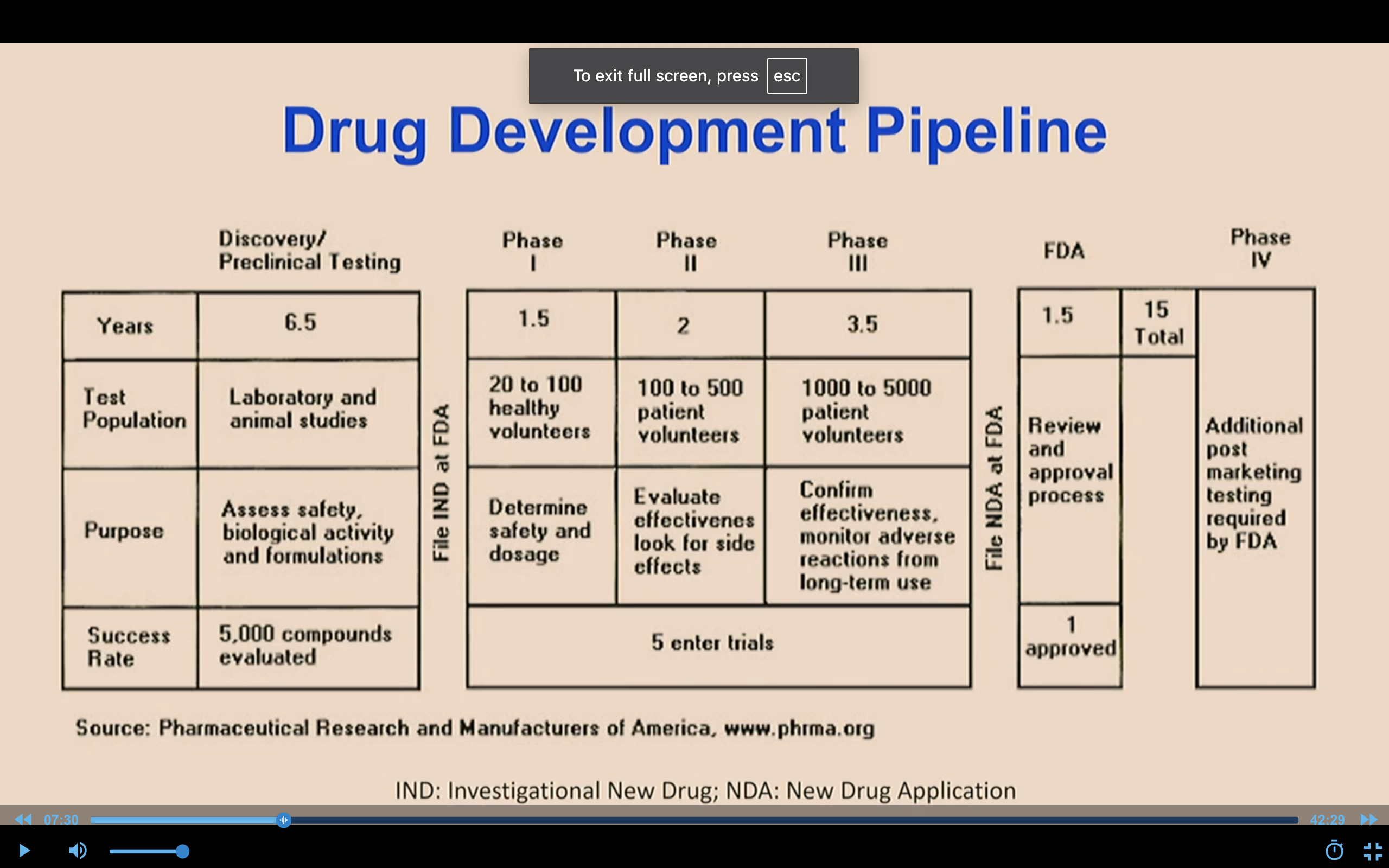
Preclinic: laboratory work to asses how safe the material is and does it work? May start with 5000 chemicals and test out what works and what doesn't
If it does then it goes to whether it can be used on human (submit request to FDA)
Phase 1= healthy volunteers to see if medication works on people who arent at risk
Only 5 chemicals made it past
Use more people
Ask FDA again and whether it can be approved and give license to company to sell
More often than not its not approved and needs more evidence
The pipeline reduces risk of exposing people to drugs that have unknown safety therefore small clinical trials with small amounts of people and then gradually increase
WHAT KIND OF DRUGS ARE BEING APPROVED
The most popular is oncology meds- cancer meds
Second is infectious disease from 2015-2019 and neurology from 2020
What should we work on though? Where should we make drugs?
Should we develop areas that already have drugs or develop areas where there arent?
WHO list of essential medications every country should have in their toolbox for emergency
Take into account: how common and deadly the disease is, efficacy and cost effective, safety of drug
Disability-adjusted life years- 1 DALY means 1 lost year of healthy life (measures how much it impacts people)
UNMET MEDICAL NEEDS:
Who decides it is unmet?
A regulatory agency looks at global evaluation
They study DALY to see what to worry about more? Eg cancer, heart disease etc
Patient advocacy groups also influence
Immense attrition (drop out) during drug development:
Number of chemical compounds you start off with vs end
Start with a lot and only 5 enter trials and 1 getting approved
Step in pipeline
Considerations: is the condition life threatening?, are patients satisfied with curren thterapy, how could a new med be better like efficacy wise? Or safety and few side effects, convenience take once a day
Drug discovery phase
Choose a disease
Identification and validation of drug target
DRUG TARGET: a molecule usually a protein involved in the disease that the drug binds to to inactivate the molecule
Figure out what chemical actually works
Disease mechanism and model
Target protein shape- can the drug actually interact with the protein with its shape
For the FDA safety has to be at least in two animals than human beings
Clinical trials
Recruiting volunteers (they all have to be approved by the ethics board)
Phase 1
Purpose: determine dosage and pharmacokinetics so how the drug moves in body
Design: slowly increase dose
Subjects: usually healthy vilunteers, sometimes with disease, patient can drop out whenever
Phase 2
To check efficacy
Subjects: Patients with disease
Design: compare treated individuals to control individuals and whether it can make it better and have a result (eg compare to other drugs in the market, or placebos which are pills with no drug to check the placebo effect)
PLACEBO EFFECT
Body response to taking what you think is a drug
Actually, brain circuits involved
Phase 2 uses blinding trials to reduce bias
Single-blind: subjects don't know who is getting treatment and the placebo
Double-blind: neither the subject nor the investigator know (but it in computer recorded so you will know)
Phase 3
Patient with disease
What is the difference between phase 2 and 3?
People don’t participate in clinical trials therefore not a lot of drugs are being developed
Drug development is a business
Patent protection gives company 20 years to make the drug and get it approved and after anyone can do it
The cost of getting a single drug to the market:
Over 2 billion dollars including cost of failure and 15 years
Dr Ian’s Video:
Gorlins syndrome:
High risk of getting skin cancer and tumour
Constant growht of basal cell carcinomas
Started in 1950 where lambs were born with one eye in their forehead
Cause was that pregnant lambs were eating something that interfered the normal pathway
This was due to cow cabbage which inhibits the SHH pathway and blocked development pathway
Constant growht of basal cell carcinomas was due to sonic hedgehog pathway
This pathway is important because it effects the division of two lobes
If the pathway stays on (overactivation) then it cause cancer
However the compound (cyclopamine) in cow cabbage can switch it off?
Cyclopamine can switch off sonic pathway
A woman with gorlins syndrome was gonna be in the clinical trial however she wanted to know what benefits she would get but she wasnt getting any so development stopped. However wasn't her or the scientists fault cause scientists have a lot of people investing and has to pay back and she wants benefit after being used too
Together, these examples underscore the SHH gene's critical role in embryonic development and how its disruption leads to profound effects across species
Reading: WHO Essential Medicines:
Essential Medicine is for the population and should be available affordable and of good quality
They are always available in sufficient amounts and doses to ensure they address the population's needs
It covers a wide range of health needs but only represents a small portion ofthe total number of medicines
Over 150 countries have an essential medicine list based on WHO’s
The idea is to have limited number of carefully selected medicines
Also controls better costs
The government makes the essential medicine list to address that nation's primary health needs depending on what disease is happening, resource availability etc
WHO’s model list is a blueprint to help the countries develop their list