PSYC 162 Week 11 (lec. 27 & 28)
The Death Penalty (Capital Punishment)
Basic Capital Punishment Statistics (U.S.)
27 U.S. states have the death penalty
But 5 states are responsible for 64% of all U.S. executions since 1976: TX, VA, OK, FL, MO
Texas alone accounts for more than 38%
At beginning of 2022, there were 2,436 prisoners on death row
Capital punishment was suspended by the U.S. Supreme Court in 1972, but it was reinstated in 1976, society got tougher on crime
US is number 1 in putting people in prison
Methods of Execution
Electric chair
For execution by the electric chair, the person is usually shaved and strapped to a chair with belts that cross the chest, groin, legs, and arms. A metal skullcap- shaped electrode is attached to the scalp and forehead over a sponge moistened with saline. A jolt of between 500 and 2000 volts, which lasts for about 30 seconds, is given.
The current surges and is then turned off, at which time the body is seen to relax. The doctors wait a few seconds for the body to cool down and then check to see if the inmate's heart is still beating.
Hanging
The neck is broken, and death comes quickly unless the free fall distance is inadequate.
This was used in the UK for many years
Firing squad
A black hood is pulled over the prisoner's head. A doctor locates the inmate's heart with a stethoscope and pins a circular white cloth target over it. The prisoner is shot through the heart by multiple marksmen. Death is almost immediate
Gas Chamber
The condemned person is strapped to a chair in an airtight chamber. Once everyone has left the chamber, the room is sealed. The warden then gives a signal to the executioner who releases hydrogen cyanide (or nitrogen) gas.
The prisoner is instructed to breathe deeply to speed up the process.
Lethal injection
Lethal drugs are injected into the prisoner who is strapped to a table.
Many people consider this the most humane way as it looks as if the person is going to sleep – this may not be the case.
The first drug paralyses all of the prisoner’s muscles, any pain that might be experienced would not be visible to an observer
Controversial if it hurts or not
The most common one
Gallup Polls
In the 60s people’s ideas were changing, leaning towards wanting the death penalty
Now about 60 to 40 in favor
More democratic states are less in favor
Men favor it more than women
Not much of an age effect
Every group is slightly more in favor of the death penalty
Gender and racial disparities in the criminal justice system
More men likely to go to prison
Black man probably less in favor of the death penalty because they’re more likely to go to prison than a white man
Demographics of Death Row (as of April, 2022)
White: 1026
Black: 987 (nowhere near population so they’re over represented)
Latino: 335
Native American: 24
Asian: 46
Women: 50
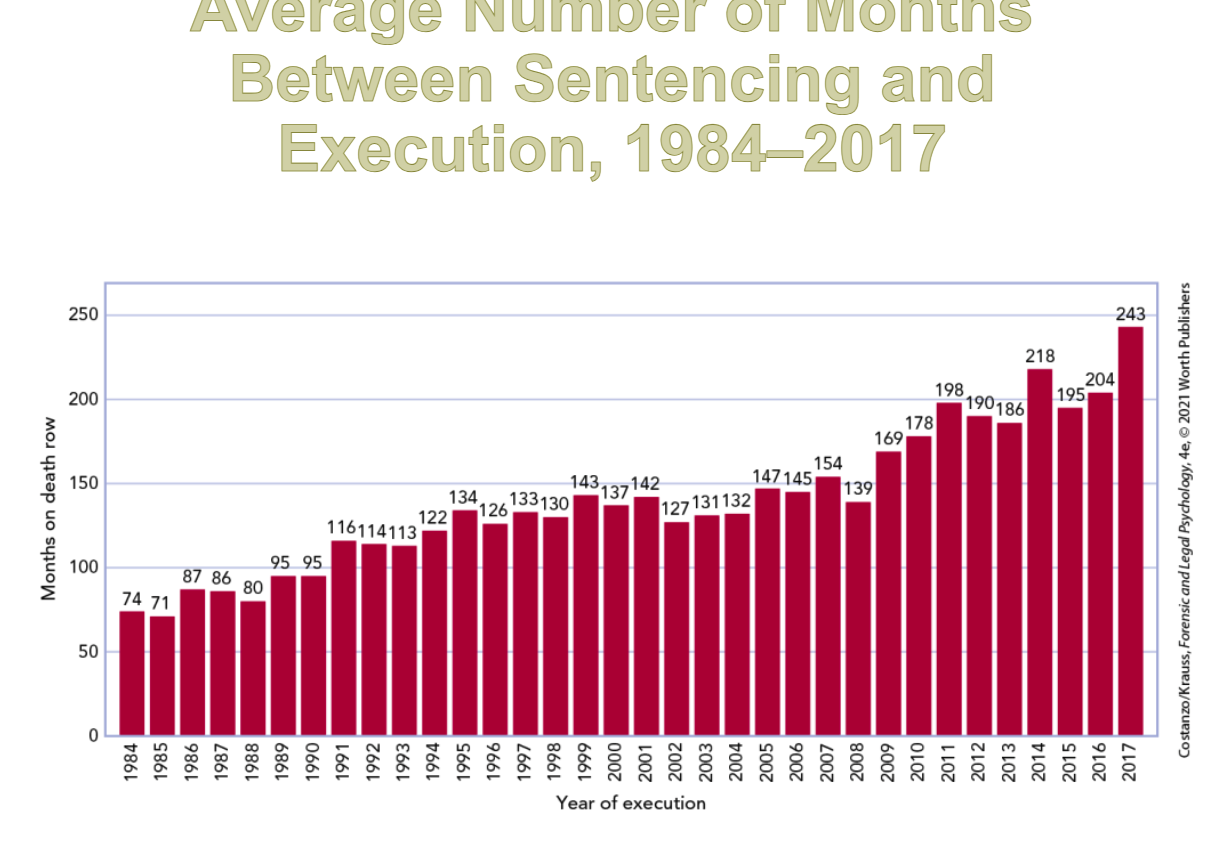
Appeals taking so long
Courts being opened
Executions in US have been going back down after 2000 → people fighting against death penalty
We’ve been in a downward trend
In 1990s crime was giung down
Research on Capital Murder Trials
Death qualification of jurors
During voir dire jurors asked if they can vote for the death penalty as result of guilty plea
Morgan v. Illinois (1992): Substantially impaired jurors excused
Lockhart v. McCree (1986): Research on death qualification reviewed and dismissed
Death qualified jurors more likely to convict
Ethical Issues in Competency for Execution (CFE)
You have to be competent to be executed
Unconstitutional to execute mentally incompetent inmate sentenced to die
Condemned prisoner must have rational understanding of execution reason
More specifically: prisoner’s ability to rationally understand connection between their crime and approaching execution
They should be able to understand why they’re being executed
Juveniles and the Death Penalty
The United States Supreme Court prohibits execution for crimes committed at the age of fifteen or younger.
Nineteen states have laws permitting the execution of persons who committed crimes at sixteen or seventeen.
Since 1973, 226 juvenile death sentences have been imposed.
To date, 22 juvenile offenders have been executed and 82 remain on death row.
Executed when they’re no longer juveniles
Should We Execute the Elderly?
Most inmates die of natural causes on death row before they are sent to the execution chamber
People more likely to die on death row than by execution because of long delays
Long delays due to appeal process in capital cases
Graying of death row inmates presents legal and ethical challenges
Is it cruel to keep someone under threat of death for extended period of time (often with long periods of solitary confinement)?
Are aging and disability relevant in consideration of commuting a death sentence?
The Case of Ray Krone
Death row sentenced people about 5% of them are innocent, smaller percentage of those who are actually executed and are innocent
Bitemark evidence got him convicted of sexually assaulting and kidnapping a women
He was sentenced to death and then he got a retrial → found guilty
Then they found DNA evidence of some other guy and he was exonerated
Arson Detection
Trained experts sift through the debris after a fire to determine how it was caused
Sometimes, they conclude it was arson
How accurate are these experts?
They’re not that good at this
The Case of Cameron Todd Willingham
Thought he set the fire killing his 3 daughters, but he was the only one who survived
Think he executed him while he was innocent
They have found no evidence of arson anymore
He was charged for other things like beating his wife when she was pregnant
Lab tests found lighter fluid
Guy still thinks he was guilty and it wasn’t an accident
Other guy thinks it was a typical fire
They think that he worshipped satan cus he liked heavy metal
He never confessed to killing his children
John Jackson still stand by his case