PSYC205 - week 5 - L9
Language Development in Childhood - Sounds to Words
Course: PSYC205 IWeek: 5Lecture Date: Monday, 4th November 2024
Learning Objectives
By the end of this week’s lectures and readings, you should understand and be able to describe:
What language acquisition involves, including features of language development and the challenges faced.
The main stages of language development, detailing what children acquire, when, and how.
Major theoretical explanations of language development and their efficacy.
Discussion Point
What is the role of nature and nurture in language development?
Structure of the Lecture
What does language acquisition involve?
Symbolism: conventional vs arbitrary
Rules vs creativity
Comprehension vs production
Components of language
Sounds
Vocabulary and semantics
Learning action words
Symbolism: Conventional and Arbitrary
Languages function as symbolic systems.
Symbolic nature: Sounds and word-forms represent meanings.
Example:
"I cooked pasta" vs. "I will cook pasta"
Meaning of "pasta" in context.
Symbols:
Conventional: Used by all speakers consistently.
Arbitrary: No inherent relation between word form and meaning.
Different languages employ different terms for the same object (e.g., 'book' in various languages).
Rules vs Creativity
Language learning incorporates both rule learning and creativity.
Children must learn rules for successful communication, as in sentence structure.
Example:
Correct: "Tom chased Jerry"
Incorrect: "Jerry chased Tom"
Creative expression is necessary for composing novel ideas.
Example:
"A shark chased the Octonauts"
Demonstrates language versatility.
Comprehension vs Production
Children usually understand more than they say.
Production often lags due to:
Articulation challenges
Memory constraints
Importance: Links to competence vs performance in language development.
Components of Language
Sounds (Phonology)
Vocabulary (Lexicon)
Word Meanings (Semantics)
Word Transformations (Morphology)
Sentences (Syntax)
Communicative Acts (Pragmatics)
Identifying Sounds
Categorisation
units of sound are phonemes - sounds which are meaningfully distinct
compare these words :
bat, cat, hat, vat
infants perceive (native and non native) sounds categorically at 4 and 1 month of age (Eimas et al 1971)
Tuning in
Werker and Tees (1984): cross-language speech perception
tested 6-12 month olds discrimination of different sounds - English, Hindi, Salish
conditioned head-turn procedure (habituation and discrimination) : on certain sounds a bunny appears so they turn their head
RESULTS
sensitivity to non-native sounds declines with age
fewer 12 month olds discriminate non-English sounds than do 6 month olds
older children have tuned in to their native sound system - don’t know the difference
Speech Production
0-2 months: Reflexive vocalization (
crying, fussing, etc.)
2-4 months: Cooing and laughter
4-7 months: Vocal play and initial babbling
7+ months: Canonical babbling (reduplicated syllables)
12-18 months: First words emerge.
7-8 years : all sounds/ sound clusters acquired
Think for a moment – what do these examples tell us about how competence and performance interact in language development?
“One of us, for instance, spoke to a child who called his inflated plastic fish a fis. In imitation of the child’s pronunciation, the observer said: “This is your fis?” “No,” said the child, “my fis.” He continued to reject the adult’s pronunciation until he was told, “This is your fish.” “Yes,” he said, “my fis.” (Berko & Brown, 160:531)
Father: Say “jump.”
Child: Dup.
Father: No, “jump.”
Child: Dup.
Father: No, “jummmp.”
Child: Only Daddy can say dup! (Smith, 1973:10)
Clark (2009, 69)
Acquiring Words
Reference Problem: words refer to things, have meaning
Children as young as 6-9 months can recognize familiar words (Bergelson & Swingely, 2012).
Typically solved by second year of life - children experience the naming insight
once they solve this problem, vocab rapidly grows - the vocabulary spurt
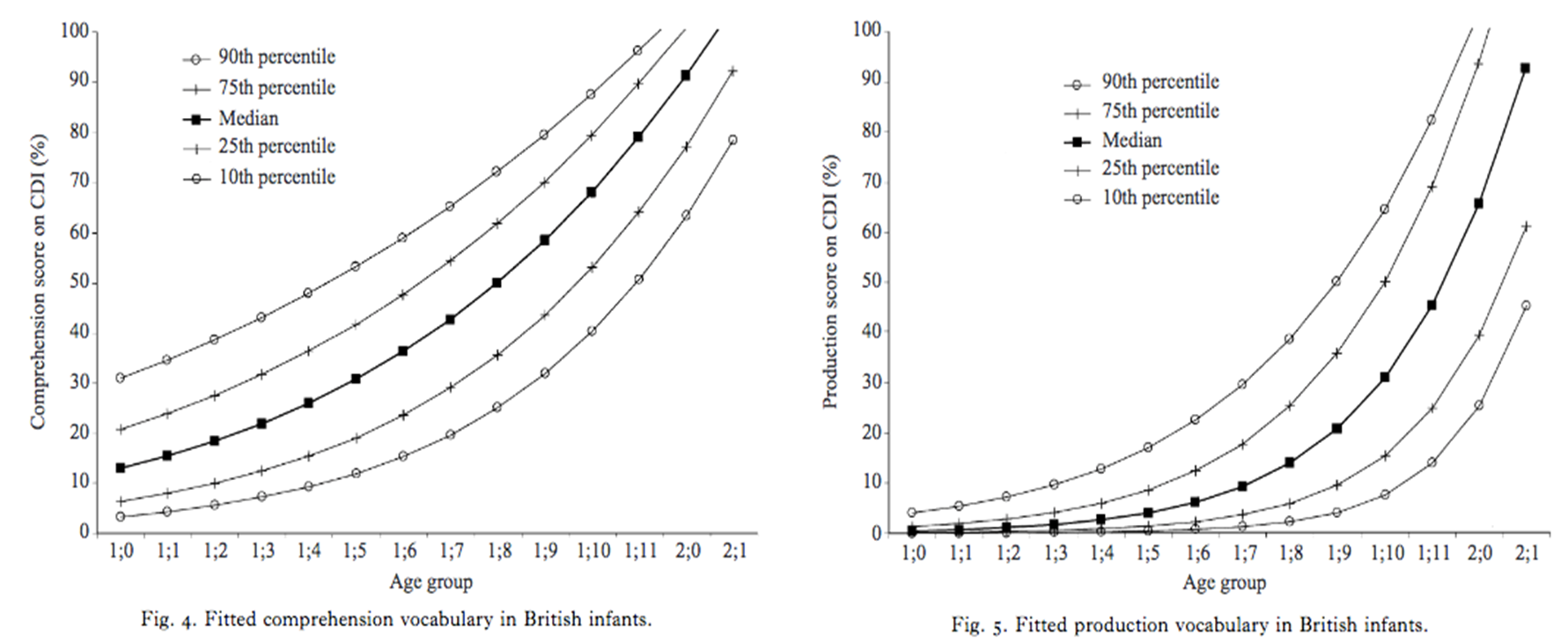
Extension Problem: Understanding the limits of word meanings.
Vocabulary spurt occurs typically in the second year of life as children experience naming insight.
Constraining Word Meanings
Extension Problem: Words can refer to individuals/instances and also to categories.
Example: "dog" can refer to a specific dog as well as the general category of dogs.
‘dog’ does not refer to other furry things or things with 4 legs : e.g a cat or a table
Typical errors include:
Underextension: child uses “dog” to just refer to their family pet, not all dogs
Overextension: Labelling all four-legged animals as 'dogs'.
Overlap Errors: child says ‘dog’ to refer to pet dogs, cats, cows, and bears but not toy dogs.
mismatch errors : child says “dog” to refer to their teddy bear
Learning Action Words
English-speaking children’s first words tend to be nouns – names for concrete objects.
What about other words, e.g. action words (verbs)?
Verbs do not represent concrete things, verbs represent events which are momentary and complex
Syntactic bootstrapping hypothesis :
children use their knowledge of language to learn language
there is a direct correspondence between the structure of events and syntactic structure of events and syntactic structure that expresses events
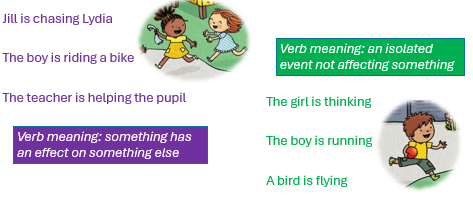
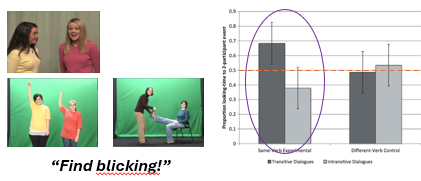
Messenger, Yuan and Fisher (2015)
22 months olds tested
dialogue training followed by preferential looking test
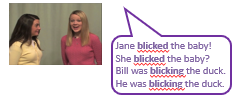
present child with new made up word (“blicking"/”blicked”)
hear it in multiple contexts
children are presented different videos of situations : a one person event (individually circling arms) or two person event (a girl wagging another girls leg)
children tended to look longer at the two person event
conclusions
Consistent with syntactic bootstrapping hypothesis: children can use language to learn basic meanings for new words.
Further implication: by 2 years, children must be able to make sense of basic syntax (how words are combined in sentences).
Combining Words in Sentences
12-24 months: One-word stage
One-word utterances = holophrases – mean more than one word
24 months+: Two-word stage
telegraphic speech – function words and morphemes omitted
~30 months+ : Three-four word + stage
Children beginning to use morphology to signal number and tense
Children make overregularization errors
3-4 years+: Increasingly long and complex sentences
Are these rule-based or experience-based?
Conclusion
This week will culminate with reading suggestions shared at the end of the Thursday lecture.
All resources and slides for the week will be available on Moodle.