In-Depth Notes on Nervous System and Action Potentials
Nervous System Overview
Cell Types and Structures
Understand different types of cells involved in the nervous system.
Recognize associated tissue types and the structural components of nerve cells.
-
Pre-Lab Questions
Familiarize yourself with pre-lab questions regarding action potentials and neuronal signaling.
Equilibrium Potential
Definition: Equilibrium potential is the membrane potential at which there is no net movement of a particular ion across the membrane.
Ion Movement: Ions move above and below this point due to gradients created by differences in concentration and permeability.
Action Potential Phases
Phases of Action Potential:
Depolarization: Membrane potential becomes less negative due to sodium influx.
Repolarization: Membrane potential returns to a negative value due to potassium efflux.
Hyperpolarization/Undershoot: Membrane potential becomes more negative than resting potential temporarily.
Ion Involvement:
Na⁺ ions: Enter the cell during depolarization through voltage-gated sodium channels.
K⁺ ions: Exit the cell during repolarization through voltage-gated potassium channels.
Membrane Potential Changes:
Understand how the membrane potential fluctuates through each phase of the action potential, including recovery back to resting potential.
Neuronal Signaling
Neurons propagate and send messages both chemically and electrically. Throughout the neuron itself from the dendrites and cell body (soma) signals are sent via changes in the electrical charge of the membrane down the axon and to the axon terminal(s). These electric signals are mediated by the movement of ions into and out of the cell. When the signal reaches the axon terminal(s) the signal changes to chemical when the pre-synaptic axon terminals release neurotransmitters into the synaptic cleft which are taken up or bound by receptors on the postsynaptic terminal of the next neuron or muscle cell.

Mechanisms of Signaling:
Messages are transmitted both chemically and electrically.
Electrical Messages: Involve changes in the charge across the cell membrane due to ion movement.
Chemical Messages: Involve neurotransmitters that are released and taken up in the synaptic cleft.
Resting State Characteristics:
Neurons typically have a negative resting membrane potential, with a higher concentration of Na⁺ outside and K⁺ inside the cell.
The resting state of the neuron is that the membrane has a negative charge (-50 to -70mV generally in mammalian neurons)
In the resting state, there are more positively charged ions outside the cell than are found inside the cell. The resting potential is calculated as the internal voltage minus the external voltage, so having a larger amount of positively charged ions outside the cell than inside the cell results in a negative resting potential.
Sodium (Na+) and Potassium (K+) ions establish the charge gradient.

Ion Channels in Neuronal Signaling
Channel Functionality:
Channels in the cell membrane (of all cells) allow specific molecules through the membrane that cannot move through the membrane unassisted.
While there are channels that allow a variety of molecules through, neuronal ion channels tend to be specific to their target ion. This is what allows action potentials to occur.
Channels may be always open (potassium leak channels for example) or may be gated either through voltage induced conformational changes, or through ligand mediated conformational changes.

Channels form openings in the lipid bilayer, allowing specific ions to pass through.
Types of Channels:
Leak Channels: Always open and allow passive ion flow.
Gated Channels: Open under specific conditions in response to stimuli.
Voltage-Gated Ion Channels:
Voltage gated ion channels are present in axons and skeletal muscles and are critical to the propagation of action potentials and muscle contractions.
These channels respond to local changes in the membrane potential of the cell.
So long as the is polarized, the inside is more negatively charged than the outside resulting in a negative resting membrane potential. If the local inside of the cell becomes less negative, a conformational change occurs for the local voltage gated channels and the channel opens to allow the target ion to move based on the concentration gradient.
This is what enables the cell to fire an action potential when the threshold is reached and enough ion channels are in the open configuration.

The voltage gated sodium channel and voltage gated potassium channels shown in the resting membrane state.
Note that the sodium channel has the activation gate closed, but the inactivation gate is open.
The potassium channel has the activation gate closed.

Present in neuronal axons and skeletal muscles.
Respond to changes in membrane potential, allowing action potentials to occur.
Channel States: Closed, open, or inactivated states define ion flow.
Action Potential Mechanism
During action potential propagation, in the initial location, the stimulus causes local Sodium channels to open which results in an influx of Na+ ions into the cell and causes the membrane to depolarize.
Some of this depolarizing current will passively flow through the myelinated internode of the axon, causing localized depolarization at the next Node of Ranvier which propagates the next passive flow.
Meanwhile, back at the stimulus site, The NA+ channels inactivate, and the potassium (K+) channels open to repolarize the membrane

Steps of Action Potential Firing:The voltage gated sodium channel and voltage gated potassium channels shown in the resting membrane state.
Note that the sodium channel has the activation gate closed, but the inactivation gate is open.
The potassium channel has the activation gate closed.

Sodium Channels Open: Membrane potential reaches threshold.
Sodium Channels Inactivate: Blocks Na⁺ entry after a brief interval.
Potassium Channels Open: K⁺ exits the cell to repolarize.
Chemical and Electrical Gradients: This allows sodium ions to flow into the cell mediated by both the concentration gradient and the charge gradient

Sodium moves in due to both gradients; potassium exits primarily due to the chemical gradient.
• The open sodium channel allows sodium ions into the cell.
Sodium enters due to both the chemical and electrical gradients

Ion Conductance and Membrane Potential Correlation
Understanding of the relationship between ion channel activity and changes in membrane potential throughout the action potential phases.
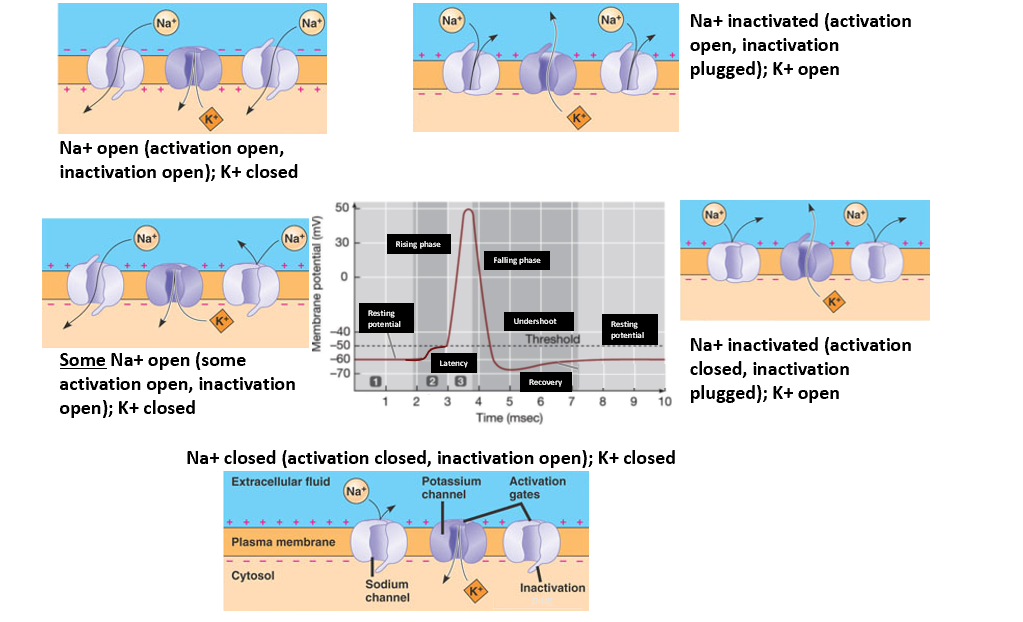
Once we reach threshold (here -50mV) there will be an action potential causing the membrane potential to become positive. Falling phase occurs as the sodium channels are shut and the potassium channels are opened for repolarization.
Undershoot or hyperpolarization occurs due to the time it takes the potassium channels to shut again and during recovery phase the sodium potassium pump works to return the ion concentrations to resting.

Initially during the resting phase, the sodium channels have the activation gate closed, inactivation gate open and the potassium channel has its activation gate closed.
During latency, some sodium channels have their activation gates open, but others are closed.
Once we reach threshold, all sodium activation gates and inactivation gates are open allowing for free movement of the sodium ions.
Eventually, the slower sodium inactivation gates close, and the potassium activation gates open. This starts the falling phase.
As the potassium gates remain open, the membrane repolarizes, but the sodium gates all remain closed. This is also when hyperpolarization (undershoot) occurs.
During recovery, all channel gates are closed and the sodium potassium pump works to bring the membrane potential back to resting. At that point, the sodium channels will return to the activation closed, inactivation open configuration.

STUDY GUIDE
Resting State Characteristics:
Neurons typically have a negative resting membrane potential, generally between -50 to -70 mV in mammalian neurons.
In the resting state, there are more positively charged ions (Na⁺) outside the cell than inside (K⁺), resulting in a negative charge across the membrane.
Sodium (Na⁺) and Potassium (K⁺) ions establish this charge gradient.
Phases of Action Potential:
Depolarization:
Membrane potential becomes less negative due to the influx of Na⁺ ions through voltage-gated sodium channels.
Sodium channels open at this stage, which leads to a rapid increase in membrane potential.
Repolarization:
Membrane potential returns to a negative value due to the outflow of K⁺ ions through voltage-gated potassium channels.
Sodium channels inactivate, blocking further Na⁺ entry while K⁺ channels open.
Hyperpolarization/Undershoot:
Membrane potential becomes more negative than the resting potential temporarily.
Potassium channels remain open, allowing K⁺ to exit the cell.
Channel States at Each Stage:
Resting State:
Sodium channels: Activation gate closed, Inactivation gate open.
Potassium channels: Closed.
Depolarization:
Sodium channels: Activation and inactivation gates open.
Potassium channels: Closed.
Repolarization:
Sodium channels: Inactivation gate closed (no Na⁺ entry).
Potassium channels: Activation gates open (K⁺ exits).
Hyperpolarization/Undershoot:
Sodium channels: Activation closed, Inactivation closed.
Potassium channels: Remain open, causing further K⁺ exit.
Equilibrium potential is the membrane potential at which there is no net movement of a particular ion across the membrane. Ions move above and below this point due to gradients created by differences in concentration and permeability.
Different Ions Involved:
Sodium (Na⁺):
Involved in depolarization during action potentials. Enters the neuron through voltage-gated sodium channels.
Potassium (K⁺):
Involved in repolarization and hyperpolarization. Exits the neuron through voltage-gated potassium channels.
Types of Channels:
Leak Channels:
Always open and permit passive ion flow.
Gated Channels:
Open under specific conditions in response to stimuli.
Voltage-Gated Ion Channels:
Present in axons and skeletal muscles, essential for the propagation of action potentials and muscle contractions. Respond to local changes in the membrane potential.
Sodium Channels: Open for sodium ions during depolarization and inactivate shortly after.
Potassium Channels: Open to allow potassium ions to exit during repolarization.