Methods
Authorship
Nature: The list of authors should accurately illustrate who contributed to the work and how. All those listed as authors should qualify for authorship according to the following criteria:
Have made substantial contributions to conception and design, or acquisition of data, or analysis and interpretation of data
Been involved in drafting the manuscript or revising it critically for important intellectual content
Given final approval of the version to be published. Each author should have participated sufficiently in the work to take public responsibility for appropriate portions of the content
Agreed to be accountable for all aspects of the work in ensuring that questions related to the accuracy or integrity of any part of the work are appropriately investigated and resolved
contributions from anyone who does not meet the criteria for authorship should be listed, with permission from the contributor in an Acknowledgments section
First author: associate you with the finding
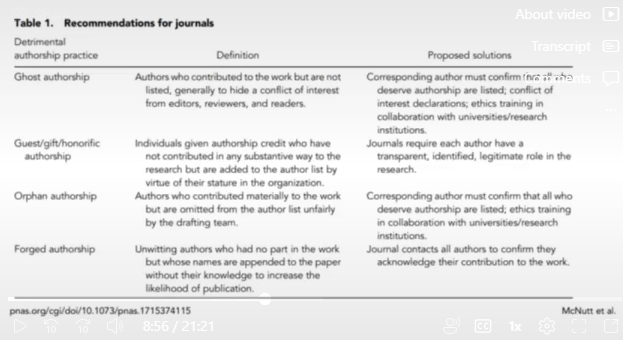
Ghost authorship, Guest/gift/honorific authorship/orphan authorship, forged authorship
First author: typically the person who did the most work on the experiments and did the bulk of the writing
last author is usually the senior scientist in the lab (e.g. supervisor)
middle authorship: most to least work
When everyone contributes equally, consider listing the authors in alphabetical order
Lab Books
complete record of experiments, reagents, data, results, and thoughts
can be written in any person or tense
passed on to other researchers
legal document (can be used for patent applications etc.)
discipline dependent
waterproof for field work
hard cover or electronic for lab work
meant to keep up to date
complete as you get data
include everything (even experiments that don’t work)
details are discipline-dependent (include location for field work but not for molecular biology)
if a physical book, must include a table of contents on the first couple of pages
include all protocols, results, figures
electronic books can contain hyperlinks
each page should be numbered
all entries must be dated
all entries require a detailed title, figures and tables need a legend
the protocol of …
we use Benchling (digital lab book)
Each entry needs:
detailed title (e.g. restriction digest of plasmid P blue script with eco R1)
this technique of this with this
date
protocols require a statement of purpose (1 sentence) above them
shows why we are performing technique (ligation, transformation
results require a BRIEF analysis (1-2 sentences)
entries will be checked weekly
Field work Unit
notes can become damaged or lost
take photos of notes as electronic backups
you will embed your photos in a word file and submit your lab notes as a pdf
will do this 3 times (each worth 1%)
each entry needs:
date and detailed location of sampling
methods of sample collection
notes about weather and time of day
results require a BRIEF analysis (1-2 sentences)
entries will be checked weekly
does not require purpose
Structure of a research paper
scientific papers are published in journals
thousands of scientific papers published every year, in thousands of different scientific journals
it is not possible for a scientist to read every paper every year, so it is important to make your paper grab the audience’s attention so it DOES get read
emphasize the title and abstract
papers have different structures
The Journal of Experimental Biology: use as referring format as it has a paper structure most common in scientific research
no references and no statistics in abstract
references appear alphabetically by last name of first author
article numbers are similar to page numbers (for fully online texts)
journals’ decision to follow different formats
Paper Structure
Title, Abstract, Introduction, Materials and Methods, Results, Discussion, Acknowledgements, References
will be writing a review paper based on papers we have read
Poster Structure does not include abstract (includes everything else)
General notes
when referring to a species, use its common name with its scientific name on first usage within the text
after, can use its common name throughout
italicize the scientific name
use the scientific name in the title, abstract, and on first usage in the introduction
title and abstract need to be able to stand alone, because many readers read no further
Example: “We studied this in bluegill (Lepomis macrochirus). In bluegill…”
use scientific name (binomial nomenclature with uppercase first letter in genus only)
use scientific name in title & abstract (better for search)
Paragraph structure
editors find it easy to help writers improve their work when the ideas are easy to follow
Topic sentence that provides context
content that is all related (use transition words)
conclusion that summarizes the main idea
each paragraph should have only one idea!
develop a skeleton of your paper before filling it in with details
write a topic sentence for each paragraph, then list bullet points supporting that topic sentence with what will be the content of the paragraph
helps recognize how ideas fit together
Title: clear and interesting, avoid long titles, witty (can be effective, but not everyone will get it, play on words work well), include a key result or list the hypothesis tested
Abstract: short summary of the paper
typically includes sections from each section in the body of the paper
give context of the paper’s research questions (why do scientists care, or what remains to be learned) - introduction
give the research question or hypothesis - introduction
briefly describe the approach to addressing the question - methods
general approach
don’t need to go into as much detail
describe the findings of the experiment - results
do not give statistics; only state in words what the experiment found
put the findings into context: how does this address the hypothesis, advance the field, resolve an unanswered question, or how can these findings be applied by scientists/policymakers/doctors/engineers - discussion
most of the time, the abstract does not have references
there are some exceptions (different journals with different formats, or if the paper is being written to criticize or re-test one paper’s results)
those exceptions are unlikely to come up during your undergrad
Nature is one of the top journals in science: they have an outline for an abstract
abstracts are longer than other journals, but the general idea is correct
Introduction
give the context for the research question and what is already known — takes several paragraphs
give the objective of the research, including the research question — the reader might be able to guess your research question after having read all the context
state the hypothesis — 1-2 sentences
state the predictions — 1-2 sentences, fitting with the hypothesis and the experimental design
start: broad, end of intro: narrow
broad: discuss the field as a whole, drawing on theory
narrower: describe what is already known from other species
more specific: what remains to be learned, and justify your choices of study species, what category of treatments you are using, location, timing
most specific: give your hypothesis and predictions
Materials and Methods
describe what you did in a way that a reader understands what you did and could repeat the experiment
mention where the uniquely important equipment was acquired
describe your statistical methods, including what the dependent and independent variables are
do not give statistics until the results section
if you excluded any data, explain why here
might include references to studies that used methods similar to your own
references help support your choices and may mean that you do not have to repeat every detail
Results
discuss what you found in your experiment
typically includes a sentence that describes the results of a statistical test, then the result of the test in brackets
avoid interpreting the biological meaning of the results here — such interpretation belongs in the Discussion
you can interpret if the statistics are significant
claim (t = ??, df = ??, P = ???; Fig. 1)
list sample sizes here
try to include a narrative for your results
becomes more important once you have several tests to report on within a single study
easier to write if you put tests for similar questions together in the same paragraph
if you had a set of experiments on the effect of temperature and another set of experiments on the effect of moisture levels, report them in different paragraphs
present your results as a table or a figure (don’t do both for one thing)
reference figure in text
figure captions should appear BELOW the graph, not above
table captions appear ABOVE the table
Discussion
do the results support the hypothesis or not?
explain why
use biological explanations rather than criticizing your own methodology
perhaps there is something different about the population you studied than what you had used to set up your hypothesis
compare to other studies (with references) that found something similar or different
do not include any statistics in your Discussion
why should we care about these results
did this experiment lead to more questions? we can use those to think of future directions
why we should care about these results
how would other scientists, policymakers, doctors, or engineers use this information
Acknowledgements
list the people & organizations that supported your work, and briefly describe how they helped
consider listing the TA’s and technicians
it is your responsibility to learn their names!
References
different journals have different referencing formats
key idea is that the reader is able to look up other research that is relevant to your paper
Journal of Experimental Biology: references are listed alphabetically by last name of first author
Within-text References
include the reference once after the first sentence, and then word the subsequent sentences to make it clear that you are still referring to the study
EX: “Hain and colleagues (2017) found that guppies recognize relatives. In that study, they found that guppies like to hang out with related fish. Those fish were happy.”