Ecology Final Review
C3 Pathway
- %%most common%% - most plants ~90%
- light independent reaction
* but occurs in the presence and absence of light
* occurs mostly in the day when NADPH and ATP are abundant - northern grass
* wheat
* rice
* barley oats
* rye
* ferns
* algae
* gymnosperms
* bryophytes - mesophyll cell
- fix C one time
- enzyme: ribulose 1,5 - bisphosphate carboxylase oxygenase (RuBisCo) (RuBP(SC))
* takes Co2 and O2 and attaches it to RuB - plants have high photorespiration rate
* low water use efficiency (Wlie)
* optimum temp is 20-25 degrees C (68-77F) - %%C3 reactions occur in the stroma of the chloroplasts in the mesophyll cells%%
- PGA - phosphoglyceric acid (3 carbon compound)
- Step 1: c-fixation
* RuBisCo attaches CO2 to RuBP and creates PGA 2x - Step 2: Reduction
* GAP (glyceraldehyde phosphate), PGAL (phosphoglyceraldehyde), G3P (glyceraldehyde 3-phosphate)
* ATP, NADH
* Sugar (need to repeat process 6 times to get a 6C sugar) - Step 3: Regeneration
* ATP - photorespiration: competitive reaction with photosynthesis
- Calvin cycle:
- concentration ratio CO2/O2
- 25-50% rate of photorespiration
- higher temp → increases O2 affinity
- higher temp → lower sugar reduction in C3 plant
* more O2 used
* more photorespiration - Water use efficiency
* ratio of the rate of CO2 fixation to water loss by transpiration
* low bc transpiration rate is high
\
C3 Pathway Additional Explanation
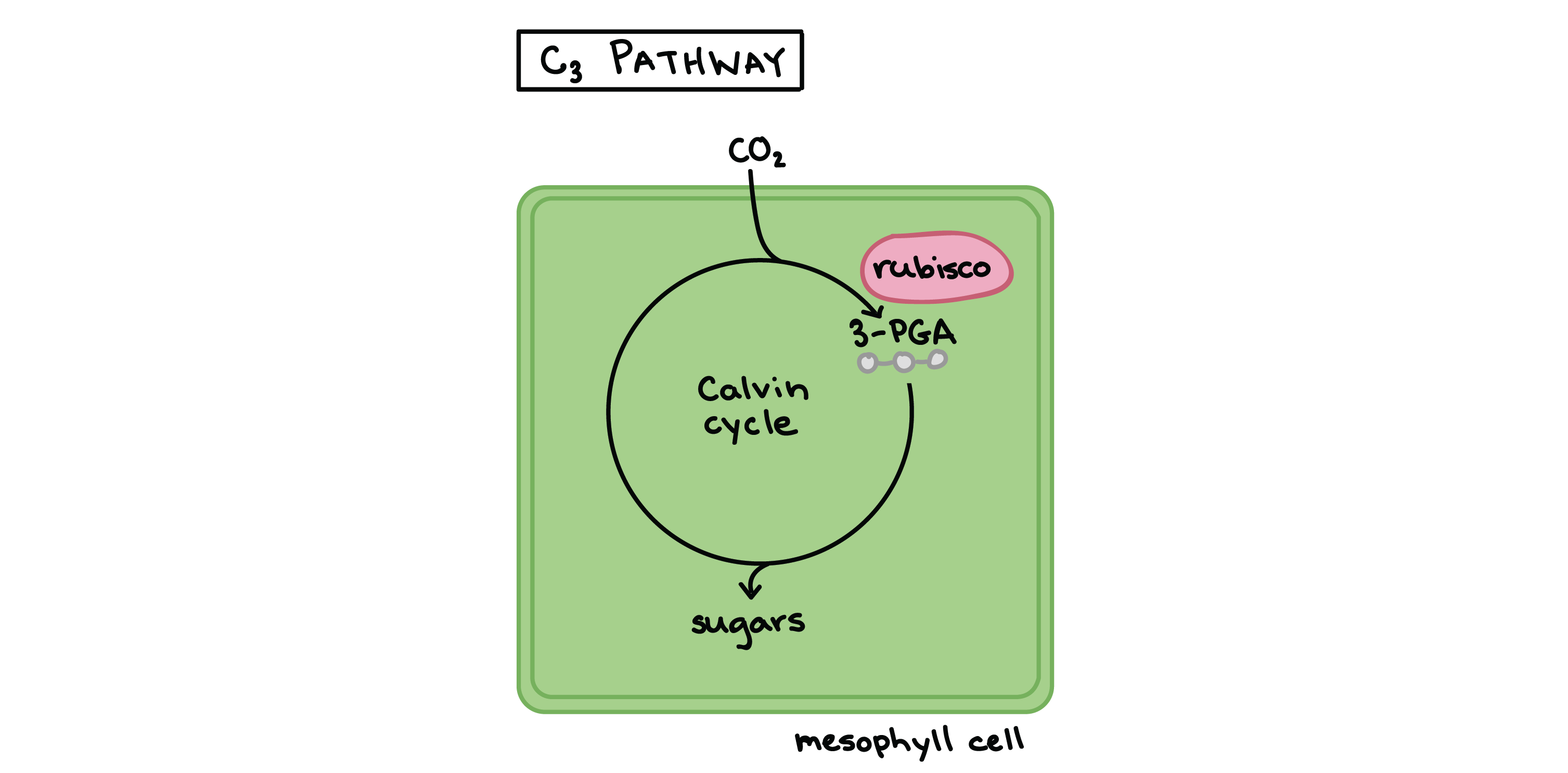
- C3 plants
* one that does not have photosynthetic adaptations to reduce photorespiration - Calvin Cycle: chemical reactions by plants to reduce CO2 and other compounds into glucose
* results in the three-carbon compound (3-PGA)
* Calvin cycle steps
* \
1. Carbon fixation
* reduces CO2 using RuBisCO
* CO2 binds to RuBP which is called carbon fixation
* forms two-three carbon molecules of phosphoglycerate (3-PGA)
* the enzyme that makes this happen is ribulose bisphosphate carboxylase/oxygenase (RuBisCO)
* \
2. Reduction
* 3-PGA molecules are converted into sugar - glucose
* obtained energy from ATP and NADPH
* these are formed during light-dependent reactions of photosynthesis
* energy from ATP and NADPH transferred to sugars
* electrons are transferred to 3-PGA molecules to form glyceraldehyde-3 phosphate (G3P)
* \
3. Regeneration
* requires ATP
* some G3P molecules used to produce glucose
* others recycled to regenerate the RuBP acceptor - Products of the C3 cycle
* ONE @@carbon molecule@@ is fixed at each calvin cycle turn
* ONE %%glyceraldehyde-3 phosphate%% (G3P) is created in three turns of the calvin cycle
* TWO ^^glyceraldehyde-3 phosphate^^ combine to form ONE ^^glucose molecule^^
* THREE ==ATP== and TWO ==NADH== used during reduction of 3-phosphoglyceric acid to glyceraldehyde-3 phosphate and in the regeneration of RuBP
* END PRODUCTS: EIGHTEEN and TWELVE are consumed to produce ONE
\
C4 Pathway
- 3% terrestrial
- southern grasses: corn, sugarcane, sorghum, millet
- Sedges, shrubs
- includes the calvin cycle
- TWO TYPES OF CELLS INVOLVED
* mesophyll cell
* bundle sheath cell - Fix carbon TWICE
* RuBisCO --- takes CO2 and attaches it to RuBP to produce PGA
* PEPcarboxylate (PEPCO)
* PEP - phosphoenol pyruvate (3C0
* operates in the mesophyll cell (carbon fixation)
* low photorespiration rates → increase yield and increase sugar
* higher water use efficiency (WUE) - optimum temp is higher temps 30-50C
* distinct advantage over C3 plants in warmer and drier habitats
\
CAM Pathway
- Crassulacean Acid Metabolism
- xerophytes typically use this pathway
* plant adapted for survival in arid habitats
* includes: cacti, crassulaceae (stonecrop plant family), agave, cactus-like euphorbs (like succulents), pineapples - only in mesophyll cell (like C3 pathway)
- fix carbon TWICE (like C4 pathway)
* use two different enzymes
* one using RuBisCo (O2 and CO2)
* PEP Carboxylate (PEPCO) - CO2 - low transpiration rate
* plants live in harsh dry environments and don’t want to dry out - optimum temperature
* 35C+ - BIG DIFF THAN C3 AND C4 PATHWAY: %%CO2 is fixed initially at NIGHT%%
- change of pH between night and day time
- pH decreases at night (4-5) and increases in the day (6-7)
- some of these plants are %%obligate%%
* only one way to fix carbon dioxide (which is at night) - facultative - options
* revert to one calvin cycle
Similarities between: C4 and CAM Pathway
- both use malic acid as intermediate
- both fix carbon twice
- RuBisCo, PEPCO
\
Differences between C4 and CAM
- C4- Two cells involved (mesophyll cells and bundle sheath cells)
* CAM- One cell (mesophyll cell) - C4 Plants enzyme- mesophyll cell (PEPCO) bundle sheath cell (RuBisCo)
* CAM enzyme- 1 cell (Mesophyll cell) at night PEPCO enzyme is operating; during day RuBisCo enzyme is operating - C4 plants fix CO2 only in day
* CAM fix CO2 night (PEPCO)
* CAM fix CO2 day (RuBisCo - C4 spatial separation
* initial CO2 fixation - mesophyll PEPCO
* Calvin cycle (sugar) - BSB, RuBisCo
* CAM - temporal separation (all happening in mesophyll cell)
* inition CO2 fixation - night
* Calvin cycle (sugar) - day
Helpful links:
- https://byjus.com/biology/calvin-cycle/
- https://www.khanacademy.org/science/biology/photosynthesis-in-plants/photorespiration--c3-c4-cam-plants/a/c3-c4-and-cam-plants-agriculture
Plants response to too much water
- Stresses
* limited gas exchange in submerged tissues
* accumulation of toxic substances in soil due to anaerobic conditions - Adaptations
* Aerenchyma (can be party of a normal development of a plant; or can be induced by stressors)
* interconnected gas filled chambers throughout the plants - straw, snorkel
* helps ventilate the plant
* can be in stem, root, leaf, etc
* Adventitious roots (can be part of a normal development of a plant; or can be induced by stressors)
* root which grows in a position where roots would not normally grow (grow from non-root tissue;)
* can replace the function of the original roots where oxygen is available
* Pneumatophores
* specialized growth on the root system that helps with gas exchange and provides oxygen
* “knees'“
\
Aquatic Habitats
- variation in salinity reflects the relative “aridity”
- Substances (salts, water) move down their concentration gradients by diffusion
- Osmosis is movement of water down its concentration gradient across a semipermeable membrane
- Osmolarity
* freshwater vs saltwater
* saltwater (brackish) > 1000 mosm
* freshwater <1000
* relationship of an aquatic organism to its environment
* isosmotic
* internal concentration of water and salt equal to the concentration in the environment
* hyperosmotic
* lower internal concentration of water and higher internal concentration of salt compared to the environment
* hypoosmotic
* higher internal concentration of water and lower internal concentration of salt compared to the environment
\
\
Population Crash
- a sharp decline in the population size
- may lead to local extinction of a population or species extinction
- Causes:
* human persecution
* scarcity of food resources
* disease
* emigration
* habitat alteration - ex: reindeer
- American Bison
* 30 million
* nearly extinct and hunted by 1880s
* 1840 - est pop. 325
* from 30 million to 325
* why?
* humans killed a lot of bison
* why?
* market hunting for hides
* take bones, grind up and use as fertilizer
* major reason: control indigenous populations (by decimating a major resource indigenous people used)
* current population: ~500,000
* yellowstone national park: ~5,000
* “managed wild populations”
* huge population crash due to humans - St. Matthew Island
* 1944 - intro reindeer
* 29 ; 24 female 5 male
* high quality food; lichen and moss
* largest herbivore on island
* 1957 daveklein - USFW
* new pop: ~1350
* healthy, thick reindeer
* exceeded domestic herd rates by ~60%
* went back in 1963
* est. pop. ~6,000
* 137.9 sq/mi = > 44 sq/mi
* ratio to fawns and adults dropped
* now they are skinny
* too many reindeers
* no natural predators
* exhausted food resources of lichen
* two harsh winter 63-64, 64-65
* went back in 1966
* population dropped to 42 reindeer
* 41 female, 1 male believed to be sterile
* great example of population crash by scarcity of food resources
* early 1980s population is gone
* island is still damaged by the intense grazing over a period of time
* this population did not recover, sometimes other populations are able to recover from a population crash
\
Life History
- lifetimes pattern of growth, development, and reproduction
- life history characteristics affect and are reflected in population life tables
\
Life History Classification
- attempt to organize life history based on population characteristics such as a number of offspring, survival, relative offspring size, age at reproductive maturity
\
r and K selection
- Mac Arthur and E. O. Wilson - 1967
- Erica Pianka - 1970, 1972
\
r selected
- population attributes
- intrinsic rate of increase (r) is high
* they grow very rapidly - tend to live in variable and unstable habitats
- may be highly disturbed or temporary
- competitive ability is not strongly favored
- reproduction starts early for them
- body size is typically small
- reproductions single, semelparity
- offspring; many and small
- es: mosquito
- type III survivorship curve
\
K selected
- population attributes
* intrinsic rate of growth is low
* do not grow at rapid rate, tend to stabilize around the carrying capacity
* competitive ability is highly favored
* live in constant or predictable environments
* woodland, grassland, forest
* development is slow
* reproduction is later in life
* tend to be larger animals
* iteroparity and repeated reproduction
* offspring, few and larger
* low disturbance
* long life expectancy
* type I and type II survivorship curve
\
Plant life history
- J. P. Grie - 1977
- Disturbance - any mechanism or process that limits plants by destroying plant biomass
- stress - external environmental conditions that limit growth of all or part of the vegetation
- 2 key variables
1. intensity of disturbance (either high or low)
1. grazing - herbivores
2. fires
3. farming
4. landslide
5. natural disaster
2. intensity of stress
1. limitations of moisture
2. lack of nutrients
3. extreme temperature
4. salinity
5. soil pH
\
Ruderals
- rely on disturbance to minimize competition - low competitive ability
- high disturbance, low stress
- grow rapidly
- produce seeds in short period
* between successive disturbance events
* they want disturbance to knock down competitors
* produces seeds quickly after disturbance events - large portion of biomass is dedicated to reproduction
- ex: dandelion
Stress-tolerant
- high stress, low disturbance
- grow slowly, limited in growth by extreme environmental conditions
- competition limited by environmental conditions, low competitive ability
- conserve carbon - evergreen; may produce unpalatable chemicals to reduce herbivores eating them
- capable of exploiting temporarily favorable conditions
- ex: cacti
Competitive
- low disturbance, low stress
selected for strong competitive ability
- ex: birch - deciduous forest
\
Human Population Growth
- 1804 - 1 billion people living estimated
- pop. largely increased within last several hundred years
- 8 billion humans - est, November 15, 2022
- factors influencing the dramatic increase in the human population
* technological innovations
* improved sanitation
* better medical care
* increased agricultural output - by 2050, ~9.7 billion people
- Age population pyramid
* graphical representation of the distribution of a population by age group and sex
* broader base - more children
* death rate - slope
* life expectancy - estimated and determined by the height
* kink - indentation : increases but indentation and then comes back into another age group
* means decrease birth rate increase death rate
* because of : war, famine, disease
* buldge : increase birth rate (baby boom)
* expansive
* triangle
* rapid population growth
* wide the base; faster the growth
* large youthful population
* dominated by infants and children
* decreased working and elder population
* high potential for growth in these populations - each birth cohorts gets larger
* high birth rate
* high death rate
* low life expectancy
* high dependency ratio
* children and elderly to the working age groups
* concerns: poverty, disease is common, civil unrest
* plan for education/schools, housing
\
12/1 Notes
Type of Human Growth Pyramid: Rapid/Expansive Pyramid
- triangle
- rapid population growth
- wide the base; faster the growth
- large youthful population
- dominated by infants and children
- decreased working and elder population
- high potential for growth in these populations - each birth cohorts gets larger
- high birth rate
- high death rate
- low life expectancy
- high dependency ratio
- children and elderly to the working age groups
- concerns: poverty, disease is common, civil unrest
* plan for education/schools, housing
Type of Human Growth Pyramid: Stationary Pyramid
- rectangular or beehive shape age pyramid
- more uniformed population size across age groups
- more rectangular that it is, the slower the growth (less of a beehive shape)
- declining birth rate
- lower death rate (higher life expectancy)
- economically developed nations
- greater access to healthcare
- greater access to birth control
- delay in marriage/having children
\
Type of Human Growth Pyramid: Constrictive Pyramid
- coffin shape (narrow at the base)
- low birth rate
- low mortality rate
- high life expectancy
- high number of elderly in population
- shrinking population
- fertility rates fall below replacement rate
- high dependency ratio mainly with the elderly
- highly developed
- wealthy nations
- access to modern healthcare
- higher standard of living
- medical care for the elderly
- concerns: meeting need like elderly services
* they need to focus on elderly needs more than school and children since there are less children
\
Demographic Transition Model
- CBR (crude birth date)= #/1000
- CDR *crude death rate)= #/1000
- %%Stage 1 - high stationary%%
* CBR, CDR - high
* growth slow- fluctuates - %%Stage 2 - early expanding%%
* CBR - high
* CRD - fall, decline
* rapid increase in population
* a lot of nations are in this stage (typically third world)
* needs kids for livelihood (work in fields, etc) - %%Stage 3 - late expanding%%
* CBR drops (less births)
* CDR low
* kids are an expense
* death rate typically is low
* population growth still occurring
* starts to decelerate - %%Stage 4 - low stationary%%
* CBR and CDR both low
* population under these conditions are slow growth but steady
\
Air Pollution
- ^^air pollution^^ - any gas or particulate matter added to the atmosphere that can produce a detrimental environmental effect on living organisms or non-living materials
- Sources of air pollution
* Natural
* ^^geogenic^^ (non-living sources) (volcanic eruption, fire, etc)
* ^^biogenic^^ (living) (outgassing from soils, cows, etc)
* anthropogenic - man-made
* mobile
* stationary/fixed sites
* evaporative (VOC - volatile organic compounds)
* agriculture/Forestry
* waste disposal landfills - ^^Point source^^
* any single identifiable source of pollution from which pollutants are emitted - ^^non-point source^^
* pollution which originates from many places or from a widespread area - ozone - O3
* NOx + VOC + O2 → O3
* (sunlight on top of the arrow) - the case of lead
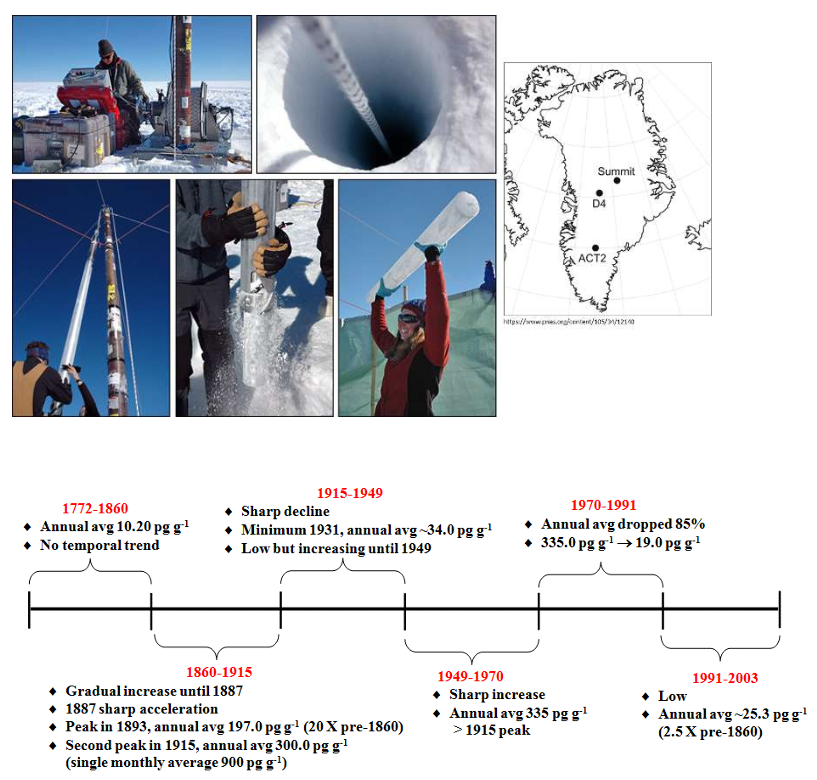
* took ice samples
* analyzed layers of ice to see the emissions
* these emissions were taken in greenland with est 50,000 pop
* ut has est 50,000 student
* conclusion: pollution is not greenlands fault, it is our and other nations who pollute a lot. emissions have no boundaries and will spread everywhere. we have to be more responsible and watch our impact on other places
*
\
\
Global Distillation Effect - Grasshopper Effect
- net transfer/transport of pollution from lower latitudes (typically where it’s warmer) to high latitudes (poles, colder)
- steps
* pollution emission
* transport emission and multiple evaporation and condensation events
* water condenses and comes back to surface
* the emission is then somewhere else 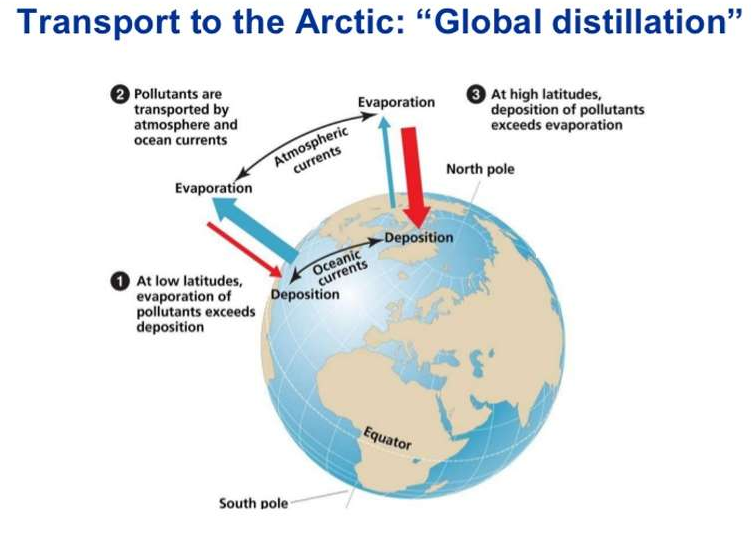
\
\