Light Reactions, Calvin Cycle, and Types of Photosynthesis
Overview
CO2 + H2O + Light → Sugars + ATP + NADPH + O2
Light Reactions
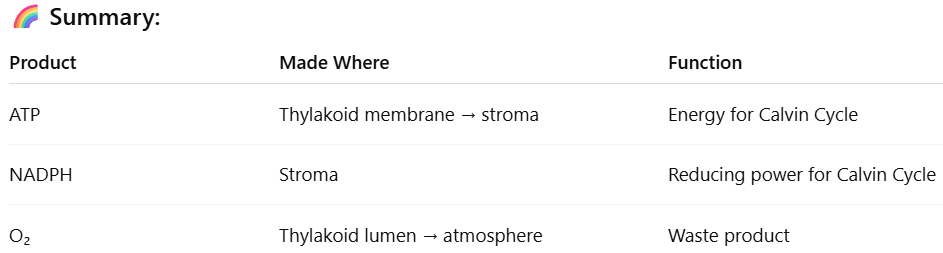
Coverts Light Energy into ATP + NADPH
Location: Thylakoid Membranes of Chloroplasts
Photosystem II
Water is split (oxidized) → releases O₂, H⁺, and e⁻
Mn, Cl, and Ca help in the water-splitting complex
e- is excited by light energy and passes through pheophytin → plastoquinone (PQ)
Electron Transport Chain
Electrons move PSII → PQ (a + b) → cytochrome b₆f → plastocyanin → PSI
Pheophytin accepts electrons, eventually transferring them to plastoquinone
H⁺ ions are pumped into the thylakoid lumen → creates proton gradient
Photosystem I
e- get re-energized by light
Protein Ferredoxin transfers electrons to NADP, Reduces to make NADPH.
facilitated by ferredoxin-NADP reductase.
ATP Synthase
H⁺ flow through ATP synthase (chemiosmosis) → ATP is made
This is photophosphorylation: ATP made by light rxn.
Types of Photophosphorylation
Noncyclic
In BOTH Photosystems.
Produces NADPH & ATP w/ Byproduct: Oxygen.
Cyclic
Only in PSI
Only produces ATP WITHOUT water-splitting or O2 byproduct
Calvin Cycle
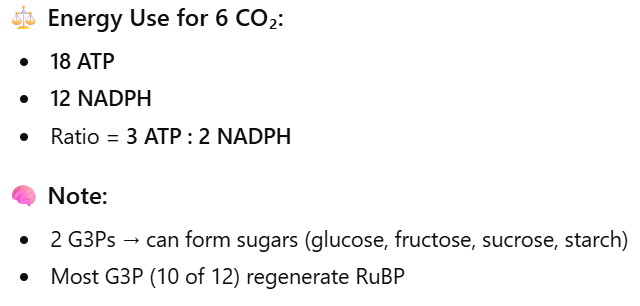
Light Independent; Uses ATP + NAPDH to fix CO2 → G3P (sugars)
Location: Stroma
Carboxylation Stage:
Enzyme Rubisco attaches CO2 to RuBP (5C → 6C intermediate) producing two molecules of (3C) PGA.
Reduction Stage:
ATP and NADPH convert PGA to G3P, which can enter various metabolic pathways.
Regeneration Stage:
Uses ATP to regenerate RuBP from G3P = net production of sugars and the possible usage of G3P for starch or sucrose synthesis.
(C3 Plants) Photorespiration - Occurs on hot days when stomata close, causing a decline in CO2 concentration.
Rubisco's affinity for oxygen increases under these conditions = PGA production, reducing sugar synthesis efficiency
C4 Photosynthesis
Adapted to minimize photorespiration w/ 2 separate carbon fixation processes.
Uses Mesophyll cells for initial CO2 fixation and bundle sheath cells for the Calvin cycle.
Uses PEP carboxylase enzyme to concentrate (fix) CO2, allowing stomata to remain closed.
CO2 + PEP = Malate, and gets decarboxylated to release CO2 directly into the Calvin cycle, minimizing water loss and photorespiration.
CAM Photosynthesis
Adapted to minimize photorespiration w/ opening stomata at night to collect CO2.
Stores the collected CO2 as malate in the vacuoles for use during the day when stomata are closed.
requires different storage and usage of pathways form C4
Limiting water loss