EARTH SCIENCE
Sciences that collectively seek to understand Earth and its neighbors in space.
GEOLOGY - “study of earth”
Physical Geology - Examines the materials that composes Earth.
Historical Geology - To understand the origin of Earth and development with its 4.6 billion-year history.
OCEANOGRAPHY - study of the composition and movements in the ocean and sea.
ASTRONOMY - the study of the universe.
METEOROLOGY - the study of the atmosphere.
NATURE OF SCIENTIFIC INQUIRY
Scientific Method - a process used to collect observation, test hypotheses, predictions, and identify patterns.
Exploration and Observation - can reveal valuable information about the natural world, can be quantitative or qualitative.
Inductive Reasoning - generalized observation.
Deductive Reasoning - general to specific.
Hypothesis - testable explanation of a situation that can be supported or disproved.
Experiment - carried out under controlled conditions, what researches often manipulate.
Independent Variable - the factor being manipulated.
Dependent Variable - factor that is being measured.
Control - used to show the results.
Theory - generally supported by a much greater body of evidence.
Scientific Law - describes a specific relationship or phenomenon. ex.: Newton’s First Law of Motion.
THE UNIVERSE AND THE SOLAR SYSTEM
The Structure, Composition, and Age of the Universe.
Stars: Main Sequence
90 percent of all stars fall along a sinuous band from the upper left (blue, bright and hot) to the lower right (red, dim and cool) called main sequence.
All main-sequence stars are composed of hydrogen and helium fueled by a hydrogen fusion.
Lifecycle of Average-mass Stars
The core and the temperature rises as the hydrogen in the core of a mature star becomes exhausted.
As helium fusion in an average-mass star ends, the star releases a planetary nebula then shrinks to a white dwarf.
Lifecycle of Massive Stars
Enough heat is produced to fuse heavier elements; its core will them explode becoming a supernova.
Remnants of a supernova can contract to become a neutron star. If the mass of a dying star is great enough, it becomes a black hole.
GALAXIES
A large volume of space containing billions of stars, held together by a mutual gravitational attraction. Spiral, Barred, and Elliptical
The Milky Way - A barred spiral where our sun lies, stars at the main disk, and dwarf galaxies inside the galaxy. Diffused clouds of gas and dust between the stars, a galactic halo, and a globular cluster of stars surrounding the disk.
Ordinary Matter - compromises 4% of the universe.
96 percent of the universe is invisible and is called the dark matter.
It has two components:
Dark Mass - makes up 23% of the universe, a form that does not interact with light.
Dark Energy - makes up 73% of the universe that pushes matter outward causing expansion of the universe to speed up.
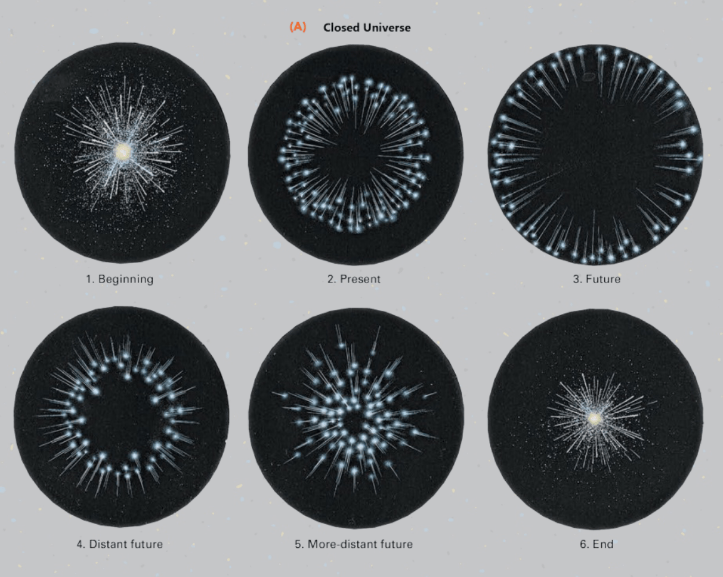
CLOSED UNIVERSE
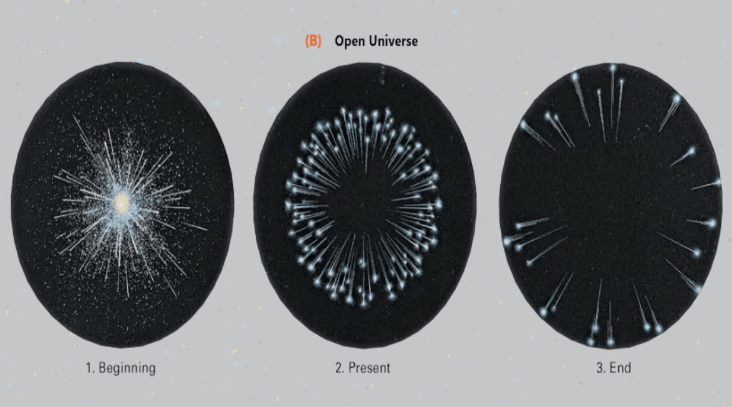
OPEN UNIVERSE
EXPANDING UNIVERSE (Waves and the Doppler Effect)
Waves - are disturbances that transmit energy from one point to another.
Crests - the highest surface part of a wave.
Trough - the lowest part of a wave.
Wavelengths - refer to the distance between successive waves.
Frequency - refer to the number of waves that passes a point.
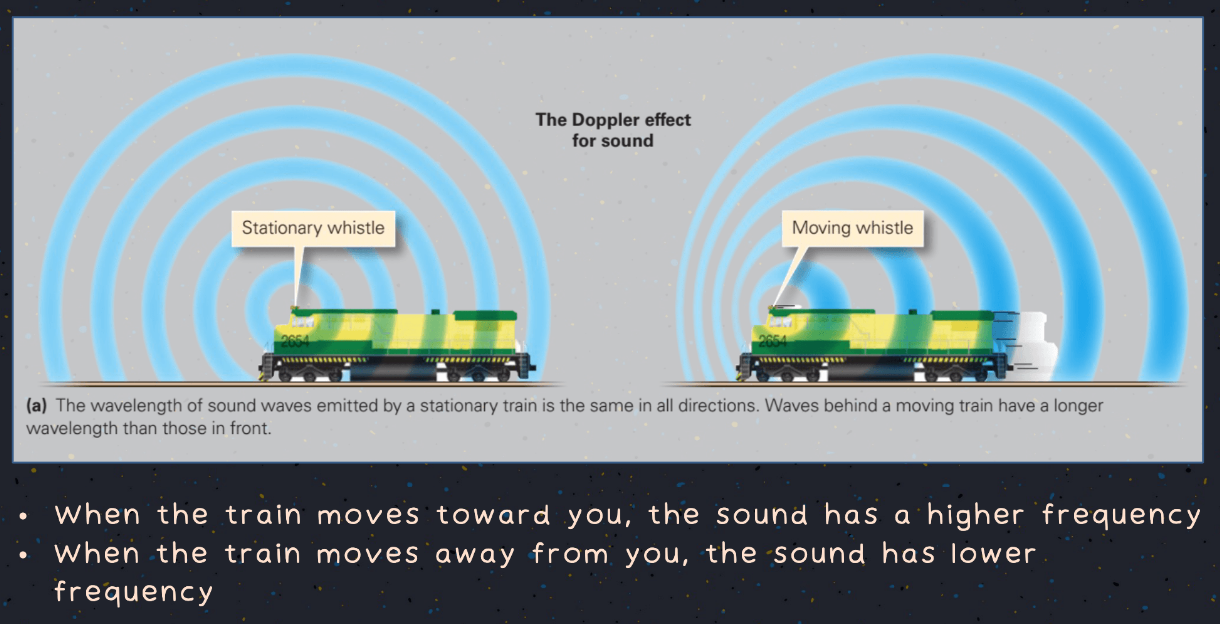
The Doppler Effect - sound at a stationary moves at equally in all the same directions while a moving train has a longer wavelength at its back and short up front.
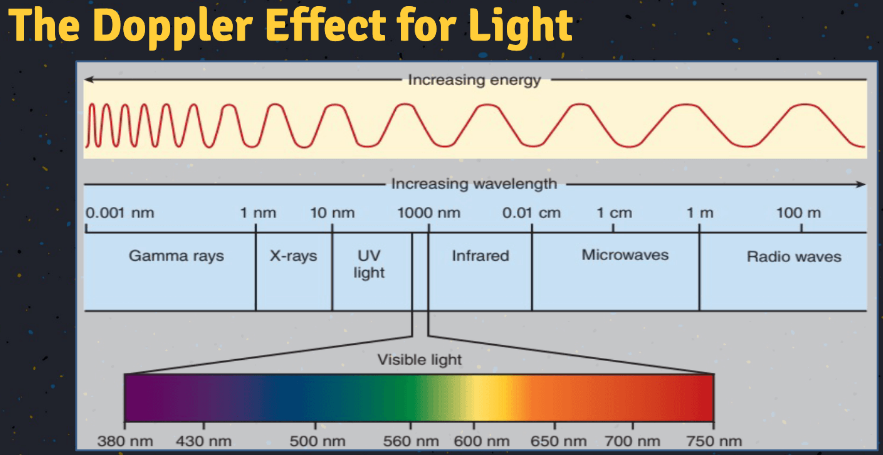
Red Shift - Has a much lower frequency than blue shift.
Blue Shift - Has a higher frequency than red shift.
EXPANDING UNIVERSE THEORY
Edwin Hubble - light coming to the Earth from all distant galaxies are displayed by a red shift. “Galaxies recede at speeds proportional to their distances from the observer.”
ORIGIN OF THE UNIVERSE
Things to note:
About 13.7 billion years ago, the universe began with a massive and rapid explosion.
Prior to that there were no existence of space nor time.
Matter and energy were contained in a compact point called singularity.
THE BIGBANG THEORY
The universe underwent a burst of expansion known as the Cosmic Inflation.
The universe then cooled to about 10-billion degrees, allowing primordial matter to form.
After the next few seconds, protons that are hot enough continuously fuse together forming a nucleus of the next-heavier element, helium.
a hydrogen nucleus consists of a lone proton, 4 protons fuse together to form a nucleus.
Hot protons also fuse with hot neutrons to form a deuterium which is an isotope of hydrogen to make helium.
When the universe was less than 1.5 minutes old, helium nuclei was blasted apart almost as soon as they form.
After 10 minutes, the universe was so cool that fusion could no longer occur. Thus, the formation of helium nuclei called The Primordial Nucleosynthesis, occurred over a time span of 8.5 minutes.
The universe continued to expand and cool to a few thousand degrees by about 300,000 years after big bang.
Electrons became attached to hydrogen and helium nuclei forming the first atom.
After 1 billion years, galaxies finally form and continuously evolve.
Our solar system is estimated to have been born 9 billion years after the big bang.
MAIN EVIDENCES TO REMEMBER:
Galaxies moving away.
The Abundance of Light Elements.
The Presence of Cosmic Microwave Background Radiation.
Arno Penzias and Robert Wilson’s unexpected discovery of the “missing radiation”
The Cosmic Microwave Background Radiation:
The universe was unimaginably hot that researchers should be able to detect the remnants of that heat.
In 1964, Arno Penzias and Robert Wilson discovered this microwave radiation which found to fill the entire visible universe.
ORIGIN OF THE SOLAR SYSTEM
The Nature of Our Solar System
formed about 4.6 billion years ago from a cold, diffuse cloud of dust and gas rotating slowly in space.
our solar system is located in the Milky Way Galaxy which is part of a galactic cluster called Local Group consisting of 40 galaxies including the Andromeda Galaxy.
An estimated 99.85 percent of the mass of our solar system is contained within the sun. The planets account for the most of the 0.15 percent.
All planets orbit in the same direction with slightly elliptical orbits.
Most large bodies orbit the Sun approximately in the same plane.
PLANETS
A planet in the solar system is a celestial body that is:
in orbit around the sun,
nearly round in shape,
and has cleared its orbit of other objects.
Terrestrial Planets - Are made of materials with high melting points such as silicates, iron, and nickel. They rotate slower, have thin or no atmosphere, has higher densities, and lower contents of volatiles - hydrogen, helium, and noble gases.
Gas Planets - Consists of Jupiter, Saturn, Uranus, and Neptune. They are called “gas giants” because of the dominance of gases and their larger size.
They rotate faster, have thick atmosphere, lower in density, and has fluid interiors rich in hydrogen, helium, and ice.
SMALLER SOLAR SYSTEM BODIES:
Asteroids - Object that orbits the sun but is too small to be considered as a planet. Asteroids that orbit the Sun, Mars, and Jupiter in a known region is called asteroid belt.
Comets - Loose collections of rocky material, dust, water ice, and frozen gases, thus the name, “dirty snowballs”.
Meteoroid - Is the debris that enters the Earth’s atmosphere.
Meteor - As the Meteoroid enters the Earth’s atmosphere, it becomes flared up called a meteor.
Meteorite - Before burning up or striking Earth’s surface it becomes a meteorite.
Dwarf Planets - Celestial bodies that orbit the Sun and are essentially spherical due to their own gravity but are not large enough to sweep their orbits clear of other debris.
Kuiper Belt - Its objects are icy bodies found inside the Kuiper Belt and include the dwarf planets found there. It contains at least three dwarf planets: Pluto, Haumea, and Make Make.
NEBULAR THEORY: FORMATION OF THE SOLAR SYSTEM
Proposes that the Sun and planets are formed from a rotating cloud of interstellar gases, mainly hydrogen and helium called solar nebula.
Tiny ice and dust particles condense in a nebula.
Other atoms or molecules attach to these particles, building into masses that are large enough to be attracted to one another by gravity.
Gravity pulls a swirling nebula inward and it coalesces into a spinning disk with a bulbous center.
The central “bulb” of this disk will become the Sun. Other materials are then formed from the flattened outer part of the disk, known as the protoplanetary disk.
The inner part of the protoplanetary disk ends up with higher concentrations of dust, whereas the outer portions ends up with higher concentrations of ice.
Gravity caused the gas, dust, and ice of the disk to separate into a series of concentric rings.
Materials from the surrounding rings collided and coalesced forming planetesimals. Planetesimals grow by continuous collisions known as accretion forming protoplanets.
Inner rings became the terrestrial planets as outer rings grew into the giant planets.
The following events of the nebular theory:
Formation of the nebula
Protosun forming
Spinning planetary disk
Solar System
Protoplanets and moon forming