Chapter 1: Units & Measurement
🔹 Measurement Basics
Measurement = recording intrinsic properties of an object/substance/space.
Must include number + unit.
Uses SI (Le Système International d’Unités).
Best to deal with grams so you don’t have to deal w complicated conversion
🔹 SI Units
Base Units:
Length = metre (m)
Mass = kilogram (kg)
Time = second (s)
Amount = mole (mol)
Temperature = kelvin (K)
Electric current = ampere (A)
Luminous intensity = candela (cd)
Derived Units: formed from base units.
Example: Volume
1 L = (10 cm)³ = 1000 cm³ or 1000 mL
🔹 Mass vs Weight
Mass = fundamental property of matter (SI base).
Weight = force keeping an object from accelerating in gravity.
Formula: Weight (newtons) = mass (kg) × gravity (ms-2)
g ≈ 9.81 m/s²
Everyday usage treats them as interchangeable, but they’re distinct.
🔹 Uncertainty in Measurement
No measurement is perfect.
Magnitude: How large the error is
Direction: Is the error too high or low
Two Types of Errors:
Random error
Inconsistencies in being able to read the instrument, or the ability of the instrument to reproduce the same values for the same measurement (magnitude and direction are random)
Systematic error:
Error built into the measuring device (magnitude and direction are the same) - easy to fix if you know
Eg. A 10 mL graduated cylinder has an uncertainty of .05 mL
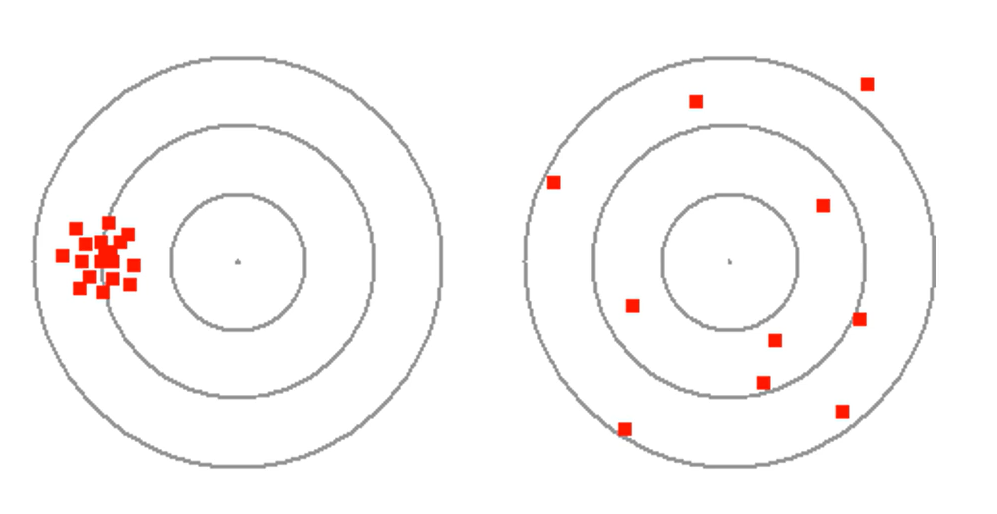
🔹 Precision vs Accuracy (NOT the same)
Accuracy = how close the value we found is to the true (accepted) value.
Precision = the ability of an instrument to distinguish between VERY similar values (each other)
Eg. You have two iron bars, one that weighs 1000 grams and the other weighs 1001 grams.
Low Precision: The instrument wouldn’t identify the weight difference, and just assume both the iron bars are 1000 grams
High Precision: The instrument would be able to tell the difference between the weight of the iron bars
Types of Precision:
Arithmetic precision
How many digits can be shown/read on the instrument or device
Reproducibility
The ability for the instrument to make the same value everytime we measure the same thing
False Precision
A measurement looks more precise than it is accurate
Eg. Even though we don’t know the accurate measurement of either iron bar, both the iron bars may seem as though we have a precise measurement but we don’t
Note: You can NEVER be more accurate than precise
You can’t surpass the true value that is already placed (considered the benchmark)
Not every measurement has to be accurate, because not every instrument is perfectly designed
Precision Examples
Balance | Description | Precision Type | Reporting | Precision & Accuracy |
|---|---|---|---|---|
A | Same reading every time for the same object; readable to 0.1 g | Reproducible, low arithmetic precision | 0.1 g | Precise but not accurate |
B | Readable to 0.001 g, but last two digits vary randomly | High arithmetic precision, not reproducible (false precision) | 0.1 g | Both accuracy and precision are good |
C | Readable to 0.001 g, consistent reading every time | High arithmetic precision, reproducible | 0.001 g | Poor precision and poor accuracy |
🔹 Significant Figures (Sig Figs)
Reflect the certainty of measurement (assume we don’t have false precision)
Rules:
Non-zero digits are significant.
Example: 15,699 → 5 sig figs
Leading zeros are not significant.
Example: 0.34 → 2 sig figs
Zeros between non-zero digits are significant.
Example: 7077 → 4 sig figs
Trailing zeros with a decimal are significant.
Example: 50.020 → 5 sig figs
Trailing zeros without a decimal are ambiguous.
Example: 5000000 (uncertain unless written with scientific notation)
Ambiguous Digits and Uncertainty
1. Uncertainty and Range
Uncertainty is written as ± (plus or minus).
Example: 500 g ± 100 g → true value is between 400 g and 600 g.
Smaller uncertainty = higher precision.
2. Ambiguous Digit
The last digit in a measurement is the uncertain (ambiguous) digit.
It shows the limit of the instrument’s precision.
3. Comparing Uncertainties
±100 g on 1000 g → 10% uncertainty (low precision).
±10 g on 1000 g → 1% uncertainty (higher precision).
The smaller the uncertainty relative to the measurement, the more precise it is.
4. Significant Figures & Uncertainty
The uncertainty should match the last significant figure of the measurement.
Example:
1000 g ± 100 g → 1 significant figure (written as 1 × 10³ g).
1000.00 g ± 0.01 g → 6 significant figures (written as 1.00000 × 10³ g).
5. Zeros & Scientific Notation
Writing style tells us how many sig figs are intended:
100 → 1 sig fig.
100. → 3 sig figs.
1.00 × 10² → 3 sig figs.
Extra zeros (e.g., 1000.00) show higher precision, not just “placeholders.”
6. Key Takeaway
Uncertainty defines how many significant figures you keep.
Always align the reported measurement with the instrument’s precision.
Examples
Instrument | Uncertainty | Recorded Measurement |
|---|---|---|
Cheap bathroom scale | ± 1 kg | 1 × 10³ g (1 kg) |
Better bathroom scale | ± 100 g | 1.0 × 10³ g (1.0 kg) |
Kitchen scale | ± 10 g | 1.00 × 10³ g (1.00 kg) |
Laboratory balance | ± 0.01 g | 1000.00 g (1.00000 × 10³ g or 1.00000 kg) |
🔹 Operations with Sig Figs
Multiplication/Division → result has as many sig figs as the factor with the fewest.
Example: 4.93 × 3.1 = 15 (2 sig figs)
Addition/Subtraction → result has as many decimal places as the least precise number.
Example: 9.42 + 6.7 + 3.3100 = 19.4
Round in your head for the sig digs, but keep the rest of the numbers the same in your calculation to ensure no errors
🔹 Logarithms & Sig Figs
In logs: digits right of the decimal are significant.
Example:
pH = 3.6677
[H⁺] = 10⁻³·⁶⁶⁷⁷ = 2.149 × 10⁻⁴ M (4 sig figs)
Or: [H⁺] = 0.0002149 M
🔹 Multi-Step Calculations
Follow BEDMAS: Brackets, Exponents, Division, Multiplication, Addition, Subtraction.
Keep extra digits until the final step, then round to sig figs
Example:
(100.2 − 99.38) ÷ 4.003 = 0.2 (1 sig fig)
🔹 Key Formulas to Remember
Weight: W = m × g (g ≈ 9.81 m/s²)
Volume: 1 L = (10 cm)³ = 1000 cm³ = 1000 mL
Sig figs in multiplication/division:
Use the smallest number of sig figs among inputs.
Sig figs in addition/subtraction:
Match the least number of decimal places.
Logarithms: digits right of decimal are significant; digits left set the exponent.
Percent Error: (actual-theoretical value) / (actual value) x 100%
✅ Study Tips:
Always include units in final answers.
Keep track of sig figs at every step.
Report only the first uncertain digit.
Use dimensional analysis to check units.