M3.3 Rural Differentiation/ Social Unrest
Rural Social Unrest (Theories of Peasant Revolution: A Critique and Contribution from the Philippines_Gary Hawes, 1990)
CONCEPTS TO REMEMBER
Patron-client relationship
Mutual agreement between a person/people with higher wealth status/power and another who benefits from their support
Political Economy
Analysis of social phenomena in the context of political power and capitalistic market relations.
Reciprocity
The expectation that people will respond favorably to each other by returning benefits for benefits, and responding with either indifference or hostility to harm.
Sharecropping
A form of agriculture production system in which a landowner allows a farmer (sharecropper) to use the land in return for a share of the crops produced on their portion of land.
Existing theories on Revolutions
Studies: Narrow focus; Does not capture full story; Flawed
Theories: explain rebellions and revolutionary movements in Southeast Asia
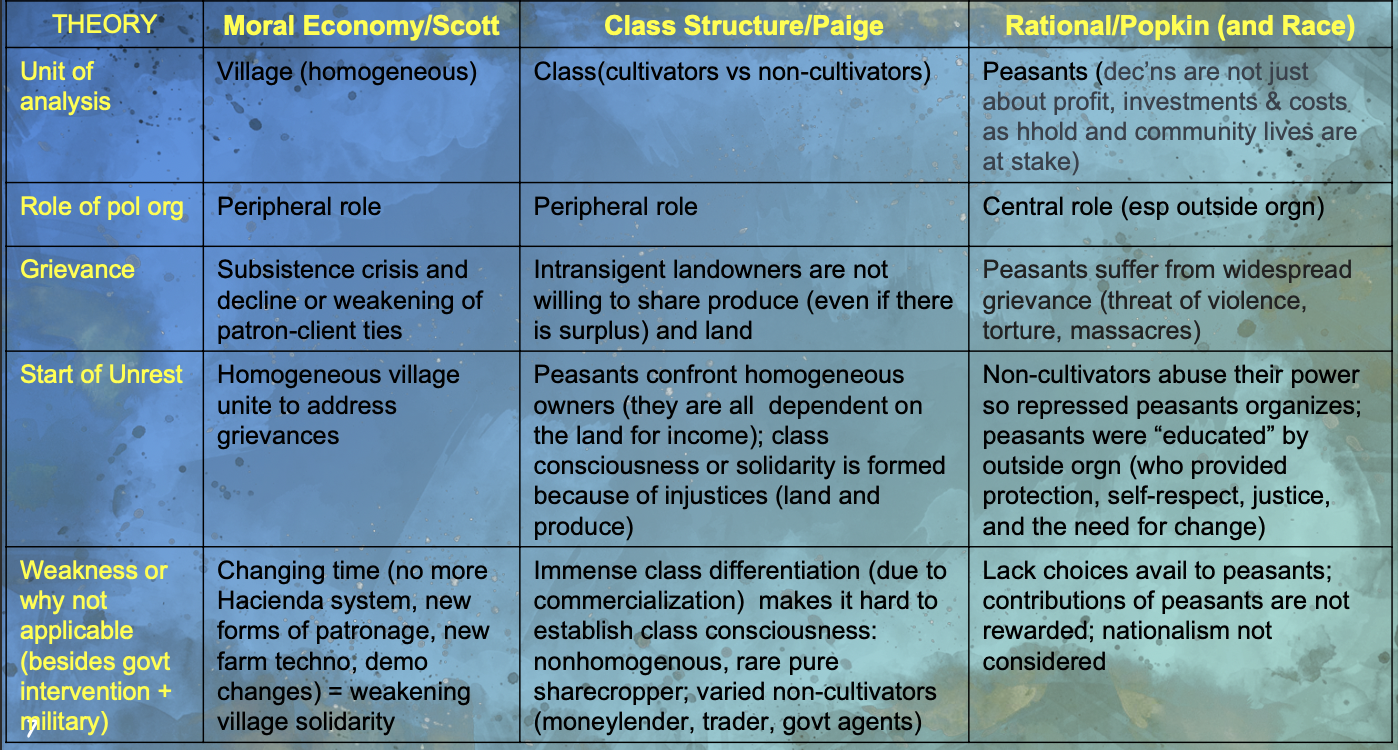
Moral economy (James Scott)
Rational choice(Samuel Popkin, Jeffrey Race)
Class structure (Jeffery Paige)
However, all three fall short in explaining the growth & continuing strength of the contemporary revolutionary movement in the Philippines.
MORAL ECONOMY (Scott)
Limited to peasant rebellion, not peasant revolution = valuable for understanding the conditions out of which revolutions emerge
Explained the depression rebellions of SE Asia
Village structure as causal variable: The more communal the village, the easier it is for the village to collectively defend its interests.
Political and Econ changes (increased production, demo changes, etc) weakened patron-client ties = peasant’s sense of security declined and they were more susceptible to subsistence crisis.
Rebellion happens: when united peasants in lowland, irrigated, settled, rice-growing villages are confronted by a common threat (a subsistence crisis) and enemy (a decline in willingness to help, reciprocity norm, by wealthier members)
Strong family & communal ties would push villagers to defend collective interests
CLASS CONFLICT (Paige)
Class is the causal variable thus focuses on class conflict typologies (esp if it leads to agrarian rev)
Class structure is determined by income source of lower- and upper-class cultivators
Cultivators/Sharecroppers: produce export crops for sale or they may work for wages; remain dependent on subsistence plots they don’t own; conservative thus unable to organize collectively
Increasing profits from capitalist plantations can be shared with workers to reduce class tension.
Cultivator and non-C are both dependent on the income from the land. Thus, control of land is where conflict arises
(Commercial Hacienda = produces export crops but primitive fashion; they repress and disenfranchise the cultivators)
Revolt (violent, armed struggle) happens when non-C are intransigent and thus, do not want to distribute land ownership & produce coz they will be economically weak.
Such injustices will result to political radicalism, powerful organizations & intense class solidarity among sharecroppers (class consciousness).
RATIONAL CHOICE (POPKIN)
Peasants (unit of analysis) are rational individuals, risk-averse, and utility maximizers who calculate their prospective returns on their investments, they get hurt by the market and state
Peasants calculate the quality of the organization and the return that they will receive from making their contribution to the organization.
Peasants suffer from widespread grievances that outside organizations offer exchanges that are attractive to utility–maximizing peasants.
Political entrepreneurs/org’n or revolution leaders play central roles as they offer protection, labor, and assistance in lowering the rents to peasants
Revolution happens when peasants feel aggrieved or do not get the returns from the system
Why is there a need to study
Philippine Revolutions?
No adequate theory or scholarly treatment ( to explain how peasant grievances transform to a revolution)
Growing fervor: NDF active in 69/73 prov; NPA numbers at 20-25K frm 63 prov; unlike in other Third World countries; Cost in human lives is rising (8.8/d to 10.3/d)
Has national and international contexts
The Philippine Case: Philippine Agrarian
Communities in the 1970s
Colonial Legacies and International Trade
Gradual opening up of the economy
Investments and expansion of capital in
Philippines Agriculture
Green Revolution Technologies, increased
in production and commodification
Some success of Land Reform and expansion of the land frontier
Declaration of Martial Law in 1972
Militarization of lowlands areas, Proximity of Lowlands to Military bases
The Rise of the NDF-NPA
Failed to establish mass support in the lowland in 1969 but achieved success in 1971 in other areas.
Who Supported the NDF
Upland settlers, migrants from the lowland
Losers of mechanization, landless laborers, socially excluded
Oppressed by logging concessionaires and land grabbers
Tactics
The NDF filled the void left by the state in upland villages
and remote villages
Provided newly settled communities with structure, norms,
and institutions
Established identities and class consciousness
Provided protection against individuals empowered by the
state: loggers, land grabbers, local politicians
Negative Effects of Martial Law on Rural Communities
Some success in land reform in areas associated with Marcos’ rivals Marcos Exchange gave unchecked political power to local politicians in exchange for loyalty, support and patronage Marcos systematically dismantled old political elites (patrons) in favor of new local elites loyal to him. Rampant logging concession and land grabbing
Toward a New Theory
• Village structure, class structure, and individual motivations are important but the analysis should be shaped within larger contexts
• Greater effort should be given to how the nation’s history shapes its comparative advantages and class structure
• It should take into account the range of choices that peasants can and cannot make.
• It needs to take into account the power of nationalism and have a wider view than focusing on local issues.
• It needs to take into account the national political economy, the contemporary international division of labor, the long history of (agriculture) trade, government structure, and policies.