S15 - Disney
CULTURE IS STICKY - PEOPLE TEND NOT TO LET IT GO!!
Summary
Key information - key milestones, key events that define the history of Disney
Started in 1934 with Snow White and 7 dwarves (very successful)
Walt Disney's death - started period of difficulty for Disney
Then Eisner and Katzenberg arrived to the company in 1984. Together gave a second life to Disney, and made some blockbusters (main one 1994 Lion King - 1Billion in net income)
Katzenberg tried to change the company (introduced personal mission to bring back former glory - pushed the story telling of the company. (Company culture based on top product). Created an open and collaborative environment even though he had a touch on everything
Wasn't appointed president in 1994, and so he decided to leave Disney and created DreamWorks with Spielberg.
Going a step back, what happened in 1991?
Pixar and Disney signed the first deal to produce a CG animated movie
End 90s:
CGIA lab was created - what was the objective of this lab? To do CG films for 3D animations. They were trying to develop the technology
First project "Dinosaur" was released in 2000 - it was a disaster though. They produced something
So they went back to 2D projects, and they had a new chief (Thomas Schuma..)
Closed the lab in 2001
Opened a division focusing on CGI in 2003
What happened in 2005?
Eisner was gone!! Iger took over as the new CEO
Challenge; the contract they had with Pixar (1991 and 1997). There have been issues with the negotiation of a new deal between SJ and Iger - very strong personalities and different views on how to generate profits for themselves. AKA EGOS
The market had changed - there were more potential sources, and home video sales was most important profits for Disney.
Talk about Pixar now…
Genesis of Pixar: Uni of Utah (Catmull) + Schue (president of NYIT) + Lucasfilms (1979) + Lasseter
SJ buys Lucasfilms in 1986 and rebrands to Pixar.
Why did SJ buy Lucasfilms?? He wanted to create a strong company for the computer hardware and software industry. As soon as he saw that it actually needed lots of investments and wasn't super profitable, he cut 1/3 of staff and only kept the animation division.
What was the by-product of that period? Which were very important and the base of Pixar!!
Three types of software:
RenderMan (type of software that applied texture) - software that allowed to color the dinosaurs of Jurassic Park
Marionette (used for character animations). Why was Marionette very important!!
Because it was good for animators, who no longer needed to draw each frame by hand, and have to change all frames if there was one small thing they wanted to change
To reduce costs, Disney reduced characters in bg, made simpler animations, etc.
So, Marionette was the full package and allowed to easily make modifications without having to redraw 50 frames.
Ringmaster (used for project management)
How many people were working at Disney?? What was the structure like?
In their prime in 1999, they had 2200 employees, and only a few years later after the lion king high they had to cut to 1100 employees (2003).
In Pixar, more or less 100 people were working on a movie. Less than Disney. So they were producing movies at 15%-20% of the cost of a Disney movie!!
Why didn't Disney try to hire everyone from Pixar?
SJ said that Pixar took 10 years to get it right.
Company culture is something that is very difficult to replicate!!!
Pixar had the vision that it's the people that mattered!! A good team can make a bad idea good, but even with the best idea, a bad team would ruin it.
Three principles of Pixar:
Freedom to communicate
Safe to offer ideas (disagreement is allowed)
Staying close to academics (capabilities, knowledge). To keep up to speed.
Loyalty
Timeline:
1991 - first contract Pixar-Disney
1997 - second contract, 10 year deal, 5 movies.
End 90s - experimenting with LAB CGIA
2003 - set up a CGI division + cost cutting
In the meantime, Pixar movies were doing better and better
2005 - they are completely reliant on Pixar, are more focused on downstream side of market, and their capabilities are not sufficient to keep up with the technology
2005 - Iger is questioning the contract, that will expire in 2 years.
Stream of revenues for Disney:
Box office (around 20%)
Home entertainment - the biggest generator (60%)
Television
Products in general (merchandising, games)
Theme parks!!!!
Pixar was 10% of Disney's revenue but 60% of their EBIT!! So Disney was exploiting Pixar, and Pixar didn't like it!!
How is it possible for a leader in a segment, and 14 years go by between the first contract and 2005, and they KNOW the problem is there because 60% of ur EBIT is coming from an external entity of the company??? Why did they not do anything about it??
The share is gonna crash once people find out that Iger doesn't want to renew the contract, cause it means they'll lose 60% of their money basically lol.
So what was the key issue?? Why after all this time have they not figured out what to do? Think Kodak - they were the best in 2D animation, but they remained anchored in that!! Clearly, the culture is playing a huge role here - it's very difficult for people to accept the fact that what made them successful can no longer be maintained. There was a disruptive innovation, which came with the risk that the leader underestimates it, and ends up being surpassed. Core capabilities become core rigidities. That's what happened with Disney.
Think of 3D - everyone thought it was the next best thing, but it ended up dying pretty fast. So it's understandable that Disney would think that maybe CGI was just a fad.
Questions
1. Should Disney acquire Pixar or work out a contract agreement?
They had two choices:
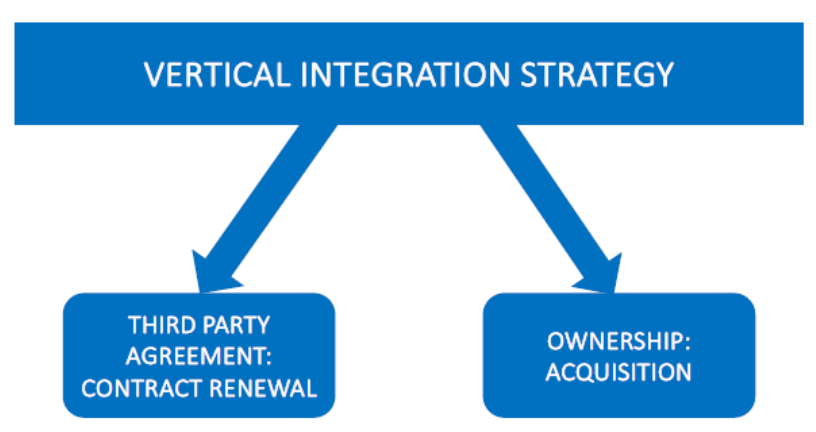
Why was it difficult to reach an agreement for a contract between Pixar and Disney??
Financial aspect - Pixar had a huge leverage since they produced most of the profits.
Disney dependent on operating earnings of Pixar agreement (60% of EBIT)
Pixar had the capabilities
Not ONLY technical and individual! Team based!
Steve Jobs: “We have spent 10 years merging two cultures together”
Technical and creative soul working together → difficult to replicate in an existing organization
Deliver 2-3x average gross revenue at box office (compared to competition)
Paradoxically, the key challenge for Pixar was to get a distribution agreement
Somehow, to have an agreement, the only condition on which they could agree was:
Disney to accept the distribution fee (around 10%)
So, 50% of the 60% would no longer be for Disney
Their stock would crash
Disney would have to do a massive restructuring!!
Devastating consequences for Disney, so no way there would be an agreement!!
Pixar can close the contract with others, but Disney literally had no other option…
Competitive tension between the two on level of support for movie, release dates, sequels, etc. “Zero-sum game”
SWAT Analysis - great complementarity!
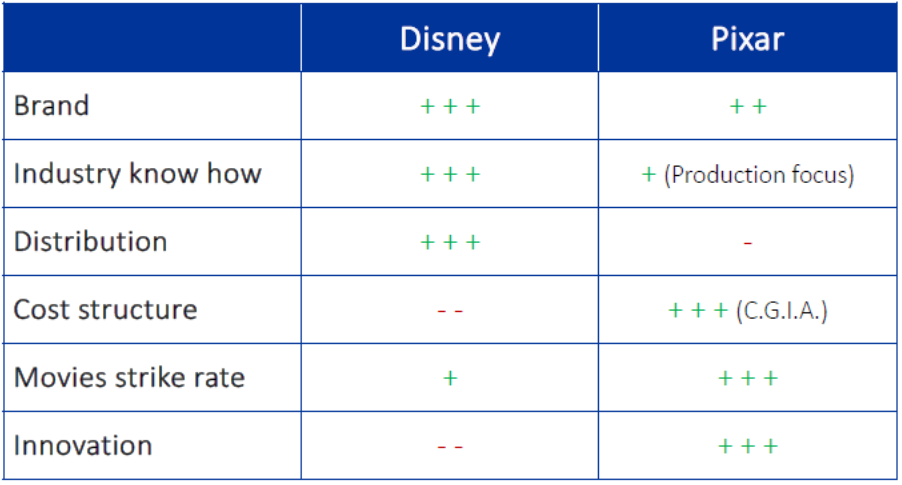
From Disney’s perspective…
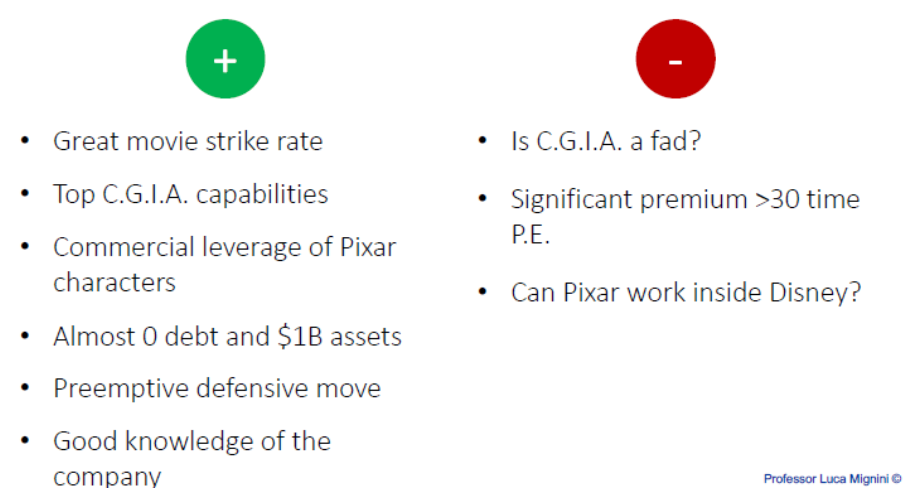
From Pixar’s perspective…
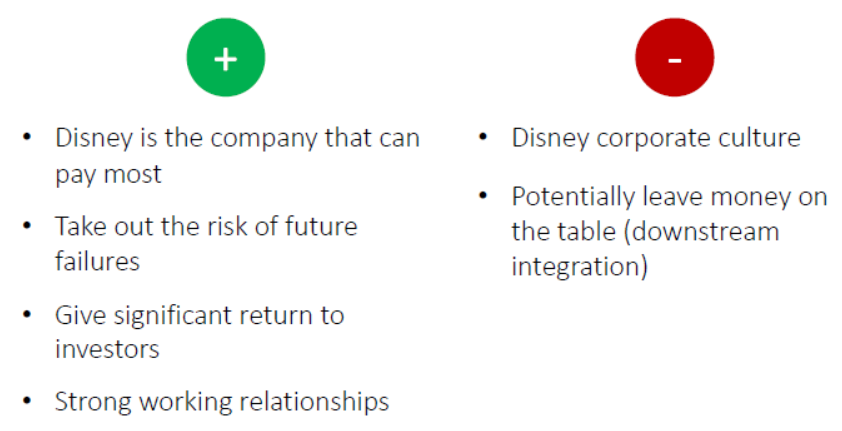
2. If you were a board member, would you approve a > in stock
Pixar culture and operating model protected. HQ stays in place and is independent.
Catmull supervised Pizar and Disney animation unit (he knew both well)
Was it a good decision in the end?
Yeah!
Strong complementary capabilities (not available on the market!)
Significant revenue synergies (sequels, toys, theme parks, etc.)
Probable cost synergy (support and commercial functions)
Top of house committed to manage acquisition, giving Pixar right level of independency.
Acquisition watch outs:
Assume to be the smartest (“We can run this business better”)
Superficial due diligence process:
Overestimate cost and revenue synergy
Underestimate integration complexity
Proper risk assessment of adjacencies versus new segment
Proper evaluation of buy versus make
Integration costs
Quality of acquired management team => key enabler of value creation
Include competitors’ reactions in business plan
Acquisition must be consistent with company’s strategic plan