Conflict Resolution - Week 8
Is Conflict Good or Bad?
Negative outcomes
Lower performance
Higher stress, dissatisfaction, turnover.
Less information sharing and coordination
More Organizational politics & power struggles
Wasted resources
Weaker team cohesion (when conflict within team).
Positive outcomes
Better decision making
Tests logic of arguments.
Questions assumptions.
Generates creative thinking.
More responsive to the changing environment.
Strong team cohesion (when conflict with outside opponents).
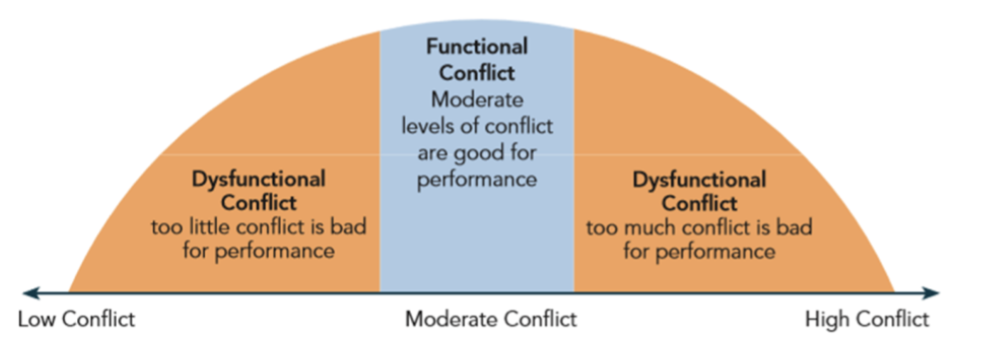
Functional Versus Dysfunctional Conflict
Optimal conflict perspective: organizations are most effective when they experience some level of conflict. Too high & too low, are bad.
Functional = Constructive, Benefits indivvidual, group or team.
Dysfunctional = deestructive, Disadvantages individuals, teams or organization
Prespectives on Conflict
Unitarist Perspective - The organisation is an integrated, co-operative, harmonious whole. The team has a common shared loyalty and one focus of effort.
Pluralist Perspective - Conflict is an agent for evolution and internal and external change. It is not good or bad. Conflict requires careful handling and attempts to reconcile.
Radical Perspective - Conflict is a feature of society influences and the disparity in power between owners and workers. Conflict is part of the class struggle.
Interactionist Perspective - Conflict is judged as a positive and encourages change and innovation. Conflict is a sign of a healthy organisation (up to a point).
Organisational Conflict - Behaviour intended to obstruct the achievement of some other persins goals at the individual, group or organisational level.
Organisational Misbehaviour- ‘Anything you do at work which you are not supposed to’ (Ackroyd & Thompson, 1999) Usually interpreted as anything unacceptable to management.
Conflict - involves action
“They praised the team, so I threw their computer out the window and vandalised their car”
“Susan is a fool. They won’t listen to anyone and I refuse to follow their instructions”
Disagreement - Involves a difference of opinion
“I think the team is headed for the championship and they think they’re headed for the trash”
“Susan thinks we can heandle a bigger workload, but I am not sure, so we are going to talk about it”.
Overview
Organisational conflict → Behaviour intended to obstruct the achievement of some other person’s goals at the individual, group or organisational level → organisational misbehaviour (‘Anything you do at work which you are not supposed to’ Usually interpreted as anything unacceptable to management)
Potential sources of conflict
Differences in perception
Limited resources
Depatmentalisation
Work activities
Role definition
Inequitable treatment
Violation of territory
Environmental change
Bullying and harassment
Organised conflict
Overt Individual conflict
Latent conflcit
The management of conflict
Clarify goals and objectives
Resource distribution
HRM
Non-monetary rewards
Interpersonal skills
Group activities
Organisational processes
One-to-one conversations
Informal social processes
A closer look - sources of conflict
Why does conflict emerge in organizations between people and groups?
Group identification and intergroup bias - ‘in group vs out group’ based on personal characteristics (race, gender) or job function. Also based on role conflict we might have.
Interdependence - Conflict that arises when groups are mutually dependent on each other to achieve goals. Ex. sales staff w/ production.
Differences in power, status, and culture
Power: when power is unequally shared
Status: often based on role, reputation. Authorities vs partisans
Culture: conflict arises due to differences in beliefs and values.
Ambiguity- conflict due to lack of clarity in goals, jurisdictions or performance criteria. When present, ambiguity breaks down formal and informal rules that govern interactions.
Scarce resources - power is magnified when resources are scarce and there are battles to hold these positions of power.
Communication problems
Poorly stated messages or incomplete information can escalate conflict.
Conflict causes emotive messages and emotion affect clarity of messages.
Less communication amplifies conflict.
Differentiation
Differences in training, value or beleif systems, and experiences.
Incompatible goals
One party’s goals seem to interfere with other’s goals.
Bullying & Harassment
…