1.2 Understanding the Business
Module Objectives
I. Identify the steps of a business’s operating cycle
II. Identify the relationship between a business’s financing needs and its operating cycle
III. Identify the relationship between a business’s financing needs and its capital investment cycle
IV. Identify the impact of supplier terms on a borrower’s financing need
V. Identify the differences between manufacturers, wholesalers, retailers, and service companies
VI. Recognize the likely length of a business’s operating cycle based on the type of business it is
VII. Identify the growth stage of a business
VIII. Identify the level of risk inherent in the different growth stages of a business
Overview/Key Points
The Decision Strategy approach balances risk and opportunities
A business’s growth state is likely to influence the amount of credit risk a business presents
Businesses in the concept creation, development, young operating, and declining stages are likely to present more risk than businesses in the middle-aged operating and mature operating stages
Preliminary Analysis
1. Preliminary assessment
What is the specific opportunity?
Is the opportunity legal and within your institution’s policy?
Are the terms logically related?
Do the risk appear to be acceptable?
2. Identify borrowing cause
What caused the need to borrow?
How long will the borrowed funds be needed?
Activities in the business cycle
Making sales
Purchasing equipment
Paying workers
Buying supplies
Buying and storing raw materials
Adding value in the manufacturing process
Collecting cash from custom,mers
Developing new products
Earning a profit
The Asset Conversion Cycle
Lenders must understand the cycles of a business to identify loan opportunities and reach conclusions about borrowing cause, repayment sources, the degree of risk, and opportunities for noncredit services
The business cycle is also known as the asset conversion cycle, which includes the activities that make up the business
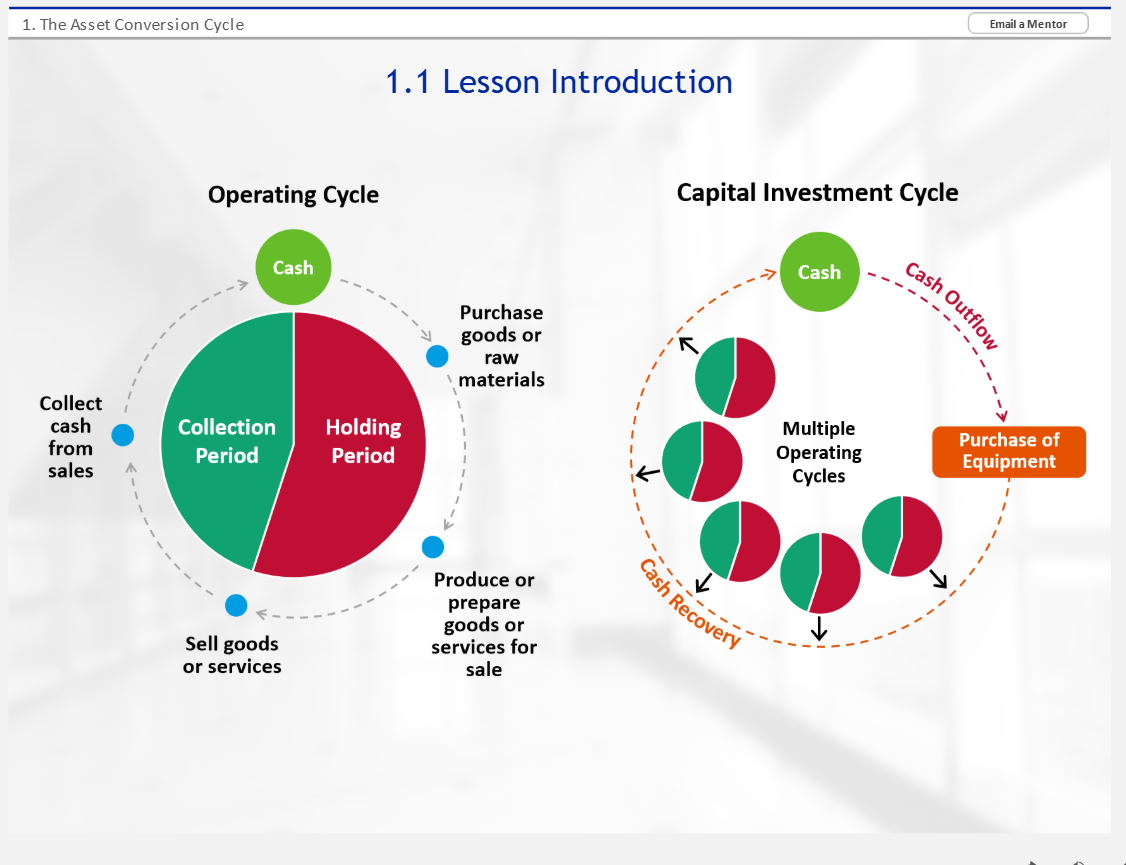
The business cycle activities are divided into those that are part of the operating cycle, and then those that are part of the capital investment cycle
Every business has an asset conversion cycle, which is when cash is converted to assets and then back to cash
The Operating Cycle
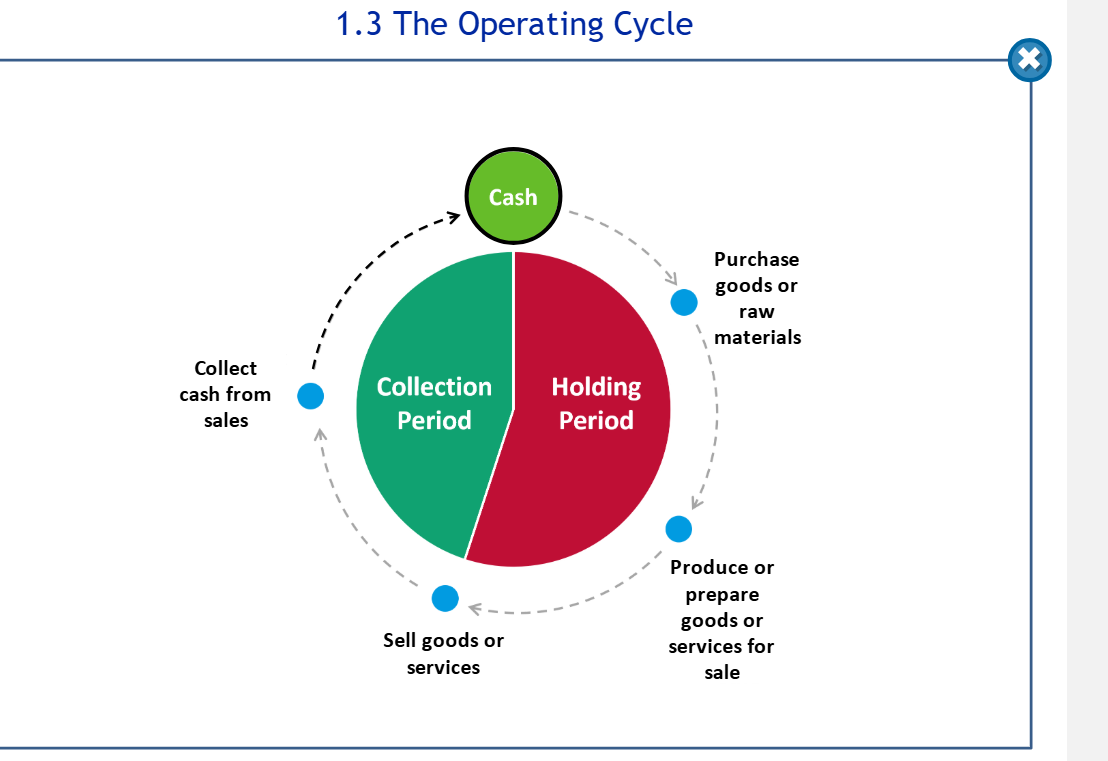
This cycle begins and ends with cash
Compromised of the collection period and the holding period (when goods are being prepared for sell, and then the collection period begins)
Once cash is collected, one operating cycle is complete
IF the company generated more cash at the need of the operating cycle than it used to complete the cycle, it has made a profit
The Capital Investment Cycle
The capital investment cycle supports the operating cycle
This includes purchasing production equipment to support the operating cycle and recovering the cost of that equipment over several operating cycle from the profits used to make that asset
The Holding Period
The time between buying goods/raw materials and selling those goods for a finished product
The Collection Period
The time between selling a product and collecting cash from customers
The Payment Period (Not part of the operating cycle)
This is the time between the purchase of goods or raw materials for sale, and paying suppliers for those good or raw materials
Knowing the length of the payment period is essential for determining financing need(s)
The payment period is usually shorter than the operating cycle (which is what creates a payment financing issue)
Cash flow timing differences occur when cash goes out before it comes in-like when a company must pay suppliers for inventory before it collects cash from the sale of that inventory to its customer
The funding gap due to the cash flow timing difference creates a financing need

Operating Cycle Financing Needs
The cash flow timing difference is the gap between its operating cycle (holding period - collection period) and payment period (the financing provided by suppliers)
Unless a company has significant cash resource, it will need to borrow to help cover the cash flow timing different
The repayment source for these loans is usually the future cash collected from the sale of goods
How can companies reduce their cash flow timing differences?
Reducing the holding period
Purchase raw materials later int eh year as needed
Produce inventory over a short period
Add a product line that would be popular in what is their off-season
Reducing the collection period
Offer a discount for early payment
Reduce the payment terms offered to customers to collect cash more quickly
Increase collection activities to encourage payment
Increasing the payment period
Negotiate more favorable payment terms with suppliers
Finding new suppliers that offer extended terms
Capital Investment Cycle Financing needs
The capital investment cycle also creates financing needs for most companies
It is unlikely that a growing company would be able to finance the purchase of large, fixed asset from the profits of a single operation cycle
Companies often finance such large purchases using long-term loans
The loans are repaid with cash flow from profitable operations over multiple operating cycles
Overview of Business Types
Businesses are grouped by their operating cycles, capital investment cycles, and borrowing needs
Business types from longest operating cycles to shortest (and length of capital investment cycle in parenthesis)
Manufacturers (Long; continuing need for fixed assets)
Wholesalers/Distributors (Varies depending on type)
Retailers (Periodic need for fixed assets)
Hybrids of manufacturing, retail, and service (Periodic need for fixed assets)
Capital-intensive service (Large amount of fixed assets needed)
Labor-intensive service (few fixed assets needed)
Product Distribution Chain
As a lender, it’s important to understand how your borrower fits into the distribution chain
Product businesses are linked together in a chain that begins with raw materials and ends with the sale of the product to the end user
The finished product of one manufacturer may become the raw materials for another
The manufacturer may sell directly to the retailer without the need for a distributors

Manufacturing
These businesses tend to have a longer operating cycle than most other businesses, as well as longer cash flow timing differences
More likely to need periodic long-term loans to fund the acquisition of fixed assets to replace, upgrade, or expand production capacity
They purchase raw materials (on credit), produce their products, and hold the products in inventory until they are sold
Most sales are on credit, creating a longer collection period
The capital investment cycle is a large part of a manufacturer’s business
They must purchase the equipment (fixed-assets) needed to process the raw materials and recoup their investment over a period of years
Wholesales/Distribution
Wholesalers and distributors need loans to finance seasonal increases in inventory and receivables
They also need capital investment cycle loans for items such as trucks, warehouses, and inventory systems and related equipment
Their inventory consists of finished goods
Sell to other business rather than an end users
Nearly all sales are on credit
Use warehouses, trucks, forklifts, shelving, and conveyor systems
Retail
Sell directly to the public
Likely to borrow for seasonal buildups of inventory, but have fewer or no accounts receivable
Mush make sufficient sales in time to repay suppliers
Long-term financing is generally is not needed, unless expanding or buying real estate
Service-Capital-intensive
Rely heavily on fixed assets to operate, like an air-charter service
These businesses need long-term financing, but also short-term financing if the business sells on credit terms
Service-Labor-Intensive
Businesses that rely heavily on labor-whether skilled or unskilled, such as a nail salon
They have short operating cycles and have few credit needs
May be seasonal in nature and need to borrow to cover operating expenses during the collection period
Professionals
Highly-educated service-providers who have received specialized education, training, and a degree, such as medicine, law, accounting, architecture, or engineering
Hybrids
Restaurants are a hybrid of manufacturing and service
The operating cycle of these business may be very short
A warehouse that sells to both individuals and manufactures is a hybrid
Business Growth Stages
As a business gets older, it has different issues and needs
Some business life cycle stages simply aren’t bankable (concept and declining)
Concept Creation
High-risk as this is just an idea in the drawing board stage
Development
High-risk as this business has no income, no saleable product, and few assets
Venture capital firms or small business programs can help at this stage
Young Operating
This is the period between when the business begins to generate sales and the point when the business has established a consistent record of profitability
It is difficult to raise capital for a new venture
Risk and failure rates are very high due to less that adequate financial backing
If recent sales increased and have generated accounts receivable and inventory, specialty lenders may help finance a business at greater cost than traditional financing
Risks include undercapitalization, low margins, powerful suppliers that set terms, strong customers that may delay payment, rapid sales growth
Middle-Aged Operating
Sales growth continues to be rapid, but more consistent
Profit margins are usually higher than in earlier years
The business often stats to diversify by introducing new products
Less administrative overhead is required as products are added
Moderate to low-risk
Mature Operating
A mature operating business is well-established and often it has grown with its market
Sales are stable
Profit margins are strong buy may begin to decline as competition increases
Most major cash needs can be met with the profit generated by the business
A mature business generally manages its working capital fairly well
Declining
Some businesses grow to maturity and remain at the state indefinitely
They introduce new products or enter new markets, thus regenerating their own life cycles
No longer has the capital to invest in new products or new markets
Has to sell assets or liquidate
High risk borrower
Campisi Brothers Case Study
Their line of credit is up for renewal in May
They got their insurance settlement from the plant fire
They want to expand both their facilities and their product line