18.3 The Krebs cycle
The krebs cycle also takes place in the mitochondrial matrix and each complete cycle results in the breakdown of an acetyl group. Acetyl groups are all that remain of the glucose that entered glycolysis.
As in the previous stages, the Krebs cycle involve carboxylation, dehydrogenation and substrate-level phosphorylation. The hydrogen atoms released are picked up by the coenzymes NAD and flavin adenine dinucleotide (FAD).
Carbon dioxide is a by-product of these reactions and the ATP produced is available for use by energy-requiring processes within the cell.
The reduced NAD and reduced FAD produced are used in the final, oxygen requiring step of aerobic respiration to produce large quantities of ATP by chemiosmosis.
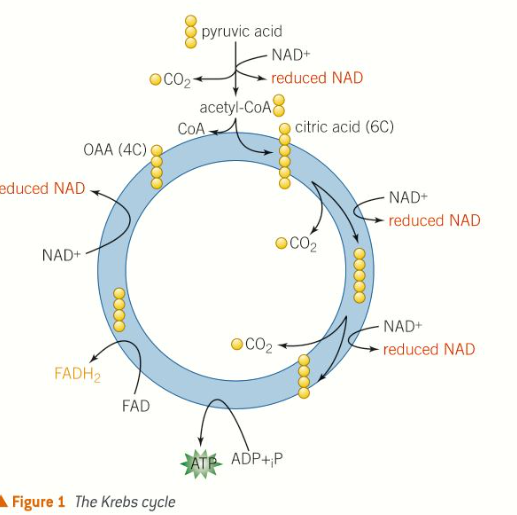
Acetyl CoA delivers an acetyl group to the Krebs cycle. The two-carbon acetyl group combines with four-carbon oxaloacetate to form six-carbon citrate.
The citrate molecule undergoes decarboxylation and dehydrogenation producing one reduced NAD and CO2. A five-carbon compound is formed.
The five-carbon compound undergoes further decarboxylation and dehydrogenation reaction, eventually regenerating oxaloacetate.
The cycle continues and more CO2, 2 more reduced NADS and one reduced FAD are produced. ATP is also produced by substrate-level phosphorylation.
The importance of coenzymes in respiration
Coenzymes are required to transfer protons, electrons and functional groups between many of these enzyme-catalysed reactions.
Redox reactions have an important role in respiration and without coenzymes transferring electrons and proteins between these reactions many respiratory enzymes would be unable to function.
NAD and FAD are both coenzymes that accept protons and electrons released during the breakdown of glucose in respiration. The differences are that
NAD takes part in all stages of cellular respiration but FAD only accepts hydrogen in the Krebs cycle
NAD accepts one hydrogen and FAD accepts two hydrogens
Reduced NAD is oxidised at the start of the electron transport chain releasing protons and electrons while reduced FAD is oxidised further along the chain.
Reduced NAD results in the synthesis of 3 ATP molecules but reduced FAD results in the synthesis of only 2 ATP molecules.
NAD molecules existing is actually charged therefore more accurately represented as NAD+. When it is reduced it accepts two protons and an electron pair (from C-H bond) forming NADH + H+. NADH, or reduced NAD, then transfers the proton and electron pair to subsequent reaction.
Coenzymes are usually derived from vitamins, this is why although coenzymes are mostly recycled, vitamins are an essential micronutrient.