MRI!!
how does it work?
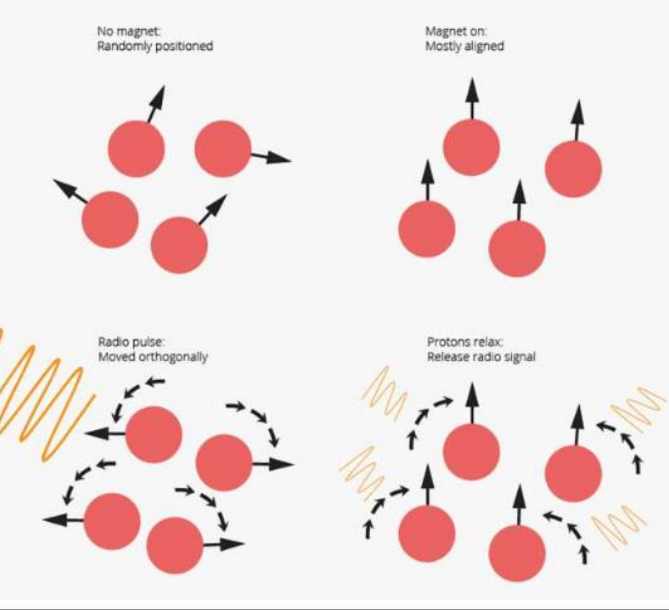
MRIs employ powerful magnets which produce a strong magnetic field that forces protons in the body to align with that field. When a radiofrequency current is then pulsed through the patient, the protons are stimulated, and spin out of equilibrium, straining against the pull of the magnetic field.
When the radiofrequency field is turned off, the MRI sensors are able to detect the energy released as the protons realign with the magnetic field.
The time it takes for the protons to realign with the magnetic field, as well as the amount of energy released, changes depending on the environment and the chemical nature of the molecules. Physicians are able to tell the difference between various types of tissues based on these magnetic properties.
• The basic principle of MRI is that all atoms in the body, especially the hydrogen atoms in water and fat, give off a small radio signal when they are in a magnetic field.
When a person is placed in the MRI machine, they are exposed to a strong magnetic field → This causes the hydrogen atoms in the body to align in a certain way.
Radio waves are then used to knock these atoms out of alignment.
As the atoms return to their original alignment, they give off a radio signal that is detected by the MRI machine.
The computer processes the signals received by the machine and uses them to create detailed images of the inside of the body.