Science, Technology, and Society
Science, Technology, and Society: An Introduction
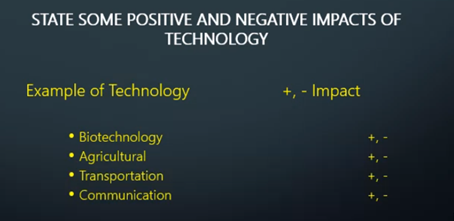
Course description • course examines how science and technology affect social, political, and economic circumstances. • this multidisciplinary course confronts society’s science and technological realities. • this course teaches you to live a good life and make ethical decisions in the face of scientific and technological advances. • climate change and environmental awareness are required in this course. There are some technological innovations that can affect our society in positive and negative ways. We must make sure to protect our environment when adapting to different science and technological advancements.
Learning outcomes
- Knowledge
- explain how science and technology change society, especially in the Philippines
- explain how science and technology affect people and the environment
- analyze human condition and critically think about philosophical ideas
- explain how social media affects lives of students as a whole
- Values
- learn how importance science and technology are for protecting the environment and building up the country
- review the relationship between human happiness and progress of science and technology so the student can decide for himself or herself what the good life is
- encourage people to live healthy lives so that society and the environment can grow a balanced and long-term way
- Skills
- to show how important science and technology to society and what they have done for it in a creative way
- look at shared concerns that make up the good life to come up with creative solutions to modern problems in line with ethical standards
- show how social media and information age change the people’s lives
INTRODUCTION TO SCIENCE, TECHNOLOGY, AND SOCIETY
SCIENCE The human attempt to understand the natural world (volcanos, ocean, etc.) with or without concern for practical uses of that knowledge.
- humans are naturally born curious
- humans will always continue to explore Science tries to discover facts and relationship and then tries to create theories that make sense of these facts and relationships.
- theories must be proved to become facts
Ex: if ghosts truly exist in this world, you have to provide evidence and show it to me. Any system of knowledge that is concerned with the physical world and its phenomena and that entails unbiased (tested) observations and systematic experimentation. Involves a pursuit of knowledge covering general truths or the operations of fundamental laws (basic standards that we follow).
Written laws are created to promote harmony, peace, and equality. Is based on the premise that our senses (visual, olfactory, auditory, and tactile) and extensions of those senses through the use of instruments can give us accurate information about the universe.
Science follows very specific rules and its results are always subject to testing, and if necessary, revision. Even with such constraints science does not exclude, and often benefits from creativity and imagination *As we imagine, we tend to ask certain questions that enhances our creativity
How important is science to society? According to Heraclitus, “Nothing is permanent except change.” Science offers society the chance to explore new things and gain new discoveries through time.
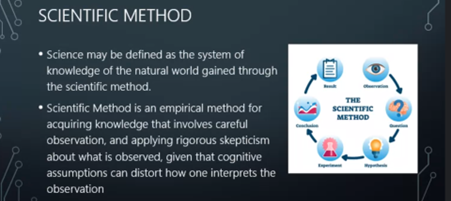
Scientific method is a continuous process. Steps of Scientific Method
- Make an observation
- Ask a question
- Form hypothesis or testable explanation
- Make prediction based on the hypothesis
- Test the prediction
- Analyze data and draw conclusions
- Repeat: Use the results to make new hypotheses or predictions
TECHNOLOGY • Comes from the Greek word meaning “art or craft” and “subject or interest.” • It is the way people try to change the world by making things that can help people. • Technology is the application of science to solve problems. • It uses tools, techniques, and procedures to put science’s findings to use. • Uses of what we know about nature in the real world. • Products of imagination thought process, and redesigning. • The main point of technology is to improve the quality of life.
How does technology address human wants and needs?
- Technology makes our lives easier
- It helps us with time management
- Improves ways of communication