Learning & Memory 2
Amnesia
- Hippocampus consilidates memories for long term shortage
- cortex stores LTMs
- amnesia: deficits in learning and or memory caused by damage to hippocampus
- loss of relational learning not. stimulus response, motor, or perceptual learning
- retrograde and anterograde
- anterograde amnesia: difficulty learninf new information after brain damage occurs
- causes: korsakoffs syndrome- mammillary body degradation, alzheimers disease, damage to the medial temporal lobes @ the hippocampus
- HM’s case: bilateral damage of the medial temporal lobe, could not form new memories, could recall early childhood memories
- demonstrates that the hipp is not the location of stored LTM, not needed for retrieval of LTM, not locarion of STM, is responsible for consolidating STM to LTM
- retrograde amnesia: difficulty rememberinf events that occurred before brain damage
- accompanies anterograde amnesia (time beriod just before damage is lost)
- demonstrates the hipp consolidates STM to LTM, if damaged before memories are transferred to the cortex then the memories are lost
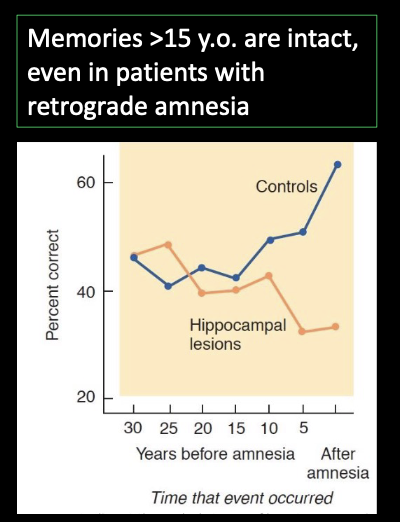
- amnesia impairs declarative memory formation AKA relattional learining, episodic memory, spatial learning
- does notimpair non-declarative memory formation, motor learnin intact, perceptual learning intact, stimulus response learning intact
Long-Term Potentiation
- neurotransmitter: glutamate
- ionotropuc receptors on postsynaptic membrane, NMDA receptors, AMPA receptors, major role in establishing LTP
Overview of Long term potentiation
- synaptic plasticity: structural or biochemical changes made to synapses
- changes can occur in presynaptic, postsynaptic neurons, or both
- includes long term potentiation
- long term potentiation: synaptic strengthening
- increases the likelihood that prresynapticactivity→ postsynaptic EPSP, presynaptic and postsynaptic changes, changes to glutamate receptorrs, NMDA and AMPA receptors
- long lasrting-months
- occurs in the hippocampal formation and other brain regions
- many axond frrrom enthorhinal cortex synapse on denate gyrus
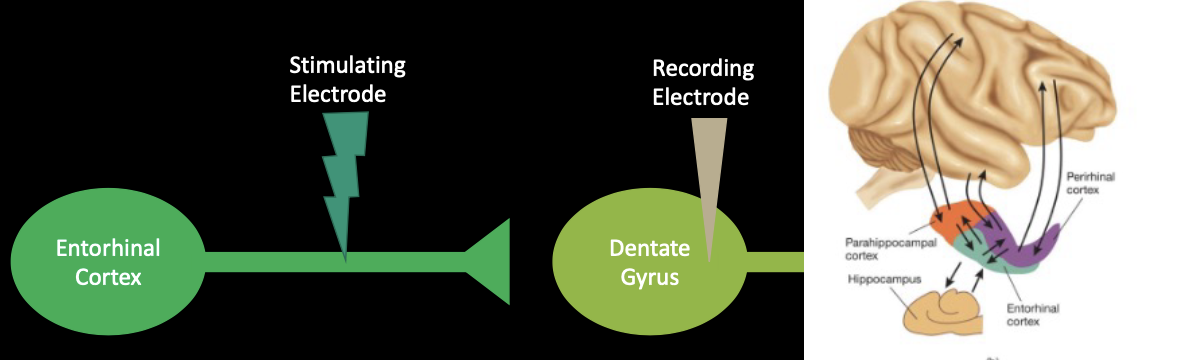
- many axond frrrom enthorhinal cortex synapse on denate gyrus
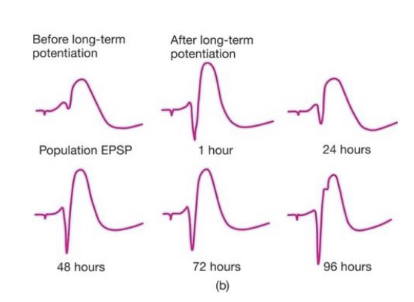
- population EPSP: summed EPSP producedby recorded neuron population
- prior to LTP: single pulse stimulation small population epsp
- establishing LTP: 100 pulse of electrical stimulation within a few seconds, temporal summation→stimulation must be rapid
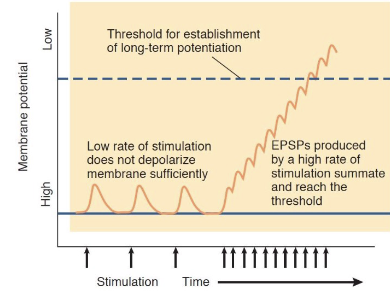

- LTP is long lasting: single pulse stimulation produces largerr population EPSPs hours to days later
- LTP can be generated via repeated electrode stimulation ot via learning
- molecular mechanism underlying simple learning like classical conditioning
- neurral circuitry: synapses are strengthened through LTP due to glutamate dependedt changes to the synapses
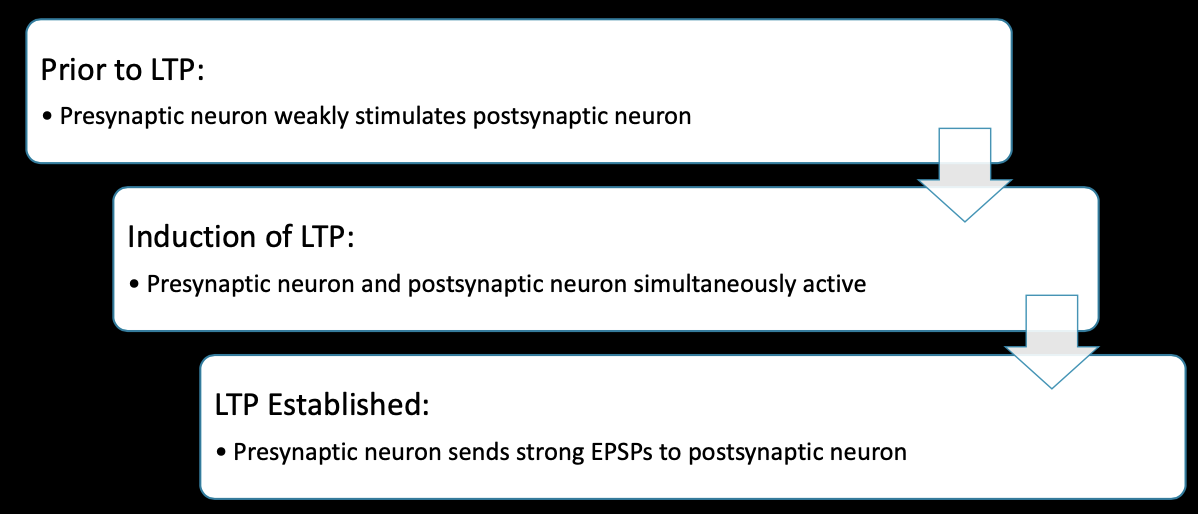
- Hebb rule: neurons that fire together wirre together
- a neuron and postsynaptic neuron are simultaneously active
- changes to synalse strengtthen and increase the likelihood of EPSP
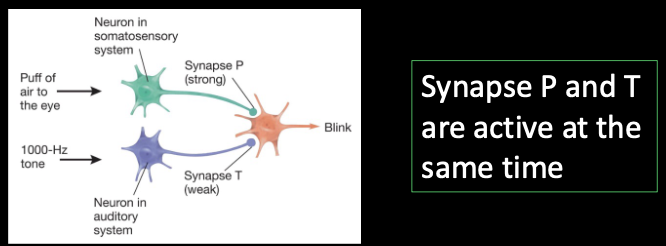
Prior to LTP
- somatosensory neurons send strong EPSPs to motor neurons→blink response
- auditory neuron does not→ does not produce blink response
- 2 glutamate receptors:
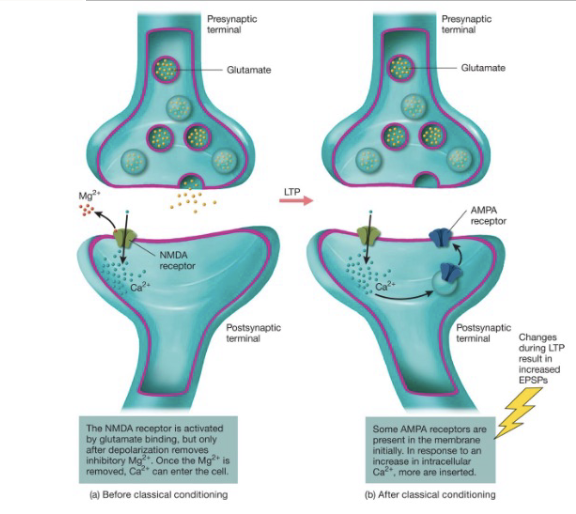
- NMDA receprors on post synaptic membranes: Ca2+ ion channel
- AMPA receptors: most stores in nonsynaptic regions of the postsynaptic neuron (Na ion channel)
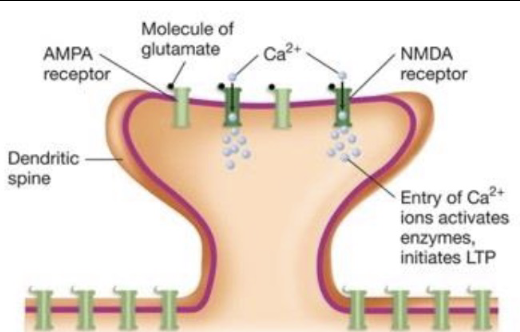
- NMDA receptors: ligand gated ion channel: glutamate binding opens calcium channel
- voltage gatted ion channel: calcuim channel blocked bt Mg2+
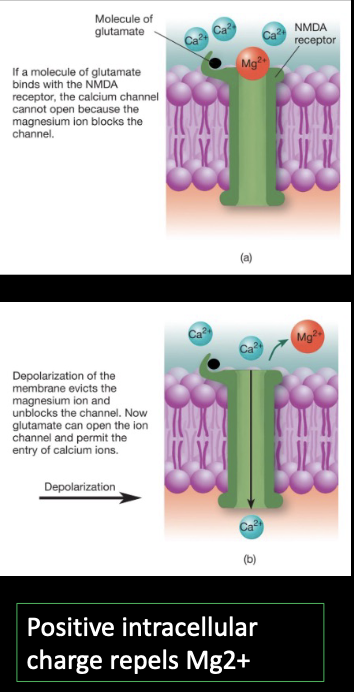
- synaptic transmission prior to LTP
- AP at presynaptic neuron
- Glu binds at AMPA and NMDA
- NMDA blocked
- AMPA allows in some Na
- Weak EPSP produced
Introduction of LTP
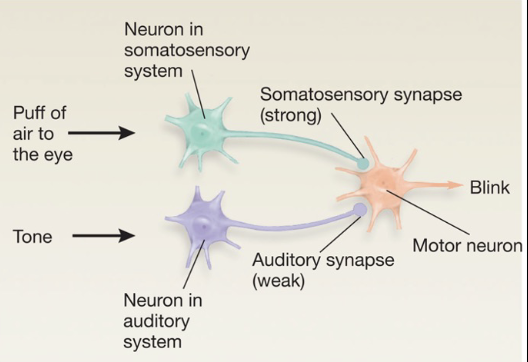
- repeated pairing of 2 stimuli
- stimualtion of motor neurons via somattosensory neuron
- simultaneous release of Glu from auditory neuron
- repeated
- glutamate alone in weak synapses cannot activatte NMDA receptors
- requires: glu binding + postsynaptic depolarization→ induction of LTP
- dendrritic spikes: action potential in dendrites
- can occur in hippocampus CA1 neurons
- occur when AP in axon o f the same neuron spreadsto dendrites
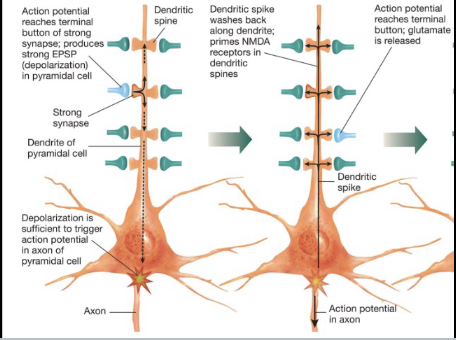
- induction of LTP
- depolarization in postsynaptic neuron
- dendritic spike. + glu binding
- Ca2+ enters via NMDA
- Ca2+. begins signaling cascade
- activates CaMKII: calcium dependednt enzyme
- triggeres AMPA receptors to move into postsynaptic membrane
After LTP Established
- NMDA receptors and more AMPA receptors
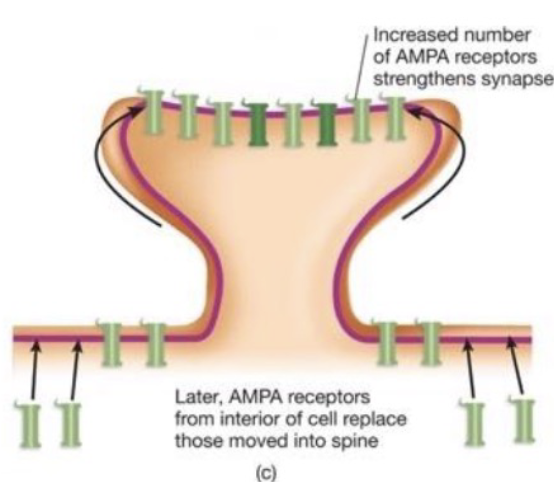
- Synaptic Transmission in potentiated synapse
- AP in presynaptic neuron
- Glu binds at AMPA and NMDA receptors
- Many AMPA receptors open
- Lots of Na2+ enters
- Postsynaptic neuron depolarized
- Mg2+ repelled from NMDA
- Ca2+ enters
- STRONG EPSP
- \
- Auditory synapse is stronger
- Auditory neuron activation produces strong EPSP in motor neuron
- Blink!