Measuring enthalpy changes
Measuring enthalpy changes with calorimetry
measure the energy transferred in a reaction as heat using a calorimeter.
Combustion calorimetry - used to find the enthalpy change when a fuel is burned. e.g enthalpy change of combustion
Solution calorimetry - used to find the enthalpy for reactions occurring i aqueous solution such as enthalpy change of neutralisation
Combustion calorimetry
a weighed fuel sample is burnt underneath a calorimeter contaning a known mass of water
As fuel combusts heat is transferred to the water. A thermometer measures temperature change
Temperature change along with mass and heat capacity of water used to calculate heat energy transferred
Inaccuracy in enthalpy changes
Heat loss - heat escaping to the surroundings means less is absorbed by the water, leading to lower measured enthalpy change
Incomplete combustion - when fuel doesn’t completely burn, less heat produces leading to lower enthalpy change
Fuel evaporation - if some fuel evaporates before burning, it reduces amount of heat generated, leading to decreased the measured the enthalpy change
Solution Calorimetry
Add a measured volume of one reactant to a polystyrene cup and record initial temperature
Add a measured volume of a second reactant and quickly seal container with a lid
Carefully stir the mixture with the thermometer and record temperature at regular intervals
Creating an accurate temperature-time graph
During a calorimetry experiment, the temperature fluctuates throughout, increasing rapidly then decreasing gradually
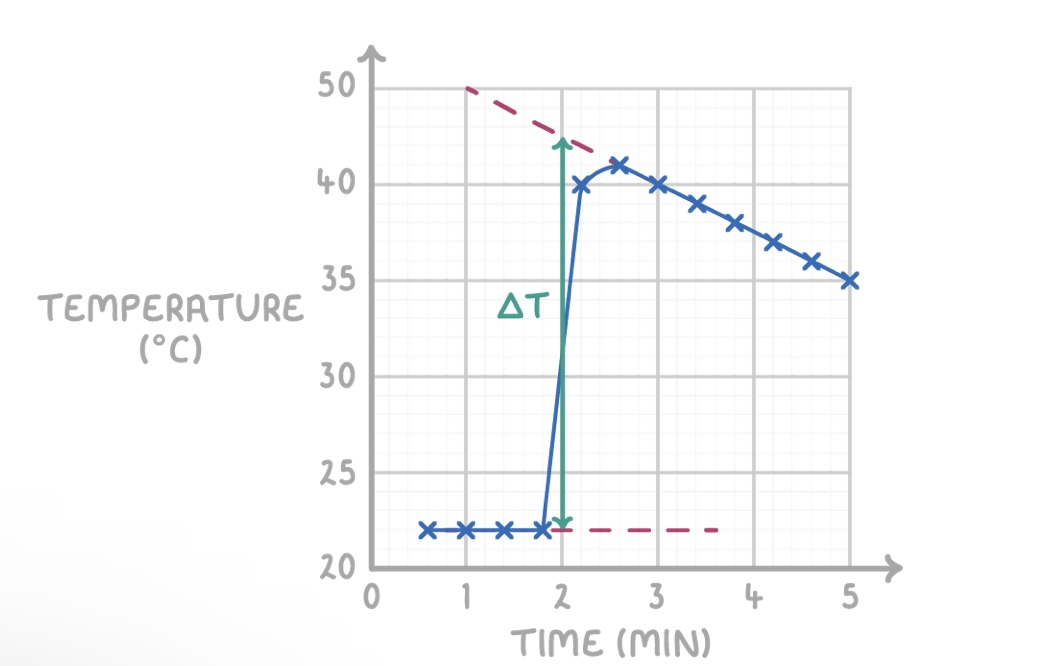
Plot data - Temperature against time
Establish baseline - Draw line of best fit for initial temperature before reactions commences
Post reaction line - After peak reaction temperature is reached, draw another line of best fit at the start of the reaction gives the accurate temperature change
Extrapolation - extend both lines to intersect at reactions start time
True temperature change - The difference between the two extrapolated lines of best fit at start of reaction to gives accurate temperature
Calculating enthalpy change
q=mc∆T
q - heat change (J)
m - mass of water (g)
c - specific heat capacity (J/g/K)
∆T - temperature change (K)
Then use
∆H = q/n
∆H - enthalpy change (kJ/mol)
q - heat energy (kJ)
n - moles of limiting reactant (mol)