The Structure of Party Competition
1. Parties in US Democracy
Political Parties & Elections
Electoral mobilization and candidate selection
Parties are coherent brands for imperfectly informed voters
Persistance of two party system
Political Parties in Government
Coalition formation and maintenance
Coordination within/across branches
Agenda control and policy making
2. The Unidimensional Spatial Model: Utility Functions
Connectedness: two alternatives, A > B or B > A
Transitivity: If C > A and A > B, then C > B
Utility Function: for each individual i, a mapping from set of alternatives to a number, with each alternative x assigned a unique value ui(x)
Alternative Point / X = the candidate’s position
Preference Profile: the set of all utility functions (for all i )
Euclidean Spatial Preferences: each ui(x) characterized by an ideal point xi and utility is decreasing in the distance between xi and the alternative x, |x-xi|
Ideal Point: the policy that maximizes the individual’s utility
The desired voter’s position
Voting for the candidate closest to you in position
The farther away the ideal point (voter’s position) is from alternative point / x (candidate’s position), the worse it is for you / the voter ‼‼
3. Hotelling-Downs Spatial Voting Model
A1. Suppose alternatives representable as points on a line
A2. Suppose all voters have Euclidean preferences over alternatives (summarized by ideal points)
A3. Suppose simple majority rule with no abstention (declining to vote)
A4. Suppose two office-seeking candidates who take unconstrained positions on the line
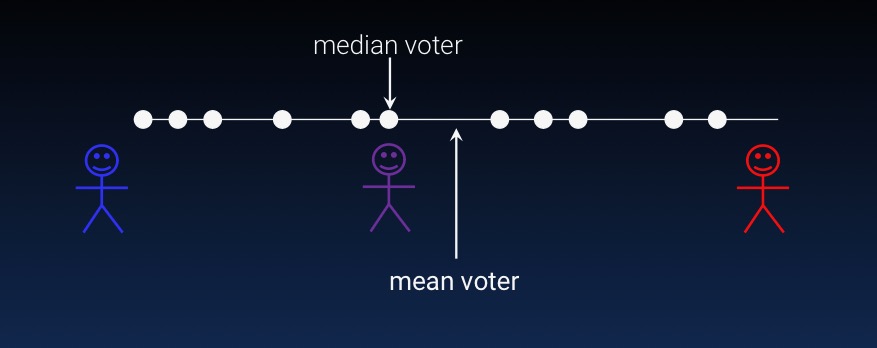 For any distribution of voter ideal points, there is a Nash Equilibrium (NE) in which both candidates converge to the ideal point of the median voter
→ The candidate moving closer to the center is desirable because they are moving closer to more voters but in real life, candidates do not do this; most candidates do not become moderate
4. The Median Voter Theorem
Separate from Hotelling-Downs Theorem !!!!
A1. Suppose alternatives representable as points on a line
A2. Suppose all voters have Euclidean preferences over alternatives (summarized by ideal points)
A3. Suppose simple majority rule with no abstention (declining to vote)
Given A1 - A3 are correct, the median voter’s ideal point is unbeatable in pairwise competition
5. The Normative Implication
The ‘Classic View” of democratic responsiveness
The median ideal point minimizes the sum of absolute distances to other ideal points, so the best move is to always position at the median point…?
→ Not so fast! In reality, politicians take on extreme positions and there is significant ideological polarization in the US
In the real world, a voter may want a more extreme representative than yourself because though they are more extreme, they will not be the sole decision maker once in office. The representative will join more moderate politicians of their party which will somewhat balance the extremities due to having to compromise
6. Constraints on Party Position-Taking
Party: an organization that seeks to elect a candidate to public office
A party needs to attract members, resources, and a candidate to operate
Typically people with more extreme ideals are more motivated— they are the people who run for office
→ This goes against the Hotelling-Downs Theorem; a candidate cannot share a median position because they have to come across as different in order to justify support against the opponent
The Hotelling-Downs Theorem also falls short because candidates don’t only care about winning and appeasing the median voter; they also care about their positions and policies so converging to the center doesn’t make sense
There are benefits to brand identification; it creates easily identifiable party cues for voters
7. Primaries
Open Primaries: any registered voter can vote for a candidate in any party
Closed Primaries: any registered voter with a particular party’s membership can vote for said party’s candidate
Top-Two Candidates Open Primary: the top two from a single ballot voting election proceed to general elections— no voting restriction
The median voter in a primary is not the same as a median voter in the general election !!
When the moderate members of each party stay home, the primary median voters shift to more extreme but more extreme candidates fare worse
When extreme candidates win primaries, there is mobilization and polarization of the opposition; the other party’s base is more motivated
8. The Decisive Vote
The importance of the state comes from
How close the forecast is supposed to be (closeness)
How swingable are centrist voters (uncertainty)
How likely would it be that flipping state would change outcome (decisiveness)
Candidates are not tactical and make mistakes in choosing where to divert focus on state electoral voters in presidential general elections
9. Why Only 2 Major Parties?
Hypothesis 1: National Consensus
Few divisions among voters— there isn’t enough disagreement to warrant multiple parties
Hypothesis 2: Election Law and Cooptation
Winner takes all vs. proportional elections
Minor parties will merge with the big party as that is more beneficial than running in Single-Member Districts
Fear of a “wasted vote”
There is no incentive for small parties to compete
Cooptation: parties diverge to prevent third-parties from forming
10. Polarization
The American constitutional system is not well designed to reap the benefits of polarized parties
There is more likelihood of gridlock when polarized