MODULE 2
YOU’RE THE MAN: ARISTOTLE
Aristotle
Was born in 384 BC, in the town of Stagira - Northeast coast of Thrace
At 17 years old, went to Athens to enroll in Plato's Academy where stayed there for 20 y years as a student and a member
In 348 BC, left the Academy and went to Assos, near Troy, upon the request of Hermeias - ruler of Assos
For 3 years, he stayed in Assos as writer and teacher; he also married Pythias, the niece and adopted daughter of Hermeias
Pythias died when they returned to Athens and he was engaged with Herpyllis who bore him a son named Nicomachus after whim the Nicomachean Ethics was named
In 343 BC, he became the tutor to Alexander, 13 years old, son of Philip of Macedon When Alexander ascended into the throne of his late father Philip, Aristotle returned to Athens
In 335 BC, he founded his own school - Lyceum, named after the groves where Socrates spent time in thinking and which were the sacred precincts of Apollo Lyceus
In Lyceum, he and his students walked in Peripatos - a tree covered walk and discussed philosophy, hence, his school was called Peripatetic.
He died in 322 BC of a digestive disease of long standing, in Chalcis
How Plato's Idea paves the way for Aristotle's Philosophy? Plato believed that there are 2 different worlds - the world of idea and the world of matter
The world of matter: Temporary, changeable, contingent, not real. It is the world we all into and where we exercise our individuality
The world of idea: Infinite, permanent, necessary, the real on. It is the archetypal - real world
Plato's Allegory of the Cave:
There was a cave which inside it are imprisoned individuals, chained since birth
What the prisoners saw inside of the cave are the shadows of real people and things outside being projected by the rays of the sun into the dark cave
The prisoners really believed that those passing shadows are the real ones, until the time when one of the prisoners got free from his chain and managed to get out of the cave
Plato's Allegory of the Cave:
From thereon, the freed prisoner realized that all they saw in the cave as nothing but mere shadows of the real objects cast by the rays of the sun into the cave
The escaped prisoner went back into the cave to inform and convince all the prisoners inside of the truth he discovered. However, they didn't believe in him and felt comfortable to remain inside the cave and be in their chains
Interpretation of Plato's Allegory of the Cave:
This material world is the cave where we are being chained by ignorance
An ignorance to believe that everything here is real and true. But, how can a finite- changeable object / thing becomes real and true, since, what we know today will not be the same tomorrow? Only what is permanent can be the true reality
Everything we are seeing and dealing here are mere reflection of what is real which is out there
The Good, The Bold, and The Strong: Bonus et Arete
There is, It's OK: Bonus (Good)
Aristotle argued that reality is not something flying upward in the unknown world of Platonic idea, rather, it is where we are right now situated - this material world. Reality is composed of many bipartite metaphysical elements, among which is matter and form (Schumpf, Ancient Philosophy, 2017)
Matter = the things that made up a given reality
Form = the essence of a given reality or that which makes something as something and not the another thing
e.g. Table: woods, nails, paint, screws are its matter
'tableness' is its form (without the 'tableness' of a table, the matters composing it can become a chair).
In the sphere of Metaphysics, man searches for what is good, not in the realm of ideas, but as they experience the reality of this material world. Hence, by reason of its existence, a thing is good. Simply saying that something is good because it exists (Aureada, O.P., Metaphysics, 2017). Example: Roses are good because they exist.
But, how about their thorns which for some suggest dangers? In themselves, the thorns of roses are good, but, in relation to us, they might be bad or dangerous
In the example of roses, it only shows that as far as a thing exists, it is good. It's danger or bad effect is only in relational to the other thing or being, like us - human beings.
In the sphere of Ethics, man searches for what is good. Good comes from the Latin word 'bonum'. For Aristotle, goodness is that which befits one's nature (Hakim, Aristotle's Discourse in Ethics, 2017). This means that what is morally good is what pertains in a given nature / essence of a thing.
For example: For the birds, flying is good (not for man, otherwise, aswang!)
For the teacher, teaching is good (not film showing for the wholes Semester)
For the students, studying is good (not sleeping during the class)
Then, man, by reason of his/her existence is good (Metaphysical) and in search of what is good (Ethical). The more man strives for the good, the more he develops in him/her what Aristotle called, "Arete". What is an Arete?
I'm pretty sure many of you have watched this true to life movie about 12 american soldiers headed by Capt. Mitch Nelson against the Taliban Fighter whose leader is Mullah Razzan. The brave 12 US soldiers was helped by a local tribe leader - Abdul Rashid Dostum who stood against the Taliban regime. With horses as their version of war tanks, they defeated the Taliban warriors of Razzan. Strong willed, strong hearts, strong beliefs are what made them victorious according to former US secretary of defense Donald Rumsfeld (Stanton, Horse Soldiers, 2009). We, too, in cases that call for our excellence to stand for what is right, undoubtedly will rise stronger in the defense of truth and goodness. Is it good to show strength in times when goodness is at peril? Others may suggest better keep quite that put your life at risk. For Aristotle, however, it's not only good, it's a virtuous act! This is a penumbra of Aristotle's next concept which is Arete.
Arete comes from the Greek word "ares" - the god of war
The emphasis is not the war or to be war-like, but, the bravery of Ares. Hence, it is what makes us strong and brave in our everyday quest
In Latin, it's translated as “vir” – man (in gender), hence, comes the English word 'virile', 'virility', and 'virulent' signifying strength, and is the root word of "VIRtue" (Pablo, Aristotelian Ethical Paradigm, 2018).
Arete, therefore, is virtue - that which makes us strong in doing what is good
The person of arete is good and does the good. So, what is the real meaning of Arete / virtue for Aristotle?
Arete/ Virtue is “Good operative habit”
Good - because in itself, arete is good and prompts the person to do good
Operative - because it makes the person possessing it operational, active and dynamic
Habit - because it must be by constant practice, not an overnight project.
The 2 kinds of Arete in us:
Intellectual Arete (resides in our cognitive faculty)
Ratio (reason) - the power to know the truth
Phronesis (practical wisdom) - knowing the right thing to do in a given situation
Sophia (wisdom) - man’s knowledge of the moral principle
Moral Arete (resides in our moral faculty)
Determining the good and doing what is right
Habitually willing the good
Excellent management of feelings and emotions (Hakim, Aristotle’s Discpirse in Ethics, 2017)
Where does our arete lead us?
Aristotle believes that all actions are oriented towards a specific goal; very action has an end. This concept of end is called "Teleology". Teleology comes from 2 Greek words - telos (end/ purpose) and logos (study). Teleology is the study of finality or end of things i.e. all things have a purpose and all actions tend towards their end / goal (Pablo, Aristotelian Ethical Paradigm, 2018). Aside from individual intention on their action, the action itself has an objective end apart from one's subjective purpose.
e.g. The telos/purpose of a pen is to write, but, man in subjective intention can use
the pen to stab his enemy
The telos / end of giving money to the poor is for the poor to have relief from from poverty. On the other hand, a politician will give money to the poor with his subjective intention to use it for his campaign ads in the forthcoming election
Now, since man is by nature good (metaphysically) and aim for what is good (ethically), why many individuals do bad / evil things, like stealing, murder, cheating, etc.?
Man, naturally does what is good. Circumstances, however, may blind man for what is good, and instead choose what is evil in the disguise of a good. Thins is what Aristotle called ‘apparent good” i.e. good as it appears to the person but, in essence, it is really bad/evil. This is due to some circumstances that surround and may influence the person.
The Moral Quantum of HappyKness: Eudaimonia kai Mesotes
Are you happy? What makes you happy? I hope this study of Aristotle's ethics is making you happy. if not, i just wish. Problematic people i.e. those who know no other story except their daily concerns, failures, number of covid19 infected (not minding those recovered), worries, are labeled as toxic, since, being with them we got no good vibe, but, a descending enthusiasm. Bottomline, we all want to be happy, in a happy company, and with happy outlook in life. Most often, we're told by Psychologist gurus that we cannot buy happiness, and really, it's true. But, what really is happiness? Where can we find authentic happiness? Is happiness related to being morally good? Or, can we happy even we're not doing good or being good?
All men yearn for happiness. All actions are inspired by and geared towards happiness (Pablo, Aristotelian Ethical Paradigm, 2018). Aristotle understood happiness, not simply as jolliness, but, in relation to man's arete i.e. virtuous act.
Happiness, in Latin, is “felix” (happy) and "felicitas" (felicity). The philosophical Greek term employed by Aristotle for happiness is "Eudaimonia" - a combination of 2 Greek words i.e. "eu" (good) and "daimos" (that which pertains to the gods). Literally, eudaimonia means the goods that pertain to the gods or the goods of the gods which make the gods happy (Pablo, Aristotelian Ethical Paradigm, 2018). To be real happy, we have to find what makes the gods happy and that is the same thing we should possess.
We have variety of happiness coming from different things. The logic of Aristotle ethical happiness rests on the subject of our happiness i.e. the higher that which makes us happy, the higher is the degree of happiness. And, the highest of all subjects which can make us happy is God (gods for Aristotle). Therefore, the more we deal with things about God, the more we become authentically happy. The highest eudaimonia is the happiness of God that eventually formed our arete. The rest are happiness, likewise, but fleeting and precarious (Marcel, Living in the Ragged Edge of Life, 2016). So, how do we attain eudaimonia?
We attain eudaimonia by being good (what we are) and doing good (what we do). Being good good precedes doing good because someone can do good with a malicious telos / purpose. But, if one's being or nature is good, doing good naturally overflows, unless some apparent goods will cloud one's knowledge (sophia) of the good. Aristotle concurred that doing good is ergon - a Greek word meaning 'dynamic', 'operational', and from where our English term 'energy' is derived. A person who does the eudaimonia of the gods (God) finds real happiness in his/her life, and becomes dynamic – active in doing good /arete (Hakim, Aristotle's Discourse on Ethics, 2017).
How, then, shall we exhibit ergon in our life that people can see in us the eudaimonia, and they, too, wil be encouraged to do the same? To do good is:
To act according to right reason (ratio)
To perform our ability willfully (phronesis)
To act in good and excellent way (moral arete)
On the other side, actions cannot be allowed to have free reign beyond the supervision of human reason, otherwise, what makes us different from animals? Though we are also animals by genera, but our specie is rational - this makes our specific difference as "rational animal" (McIntyre, After Virtue: A Study in Moral Theory, 2011). We need, in this case, something that will balance our actions. This is what Aristotle called mesotes.
From the above explanation of Aristotle, we can infer that real happiness is what makes us relate and connect with God (in his case, since he's pagan, it's the gods of ancient Greeks). Hence, we need to fell prostrate to God in total submission of our wants and desires if we want to possess real - pure happiness i.e Eudaimonia. I hope you understand it, hmm.
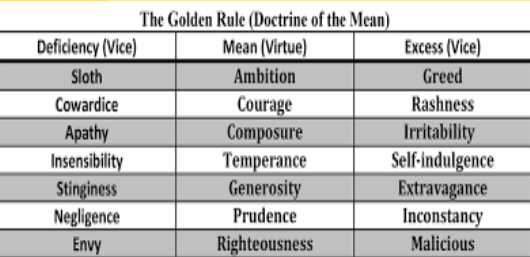
Mesotes is a Greek word that can be translted in English as the “mean”. The following are the roles of mesotes in man’s ergon / action:
It serves as the right measurement of the action
It’s the measure that serves us to avoid the extreme of our actions
It’s the mean of an action (Hakim, Aristotle’s Discourse on Ethics, 2017)
Hence, only right action/ergon has a mesotes, and therefore, solicits arete. Any wrong actions are devoid of mesotes. Since, it strikes the pendulum of our actions ensuing balance amidst diverging sides, mesotes is what we ought to do, regardless our age, gender, belief, religion, etc. Aristotle's famous meme as principle of mesotes is "Virtus Stat In Media" i.e. "Virtue srands in the middle". True arete is a product of a balance act, not falling prey into both extremes - left or right.