4d. Oligopoly
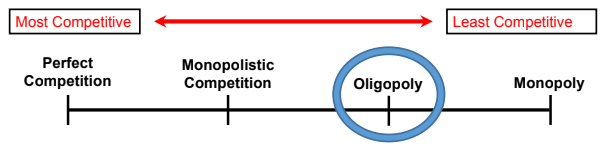
Different Market Structures
Characteristics of oligopoly
Price maker or price taker → Price maker
The objective of firms → Protect market share, profit satisficing (but use MR=MC)
they look to protect market share
there’s a divorce between the shareholders and day to day managers who run the firm
Number of firms → Few (high concentration ratio)
4/6 firms dominate but some smaller firms in the industry
similar to supermarkets in the UK (7/8 large firms and lots of small ones)
Size of firms → Large
Barriers to entry/exit → High
Products → Close substitutes but seen as different by consumers
Oligopoly Market Structure
The majority of markets are concentrated markets, dominated by a few suppliers. Therefore the theory of oligopoly is arguably the most important of the theories of the firms.
Firms are interdependent. The actions of one large firm will directly affect another large firm.
This is the opposite of perfect competition and monopolistic competition where firms are completely independent.
Market conduct
Price rigidity - Prices in oligopolistic markets seem to change far less than in perfectly competitive markets. Despite changes in costs of production, firms are often observed to maintain prices at a constant level.
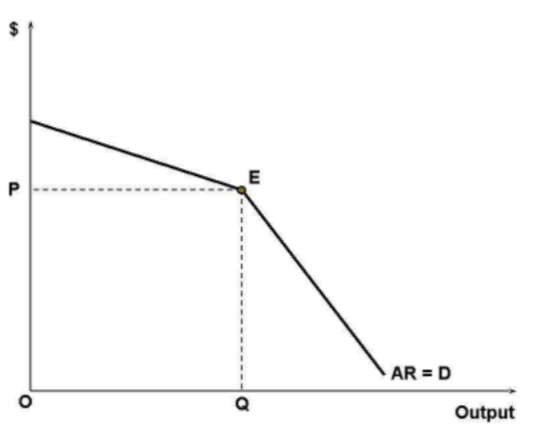
Price rigidity using a Kinked demand curve
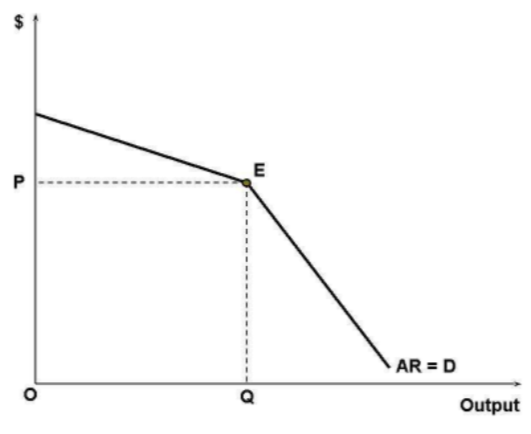
One reason that firms in oligopolistic markets might keep prices constant is that their AR curve is kinked. If this firm was to put its price above P it would find that their competitors maintain their own prices. Because firms are likely to be substitutes, consumers switch to a firm that has kept their price at P. As a result, the output would fall proportionately more than the increase in price. Demand above the price level is therefore elastic and increasing the price of an elastic good reduces the revenue. It is therefore unwise to raise prices in this market.
Price rigidity using a Kinked demand curve
Contrastingly, if the firm were to lower its price all of the other firms in the market would have to do the same. This is so they do not lose market share. Therefore the drop in price would be proportionately larger than the increase in output. This means that below the price level, demand is inelastic, and putting the price down for an inelastic good reduces revenue. Increasing or decreasing the price results in a loss of revenue and therefore prices tend to be constant.
However you could argue that the firm gets a bit off first move advantage up until the other firms finally meet their price
Price rigidity using a Kinked demand curve (not on spec)
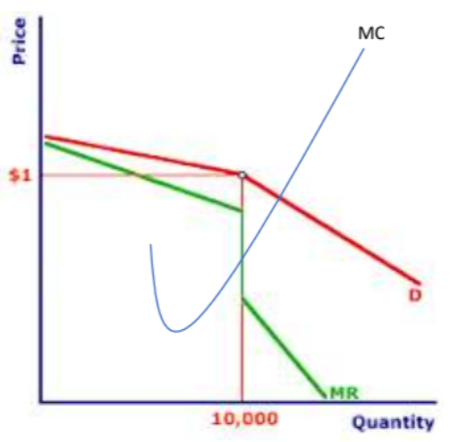
A firm might also keep prices the same despite changing variable costs. The MR curve has a split to demonstrate the curve falling twice as steeply for each part of the AR curve. This means that MC=MR is a range rather than a singular point. Therefore variable costs could go up or down a certain amount and as long as MC stays in the correct range, the firm will still be profit-maximising. Therefore, prices will remain constant in an oligopoly when they might change in others.
even right var costs change the firms will not change their prices due to the degree of movement the MC curve has on the MR curve
Competition and barriers to entry
Price competition
Price wars – occurs when non price competition is weak. Consumers may be highly price conscious
Predatory pricing – occurs when an established firm is threatened by a new entrant. The established firms sets prices too low for the new entrant to be able to make profit
they could shift from price satisficing to sales max which you can link into economics off scale as they would buy in larger quantities so their costs would decrease further unlike small firms
Limit pricing – occurs when firms wish to deter any new entrants from the market. Low prices mean normal profit and discourages new firms
Pricing strategies
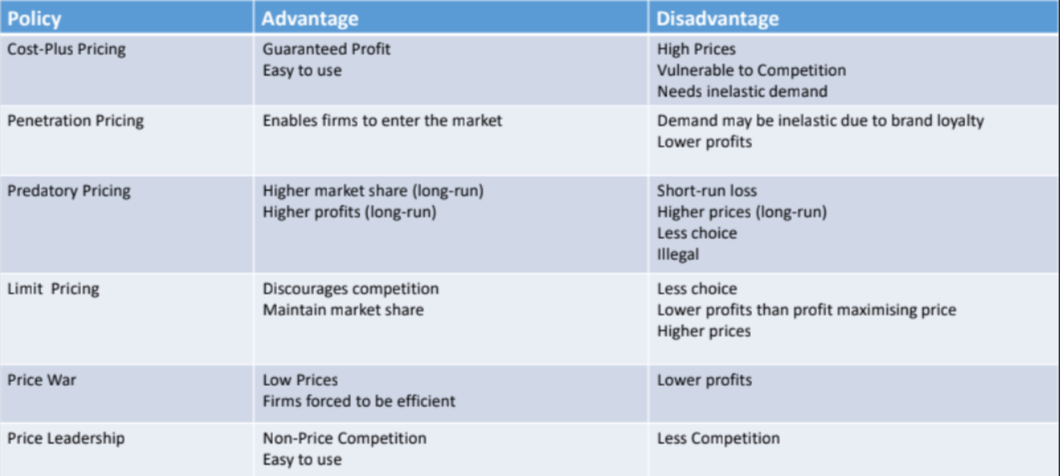
Penetration pricing: Setting a low initial price when a firm starts a product to boost brand recognition
Predatory pricing: Pricing at a level below variable cost to drive out existing firms and then raising prices above the previous equilibrium
Limit pricing: Pricing at a level low enough to limit profits, which has the effect of discouraging new entrants from joining the industry
Price wars: Competition between rival firms through aggressive price cuts
Price leadership: The biggest firm in the market sets a price and other firms follow suit
Market conduct
Non price competition
Price is not always the most important factor in attracting consumers. Firms compete using their marketing mix (the 4 Ps) Branding is very important as it allows products to appear unique. Often higher priced branded products will do much better than lower priced unbranded products despite the two being essentially the same.
Non price competition
Particularly in oligopolistic markets, it may not make sense for firms to compete on price.
They therefore use other parts of the marketing mix to gain customers
Promotion - shift out AR & MR to increase profit but also sunk costs
Place - AC shifts up or sunk costs
Product -
Price
Branding
People
Packaging
Processes
Physical evidence
Non price competition
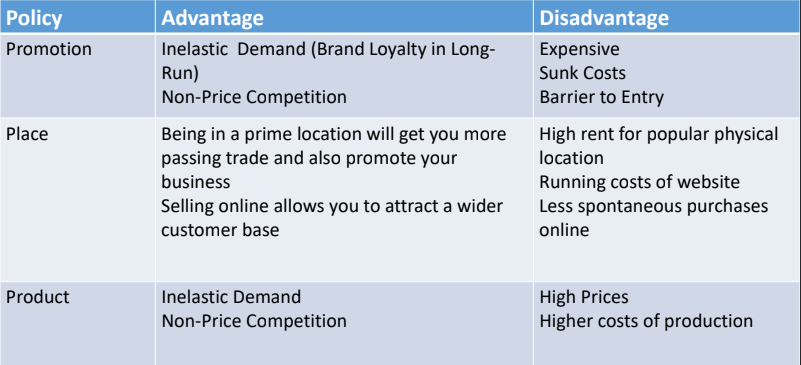
Promotion: Advertising and special offers are used in order to increase awareness of the company and create a level of brand loyalty.
Place: Firms wish to sell their products in the most convenient way possible for customers. This could be a popular physical location with high footfall or online
Product: Ensuring product is of highest possible standard in order to differentiate itself from rivals.
Competition and barriers to entry
Natural barriers to entry
Economies of scale
Ownership or control of scarce resources
High start up costs
High sunk costs
Artificial barriers to entry
Predatory pricing
Limit pricing
Superior knowledge - more money for R&D
Predatory acquisition - facebook and instagram
A strong brand
Loyalty schemes
Exclusive contracts, patents, licensing
Vertical integration
Collusion
Collusion is often a feature of the behaviour of firms in an oligopolistic markets where it is not illegal. When firms do compete amongst themselves it is called a non-collusive or competitive oligopoly
However there are very strong incentives (due to profits) for oligopolistic firms to collude. This means that they make agreements amongst themselves so as to restrict competition and maximise their own benefits.
Collusion
Formal collusion exists when firms in a cartel make agreements. For this a number of conditions need to apply:
An agreement has to be reached
Cheating has to be prevented
Potential competition must be restricted
Formal collusion is illegal across the EU, the USA and many other countries. OPEC are the best example of a cartel that does exist.
Firms could engage in tacit collusion though where there is no formal agreement and instead it is an understanding that exists between firms
it is quite each to prove this as there is physical evidence
Overt Collusion – or openly colluding is rare, as it is illegal
Covert Collusion – This is where firms meet secretly and makes decisions about prices, output and who will win tenders.
Tacit Collusion –This is where there is no communication between firms but firms act as if there were an agreement in place. This helps to explain price stability as firms know that it is in their interests to not compete on price
Conditions Required for Collusion
A high concentration ratio
The more firms there are the more difficult it is to coordinate and the higher the chance of a party defecting
Barriers to entry must be high
If firms collude to raise the price this will not work if new entrants can enter the market and undercut the colluders
Inelastic demand
Consumers must be willing to pay a high price otherwise the firm will make less revenue
It is easy to monitor output and prices
Firms need to be able to easily work out if a fellow colluder is cheating
Market concentration
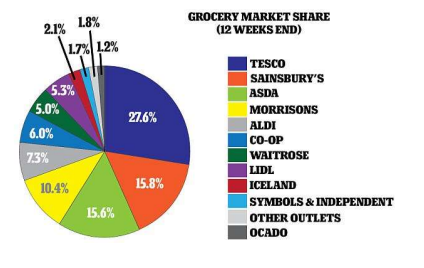
The concentration of a market is calculated by adding the market share of a set amount of firms.
For example, a four firm concentration ratio is calculated by adding the market share of the largest 4 firms 27.6+15.8+15.6+10.4 = 69.4%
Why join a cartel?
Higher prices leading to higher revenue
Lower costs from less competition e.g. less advertising and sales promotion
Increased certainty about future performance/stable market share
Game theory
Game theory is concerned with predicting the outcome of games of strategy in which the participants (for example two or more businesses competing in a market) have incomplete information about the others' intentions
Game theory
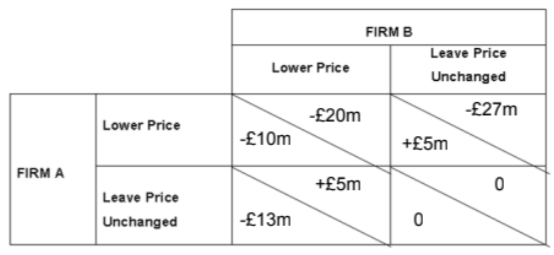
If Firm A gets to move first and decides to charge a lower price then they will increase revenue from 0 to £5m as Firm B are unable to change their price in the short-run
However, once Firm A have chosen a lower price, in the long-run Firm B will also charge a lower price as -£20m is better than -£27m
There is therefore no incentive for Firm A to lower their price as they will face retaliation in the long-run
Types of strategy
A maximax strategy is one where the player attempts to earn the maximum possible benefit available. This means they will prefer the alternative which includes the chance of achieving the best possible outcome – even if a highly unfavourable outcome is possible.
This strategy, often referred to as the best of the best is often seen as ‘naive’ and overly optimistic strategy, in that it assumes a highly favourable environment for decision making.
A maximin strategy is where a player chooses the best of the worst pay-off. This is commonly chosen when a player cannot rely on the other party to keep any agreement that has been made - for example, to deny.
Nash Equilibrium
Nash Equilibrium is an important idea in game theory – it describes any situation where all of the participants in a game are pursuing their best possible strategy given the strategies of all of the other participants.
In a Nash Equilibrium, the outcome of a game that occurs is when player A takes the best possible action given the action of player B, and player B takes the best possible action given the action of player A
Game theory limitations
In real life there could be long-run costs to ‘cheating’ such as damage to a brand’s reputation and firm’s reluctance to trust them in the future
Players will act differently if the game is repeated- they may pick worse options in the short-run to gain trust which allows better outcomes in the future
Assumption that firms are perfectly rational and have a perfect knowledge of the pay-offs are unrealistic and people frequently act for non-rational reasons
Regulation
Prior to 2014 investigation of anti-competitive practices was carried out by the Office of Fair Trading (OfT) whilst decisions about whether to permit mergers was carried out by the Competition Commission (CC). In 2014 these bodies were merged into the Competition and Markets Authority (CMA).
The CMA is responsible for:
Investigating markets where there appear to be competition problems e.g. high prices
Investigating suspected collusion
Investigating mergers which could restrict competition
Powers of the CMA
To encourage the industry to set up a voluntary code of practice
To insist firms publicise information
To recommend actions for the industry regulator e.g. price capping
To block a potential merger
To insist on a demerger
To fine companies acting anti-competitively (up to 10% of worldwide revenue)
To bring criminal proceedings against those involved in cartels
Regulation mergers
Generally, mergers will be considered by the UK competition authorities if the merger creates a 25% market share or more. A firm holds a dominant position if its power enables it to operate within the market without taking account of the reaction of its competitors or of consumers.
Mergers which might otherwise be banned can be allowed if they help pursue the national interest e.g. the merger of Lloyds TSB and HBOS gave the new Lloyds Banking group a 35% market share but was permitted due to the problems caused by the credit crunch.
Criticisms of the CMA
Each investigation is made up of a panel of five members. The panel changes for each investigation. Actions taken by the panel can be quite subjective leading to inconsistencies in approach
Only a small % of mergers and anti-competitive practices are actually investigated
The CMA has been criticised for being too lenient possibly as a result of regulatory capture
The role of the European Commission
The greater number of multinationals has meant that EU legislation has become increasingly important to provide effective competition in markets.
Broadly speaking, mergers involving enterprises with an aggregate worldwide turnover of more than €5 billion and where the aggregate Community-wide turnover of each of at least 2 of the enterprises concerned is more than €250m will be investigated by the European Commission.
However, those mergers where more than two-thirds of the Community-wide turnover of each enterprise concerned falls within one and the same member state, are not caught by the EC Merger Regulation.
Evaluate the price and non-price competitive options that might be used in an industry of your choice.
KAA1
predatory pricing
limit pricing
EV1
consequences of putting the price too low
kinked diagram
KAA2
4 Ps
Promotion - AR shifts
Product - AR shifts
Place - AR shifts
EV2
Sunk costs of all above
AC shifts up lower profit
In the oligopolistic market, John Lewis has the opportunity to utilize both predatory and limit pricing strategies. Predatory pricing involves setting insurance premiums substantially below the costs incurred by the firm. This approach aims to deter potential competitors and safeguard the company's market share. The Profit Max to Sales Max diagram illustrates the benefits of this strategy. In the short term, this sacrifices profits, but the ultimate goal is to eliminate competitors and later raise prices back up to P2, where MR equals MC, restoring profit maximization. On the other hand, John Lewis might opt for limit pricing at P3, which serves to deter potential new entrants while enabling the firm to maintain higher prices and profits. Limit pricing acts as a barrier to new competitors, deterring them from entering the market and protecting the company's market share.
While both predatory and limit pricing have their advantages, there are potential drawbacks associated with aggressively low pricing strategies. Predatory pricing can lead to a risky situation where costs cannot be substantially reduced, the firm risks provoking a price war among competitors. Competitors may retaliate, and the firm could incur significant losses if it is unable to maintain the low prices. The kinked demand diagram demonstrates the consequences of overly aggressive price competition, potentially leading to a loss. Limit pricing, while deterring new entrants, may not guarantee that they will not find efficient ways to operate at prevailing low prices. In such cases, the firm might miss out on profitable opportunities that a less conservative pricing strategy could have capitalized on.
Besides price strategies, John Lewis can employ non-price competitive options to bolster its presence in the insurance industry, leveraging the "3 Ps" of marketing: Promotion, Product, and Place. Promotion strategies encompass advertising and special offers, which serve to increase brand recognition and shift the Average Revenue (AR) and Marginal Revenue (MR) curves outward, ultimately boosting profits. These efforts help create brand loyalty and increase demand for the firm's services. In addition, the firm strategically ensures that its products are conveniently available in both physical and online locations. This approach provides customers with easy access to its services, enhancing demand and profitability.
However, promotion efforts may result in substantial upfront creative and promotional costs. These investments do not always guarantee brand loyalty, and customers may not perceive the added value, potentially impacting profitability. Ensuring convenient product availability, be it physical or online, may result in increased costs. These expenses, whether from selecting premium physical locations or investing in online infrastructure, can have a detrimental effect on profits.
Firms in oligopoly like John Lewis may use predatory pricing strategies to undercut smaller rival supermarkets. By pr
as shown when it offered “accidental damage cover” for low prices in Extract B. However, this risks unsustainably low prices if costs cannot be reduced, and may provoke retaliation (EV1). John Lewis could also use limit pricing to deter new entrants, but again faces the danger of unprofitable margins if costs remain high. As depicted in the kinked demand model, overly aggressive price competition can lead to a race to the bottom.
Firms in oligopoly like John Lewis could use predatory pricing strategies to undercut smaller rival supermarkets and gain market share. As shown in Extract B, John Lewis offered low-cost “accidental damage cover” as a competitive pricing strategy. Predatory pricing involves lowering prices below average costs, as depicted in the diagram where price is set at P1 below average cost AC. The aim is to eliminate or weaken rivals by pricing them out of the market. Losses are accepted in the short run to drive out competition and allow the predatory firm to later raise prices and restore profits, maximizing revenue rather than profit. However, predatory pricing relies on sufficient capital reserves to sustain losses until rivals exit. John Lewis could also use limit pricing at P2 to deter new entrants, though again risks unsustainably low margins if average costs remain high.
Alternatively, John Lewis differentiates itself through non-price strategies. Extract A shows John Lewis launching a new “brand promise” campaign highlighting “cherished family moments” to strengthen brand loyalty. Significant upfront creative costs were invested, with the advert reaching a mass audience to shift out demand. Product development, service quality, marketing and an “omni-channel” retail presence also distinguish John Lewis (KAA2).
However, non-price competition carries risks, as shown when the misleading insurance advert was pulled in Extract B. The high costs of “special effects”, promotions and branding may fail to build loyalty (EV2). Extract C suggests the Christmas advert alone cost “around £5 million” in media spending.
In conclusion, oligopolists optimally balance price and non-price strategies (EVAL). While price competition risks an unsustainable race to the bottom, avoiding it completely allows rivals to undercut prices. John Lewis can justify premium pricing through strong brand differentiation, while using selective discounts to remain competitive. Integrating both approaches helps sustain margins and market share.
Predatory pricing is a price competitive strategy in which a firm sets prices below production costs to eliminate competitors or deter potential entrants. The primary benefit of predatory pricing is its potential to establish market dominance. By driving competitors out of the market, a firm can secure a significant share of the market. Even though it may lead to initial losses, predatory pricing, as illustrated by a profit-maximization-to-sales-maximization diagram, can result in substantial long-term gains. This strategy allows the firm to raise prices once competitors are driven out, leading to higher profitability.
However, predatory pricing is not without its disadvantages. Sustained periods of pricing below production costs can lead to significant financial losses, potentially harming the firm's long-term viability. Furthermore, competitors may respond by filing antitrust complaints if they believe predatory pricing is being used to stifle competition. This legal scrutiny can result in substantial legal costs and damage to the firm's reputation.
In contrast, limit pricing is a more conservative approach to price competition. It involves setting prices at levels low enough to deter potential entrants. While it ensures price stability, limit pricing can lead to lower profits in the long run, as depicted in a kinked demand diagram. The absence of aggressive pricing might deter innovation and hinder the firm's long-term competitiveness.
Beyond price strategies, non-price competitive options are crucial for firms. The 3 Ps—Product, Promotion, and Place—offer alternative strategies for differentiation and revenue growth.
Product: Improving product quality and features can attract customers willing to pay a premium, leading to a shift in average revenue (AR) and increased profit margins.
Promotion: Effective advertising and marketing can elevate brand recognition and customer desirability, translating into increased AR. Promotions stimulate demand, thereby boosting overall revenue.
Place: Strategic expansion of distribution networks, market entry, and enhanced accessibility can lead to shifts in AR, ultimately contributing to higher profitability.
However, non-price competitive options also come with their own set of challenges:
Sunk Costs: Investment in product development, promotion, and place expansion incurs significant upfront costs. These costs, especially in the case of advertising campaigns or new market entry, might not yield immediate returns and can strain the firm's financial resources.
Rising Average Costs (AC): While a focus on increasing AR can enhance profitability, expanding product lines and distribution networks often leads to rising average costs due to increased overhead. If AR doesn't keep pace with the rising AC, it can result in lower profit margins, despite increased revenue.
In conclusion, competitive strategies in the retail industry encompass both price and non-price elements. While predatory pricing and limit pricing can influence competitors and profitability, non-price strategies such as the 3 Ps offer avenues for product differentiation and revenue growth. John Lewis, as a prominent player in the retail sector, must judiciously weigh the advantages and disadvantages of these options to maintain its competitive position and long-term profitability.
In the context of John Lewis, these strategies have played a significant role in shaping its market presence and will continue to be essential in navigating the ever-changing landscape of the retail industry.
The key advantage of advertising is increasing brand awareness and customer loyalty, enabling a firm to reach a wider audience and potentially expand market share. Through effective advertising, the firm can create a stronger presence in the market, making consumers more aware of its products and services. This increased recognition can lead to higher customer trust and loyalty. Moreover, advertising enables the firm to reach a broader audience, potentially tapping into new market segments or expanding its customer base. The optimal strategy depends on competitors’ actions (KAA). If neither firm advertises, profits are £40m each. If Firm A alone advertises, it earns £70m versus Firm B’s £15m.
On the other hand, advertising can be a costly move. It demands substantial financial resources that firm A may not have readily available. High advertising expenses can significantly impact the firm's profitability. Additionally, the effectiveness of advertising campaigns is not guaranteed. In some cases, despite substantial investment, advertising— efforts may not yield the desired results, leading to a suboptimal return on investment. In this scenario, firm A must carefully assess its competitors' strategies and objectives. The equilibrium is reached when firm A's advertising decision aligns with what firm B is doing. This equilibrium may involve choosing to advertise or not, depending on what other players in the market are doing, however in the end both firms will end up at nash equilibrium where they end up making an ultimate loss.
With reference to Asda or a firm of your choice, evaluate the extent to which a firm in an oligopolistic market has control over the price levels they set. Use game theory in your answer (25)
use game theory
P1
KAA
cut prices from profit max to sales pricing
EVAL
about kinked diagram as they can decrease but not increase again after
P2
incentive to decrease prices using game theory
but at the end nash equilib cause losses
In the oligopolistic market, Asda has the ablility to utilize both predatory and limit pricing strategies. Predatory pricing involves setting insurance premiums substantially below the costs incurred by the firm. This approach aims to cause potential competing firms to make losses and exit the market which protects the company's market share. The Profit Max to Sales Max diagram illustrates the benefits of this strategy. In the short term, this sacrifices profits, but the ultimate goal is to eliminate competitors and later raise prices back up to P2, where MR equals MC, restoring profit maximization. On the other hand, Asda might opt for limit pricing, which helps deter potential new entrants while enabling the firm to maintain higher prices and profits. Limit pricing acts as a barrier to new competitors, preventing them from entering the market and protecting the company's market share.
While both predatory and limit pricing have their advantages, there are potential drawbacks associated with aggressively low pricing strategies. Predatory pricing can lead to situations where costs cannot be substantially reduced, in which the firm risks provoking a price war among competitors. Additionally, competitors may retaliate, and the firm could deal with significant losses if it is unable to maintain the low prices. The kinked demand diagram demonstrates the consequences of overly aggressive price competition, potentially leading to a loss. Limit pricing, while deterring new entrants, may not guarantee that they will not find efficient ways to operate at prevailing low prices. In such cases, the firm might miss out on profitable opportunities that a less conservative pricing strategy could have capitalized on.
Asda also has the incentive to cut prices as it increases brand awareness and customer loyalty, enabling a firm to reach a wider audience and potentially expand market share which would increase their profits. Their strategy depends on what their best course of action would be in comparison to another firm in the market. If both firms currently make 40m, it is in Asda’s interest to cut prices as this would mean they increase profits to 70m.
On the other hand, in this scenario, firm B will also act according to how Asda behaves and in doing so would choose to cut prices so they go from 15m in profits to 20m. At this point nash equilibrium is reached when both Asda and firm B have decided to cut their prices ultimately leading to a loss for both firms.