BACTERIA
Small, single-celled organism is a Bacteria. Almost all areas of the world are home to bacteria, which are essential to its ecosystems. Several organisms can survive in environments with high pressure and temperatures.
• Extremophile which thrive under extreme environments such high temperature and pressure.
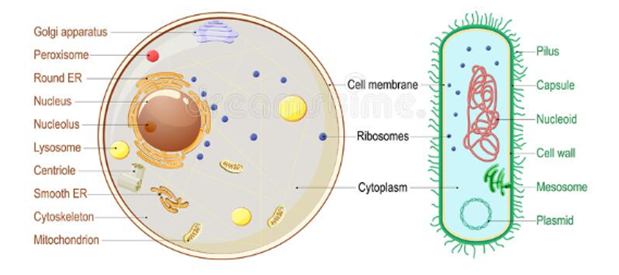
Human Cells vs Bacterial Cells
Binary Fission
• When an organism divides into two identical offspring. It is a asexual reproduction that frequently takes place in prokaryotic microbes.
Etymology
• The word bacteria is the plural of the New Latin bacterium, which is the Latinisation of the Ancient Greek baktḗrion (βακτήριον), the diminutive of baktēría ( βακτηρία), meaning "staff, cane", because the first ones to be discovered were rod-shaped
Ancestors of Bacteria
• The ancestors of bacteria were unicellular microorganisms that were the first forms of life to appear on Earth, about 4 billion years ago.
• For about 3 billion years, most organisms were microscopic, and bacteria and archaea were the dominant forms of life.
• Studies indicate that bacteria diverged first from the archaeal/eukaryotic lineage.
• The most recent common ancestor of bacteria and archaea was probably a hyperthermophile that lived about 2.5 billion–3.2 billion years ago.
Hyperthermophile • A hyperthermophile is an organism that thrives in extremely hot environments—from 60 °C (140 °F) upwards. An optimal temperature for the existence of hyperthermophiles is often above 80 °C (176 °F).
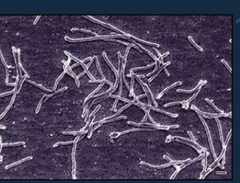
Habitat Soil- Bacteria are essential for the decomposition of organic matter in soil. • Nutrient Cycling Water- Nutrient Cycling, Photosynthesis, and Nitrogen Fixation Human and Animal Bodies- Some bacteria are commensal, while others are pathogenic. Plants- Can form symbiotic relationships with plants, providing them with essential relationships. Extreme Environments- E.g. Hot springs, deep-sea vents, and acidic or alkaline environments
Behavior Motility: Some bacteria are motile and can move by using flagella
Chemotaxis: Bacteria can detect and respond to chemical gradients in their environment
Quorum sensing: Some bacteria can communicate with each other through the production and detection of chemical signals.
Biofilm formation: Bacteria can form biofilms, which are communities of bacteria that are surrounded by a protective matrix of extracellular material.
Sporulation: Some bacteria can form dormant structures called spores
Conjugation: Bacteria can exchange genetic material through a process called conjugation
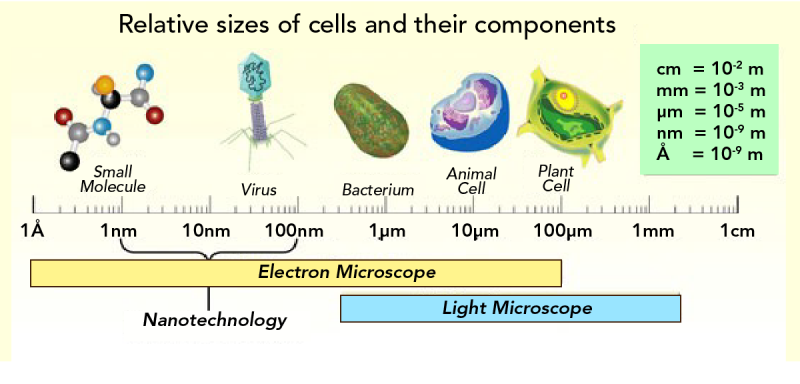
CELL STRUCTURE OF BACTERIA • Bacteria are single-celled organisms. • Bacterial cells are much smaller than human cells. • Bacterial cells can measure from about 1 to 10 μm long.
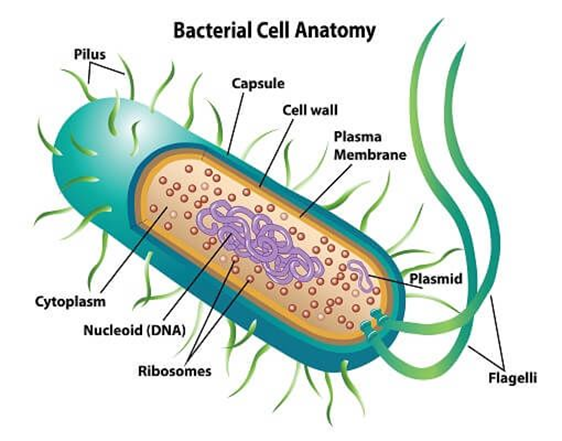
Pili- hair-like structures that help bacteria attach to surfaces and other bacteria
Plasmids - genetic material (DNA)
Ribosomes - structures that make proteins.
Cytoplasm- A gel-like substance that holds the ribosomes and genetic material.
Cytoplasmic Membrane - a thin layer of phospholipids proteins that controls the movement of nutrients in and out of the cell.
Cell Wall- rigid wall that gives the cell its structure and protects the plasma membrane
Capsule- a third layer that helps prevent the bacteria from drying out.
Nucleoid - a mass of genetic material (DNA)
Flagellum- structure that helps the bacteria move around and sense their environment.
Types of Bacteria • There are several ways on how to classify and define bacteria.
• Bacteria can be identified by shape.
• Scientists also classify bacteria based on their need for oxygen to live and grow.
• Another way scientists classify bacteria is by their genetic makeup and scientific name.
• Scientists classify bacteria by the color they turn after they apply special chemicals (stains) to them.
Shape
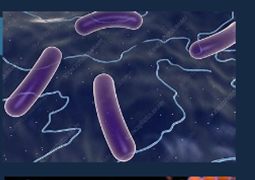
BACILLUS • A bacillus (plural bacilli) or bacilliform bacterium is a rod-shaped bacterium or archaeon.
COCCI • A coccus (plural cocci) is any bacterium or archaeon that has a spherical, ovoid, or generally round shape.

VIBRIO
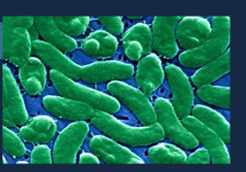
• A vibrio, (genus Vibrio), any of a group of comma-shaped bacteria in the family Vibrionaceae.
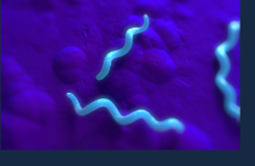
SPIRILLA • A spirilla (singular, Spirillum) are a group of bacteria characterized by a corkscrew (spiral) appearance.
Need for Oxygen- Bacteria that need oxygen are called aerobes. Bacteria that can’t live or grow when oxygen is around are called anaerobes.
Genetic Makeup- Each bacterium contains a different genetic makeup. This is called their genotype.
Scientific Name- One-way scientists classify bacteria is by their scientific name.
Staining
GRAM-POSITIVE Gram-positive bacteria look blue to purple under a Gram stain.
GRAM-NEGATIVE Gram-negative bacteria look red to pink under a Gram stain.
IMPORTANCE/ SIGNIFICANCE OF BACTERIA • Bacteria are useful in many areas of industry. • Making of Yogurt, Cheese, Buttermilk and Pickles. • Produces Vitamins in our Intestine. • Helps in digestion of Insoluble Fibers. • Bacteria breaks down waste products in sewage. • Bacteria can also help clean up oil spills. • Bacteria are an Important part of the nutrient cycles that all life depends upon. • Bacteria are "Nature's Recyclers." • Bacteria are also helpful in Biotechnology, and the manufacture of Antibiotics and other chemicals. • Actinomycetes, produces antibiotics such as Streptomycin and Nocardicin.
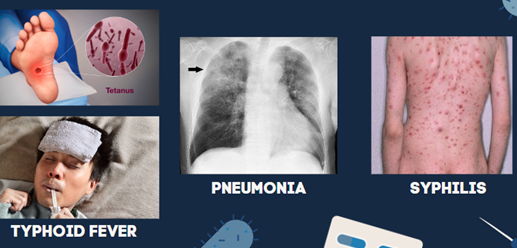
HARMFUL EFFECTS OF BACTERIA
DEFINITION OF BACTERIOLOGY • Bacteriology is the branch of microbiology that deals with the morphology, structure, classification, and
biochemistry of bacteria. • Some of these organisms play a significant role in the pathogenesis of diseases.
CLASSIFICATION • Morphology and Gram Stain • Growth Requirements • Genotype
MORPHOLOGY AND GRAM STAIN • are two of the most important systems when it comes to bacteria classification. With regards to morphology, bacteria are classified into three major categories including Cocci (spherical in shape), Bacilli (rod-shaped), Spiral, and Vibrio which is comma-shaped.
GENOTYPES • Genotypic systems in bacteriology have made it possible to classify bacteria at a molecular level.
Morphology • A biological approach to the study of the form and structure of living things. • A branch of biology called morphology examines how organisms are built, including their specific structural traits.
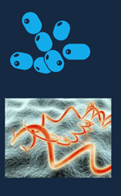
Coccus (plural cocci):
• Spherical shape, like tiny balls
Spiral:
• Twisted like a DNA helix
Bacillus (plural bacilli):
• Rod shape, like cylinders
Vibrio
• Comma-shaped