Week Twelve: Conflict and Negotiation
Describe the Nature of Conflicts in Organizations
Conflict in Organizations
What is conflict?
Any situation in which incompatible goals, attitudes, emotions, or behaviors lead to disagreement or opposition between two or more parties.
What is conflict about?
Task conflict (about work content and goals)
Relationship conflict (about interpersonal relationships)
Process conflict (about how the work is done)
Is it always bad?
Functional versus Dysfunctional Conflict
Functional Conflict: Healthy, constructive disagreement between two or more people.
Origin is often cognitive: Results in new ideas, learning, and growth among individuals.
Improves working relationships.
Leads to innovation and positive change for the organization.
Dysfunctional Conflict: Unhealthy, destructive disagreement between two or more people.
Origin is often emotional or behavioral: Drains energy.
Leads to aggressive acts or retaliation.
Losses may exceed any potential gain from the conflict.
Describe the Factors that Influence Conflict between Individuals in Organizations
Types of Intrapersonal Conflict
Inter-role Conflict
Occurs when a person experiences conflict between multiple roles in his or her life.
Intra-role Conflict
Occurs within a single role, when a person receives conflicting messages from role senders about how to perform a certain role.
Person-role Conflict
Occurs when the expected behaviors of an individual clash with his or her personal values.
Identify Five Styles of Conflict Management
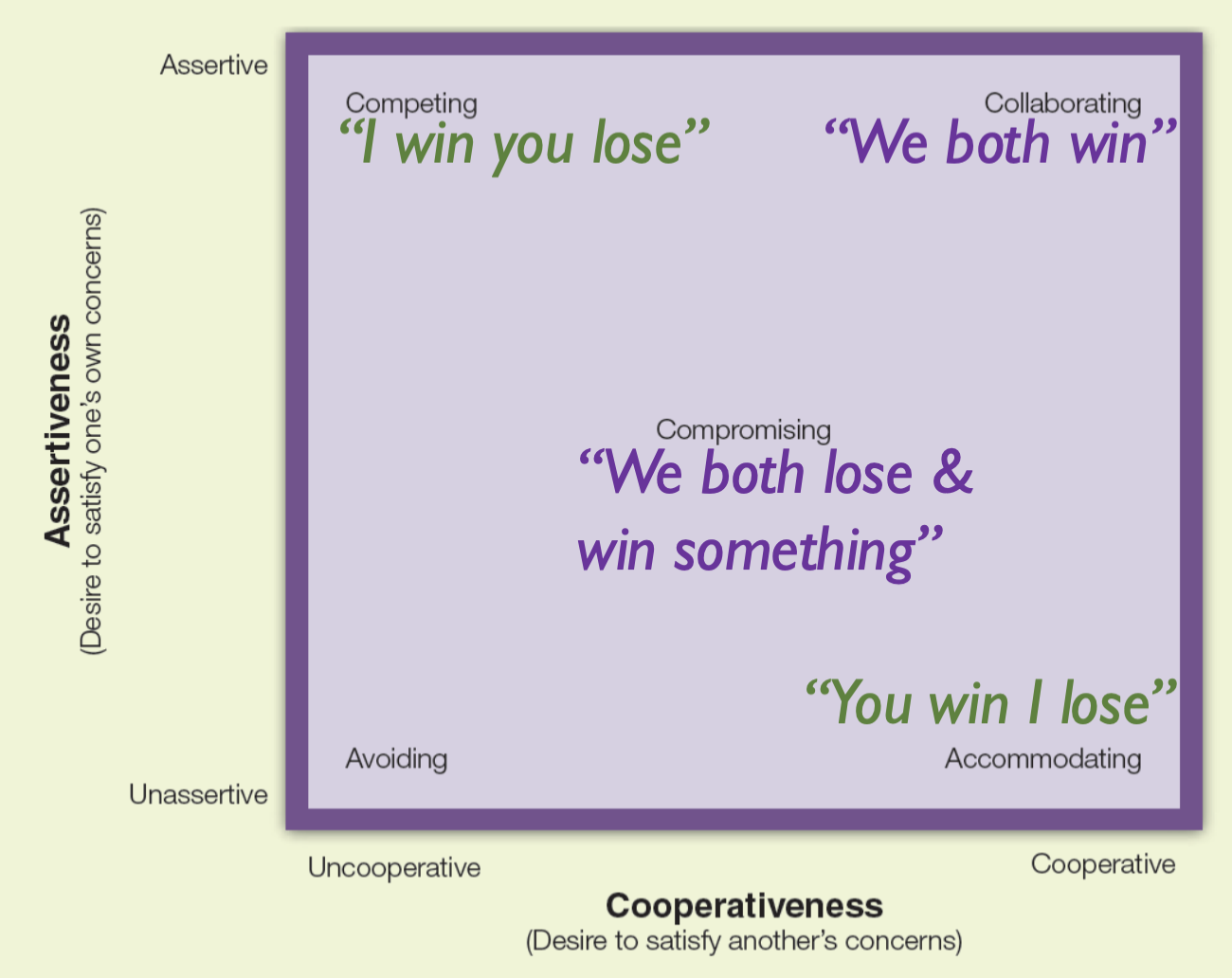
Competitive vs. Cooperative Conflict Management Styles
Competitive: Entails dishonest communication, mistrust, and a rigid position from both parties.
When quick, decisive action is vital (emergencies).
On important issues for which unpopular actions need implementing (e.g., cost cutting, discipline).
On issues vital to company welfare when you know you are right
Cooperative: Honest communication, trust, and openness to risk and vulnerability.
When both sets of concerns are too important to be compromised.
To merge insights from people with different perspectives.
To gain commitment by incorporating concerns into a consensus.
Avoiding vs. Accommodating Conflict Management Styles
Avoiding
For trivial/non priority issues.
Perceive no chance of satisfying your concerns.
When potential disruption outweighs the benefits of resolution.
To let people cool down and regain perspective.
Accommodating
When harmony and stability are especially important.
To satisfy others and maintain cooperation.
To build social credits for later issues.
To minimize loss when you are outmatched and losing.
When you find you are wrong—to show your reasonableness & learning from mistakes.
Compromising Conflict Management Style
As a backup when collaboration or competition is unsuccessful:
When opponents with equal power are committed to mutually exclusive goals.
To achieve temporary settlements to complex issues.
To arrive at expedient solutions under time pressure.
Conflict Management Styles & Communication
Assertive: Use the DESC technique.
Cooperative: Use the active listening technique.
Communicate to Resolve Conflicts: Don’t forget your toolkit!
Sender:
D: Describe the behavior/situation as completely and objectively as possible. Just the facts! AVOID:
“You” (accusations) → facts
“Always, never” (generalizations) → when, where, who
E: Express your feelings and thoughts about the situation/behavior.
Use “I” (take responsibility)
Receiver
1. Show your interest and that you are listening through your non-verbal behavior (e.g., eye contact)
2. Reformulate what has been said by using your own words to verify your understanding.
3. Ask an open-question to clarify any unclear message.
Describe Effective and Ineffective Negotiation Techniques for Managing Conflict
Two General Negotiation Approaches
Distributive bargaining: Goals of the parties are in conflict and each party seeks to maximize its resources;
Win-lose (competition): Party A vs. Party B
Fixed amount of resources (“fixed pie”)
Zero-sum: every dollar you make is a dollar I lose
More common in single-issue and one-time-only negotiations
Integrative negotiation: Parties’ goals are not seen as mutually exclusive. The focus is on both sides achieving their objectives.
Win-win is possible (collaboration/joint problem-solving)
Consider parties’ values, attempt to trade off so everyone gets more of what they want
Look for ways to “expand the pie” and create value
More common when parties can resolve the issue multiple ways, trust each other, may interact again
Creating Value
Look for ways to create value
Add additional issues - “Expand the pie”
Creating Value – Example: Buying a coat from a seller online
The main issue is the price: But what issues could the seller and I add to the negotiation to expand the pie?
Maybe I really need the coat for a trip this weekend, and I’m willing to pay a little more to have it shipped sooner.
or she has a busy week at work and would accept less for the convenience of not having to go to the post office until next week.
or maybe the seller is willing to accept a lower price if I have the coat dry cleaned myself, instead of having her do it.
or maybe the sleeves are going to be too long for me and I’d pay extra to have the seller hem them with her sewing machine before shipping, so I don’t have to go to the tailor.
or maybe I have an item that the seller would accept as a partial trade.
or maybe we live near each other and could meet at Starbucks, saving one of us the cost of shipping.
There are all kinds of extra things we could conceivably add to the agreement!
Describe Effective and Ineffective Negotiation Techniques for Managing Conflict
Bargaining Zone
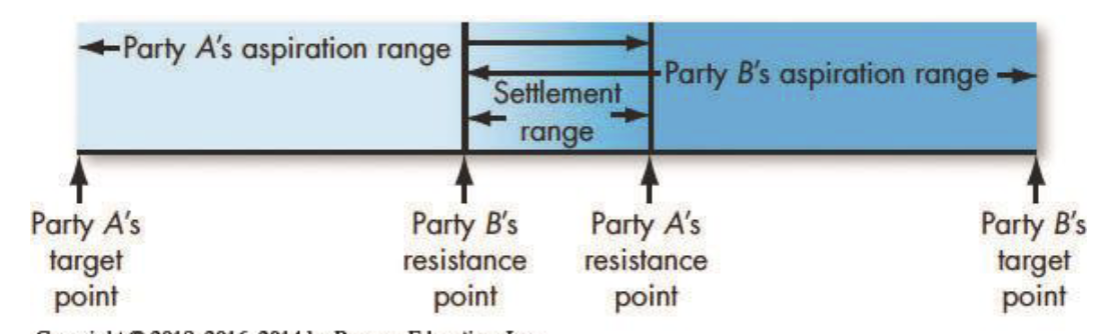
Aspiration Range
What you want, your optimistic goal for the negotiation
Also called aspiration price, target point, preference.
Should still be realistic!
Anchoring your counterpart on favorable-to-you initial terms is okay.
Insulting your counterpart or looking like you don’t know what you’re doing is not.
ZOPA
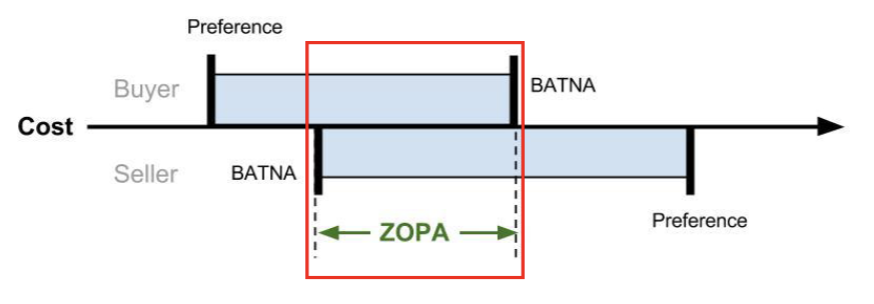
Zone of Possible Agreement: Bargaining room; the range of potential offers in which agreement is possible.
BATNA
Best Alternative to a Negotiated Agreement: An outside option that can be pursued if the negotiation fails (you can’t reach a deal).
Obviously, you never want to negotiate an outcome that’s worse than your BATNA!
Goal: To prevent you from accepting a deal you would be better off not taking.
Examples: Another product you could buy, Another job offer you could take.
Resistance Point
The worst agreement you are willing to accept before ending negotiations and resorting to your BATNA.
Your walk-away point /bottom line; “how far you can be pushed”
The point where you’re indifferent between reaching a negotiated agreement and going for your BATNA.
Very similar to your BATNA or slightly better.
Examples:
For sellers: the lowest price you will accept
For buyers: the highest price you will pay
In multi-issue negotiations: the worst package(s) you will take
Describe Effective and Ineffective Negotiation Techniques for Managing Conflict
The Negotiation Process
Prepare
Information Exchange and validation
Bargain
Conclude
Execute
Preparation
Research has shown that the recommended time allocation for negotiations is:
70% preparation
20% information exchange at the negotiating table
10% bargaining
Preparation is more than half the battle!
What Do You Need to Prepare?
Do your research:
What issues are involved?
What is a reasonable bargaining range for each?
What are your goal(s), BATNA, and resistance point(s)?
Understand the other side(s):
What do they want?
How should you approach them?
How much authority do they have?
Plan your strategy:
What are your counterpart’s likely objections, and how will you counter them?
Pawn Stars: Cause for Success
They know a lot about what items are worth.
Sellers often undervalue their items!
When the buyers don’t know what an item is worth, they get it appraised.
They have almost infinite BATNAs
They’re constantly making deals. It’s easy for them to walk away
They know how to expand the pie
They sometimes throw in another item in the shop that a customer likes
Pawn Stars: Useful Tips
Ask open-ended questions
→ Try to elicit information, and be willing to give it in return
→ Try to find out not just what your counterpart wants, but why
→ Try to understand your counterpart’s constraints
Label your concessions → Make contingent concessions (“I’ll do X if you’ll do Y”)
Think about how you can solve your counterpart’s problem
Listen—actively listen (remember reformulation, clarification, etc.)! → “What I hear you saying is ____.” “Help me understand why ____.” “How did you arrive at that #?”
Use silence →Often, people will continue talking to fill it