P3
LOs:
1) Explain how DPIs produce an aerosol
2) Understand the factors affecting the delivery of drugs from DPIs
3) Understand the factors affecting the formulation of DPI powders
4) Explain the advantages and disadvantages of DPIs
DPI= dry powder inhaler which the patient ‘sucks’ into their lungs. It is automatically breath-actuated (drug released only when the user inhales), relatively easier to use and has lower carbon footprint than pMDIs.
DPI dependant on patient breathing in whereas with pMDI dependant on conc of drug.
Because dependant on patient breathing in there is variable drug delivery
1) Explain how DPIs produce an aerosol
Aerosolization composed of 3 phases:
1) Fluidisation: Start with static powder bed- particles touching each other but not doing anything. Patient starts breathing in and you get a pressure drop over the powder bed. So air being sucked out from the top for example and air trying to come through underneath. When the differences between the top and bottom is big enough to overcome the forces of gravity, the air begins to separate the particles out and flow through the powder bed so they are fluidised. From the top of the dilated powder bed is the air passing by. The air can begin to pick up these agglomerates of particles, although we have separated them a bit from each other there are still particles stuck together but are flying off into air and heading towards patient= entrainment
Deaggregation-Entrained particles fly through the air, but particles stuck together. So go through deaggregation where we pull the particles apart so small enough drug particles to be inhaled.
FPF= Fine particle fraction= % that reaches the lungs
The size of the FPF is dependent on three inter-dependent factors:
Inhaler device
Patient inspiratory flow
Powder formulation
How does the deaggregation process occur?
•always going to be adhesion- as two particles are stuck together with a certain strength.
•will also be getting a drag force- air will be going faster than particles as it is accelerating up to the speed of the air so drag acting on both the smaller and bigger particle. Drag is going to try and accelerate particles up to speed of the air, the smaller ones will want to accelerate faster than the bigger ones, because they are lighter so you get a force pulling them apart.
•particle also spinning around so you get centrifugal force that will try to pull particles apart
•turbulence- air that is not flowing in one direction, but chaotically in multiple direction- we design our inhalers to give us turbulence
•as the turbulence comes in you get pulling away from particle getting a lift force pulling small particle away from big particle, might change the direction of the particle and make them spin even more, might change the direction that they slam the wall of the inhaler or crash into the other particles and those collisions can give us deaggregation.
Types of DPI
Single unit dose= can be reusable or disposable which would be one use
multi- unit dose= reusable, non-reusable, reservoir (these don’t contain the foil blisters containing the drug but has a system to give a measured dose of the inhaler, these are usually non-reusable)
Moisture in the environment can affect how it works.
Powder formulations:
Behaviour of particles is dominated by their adhesion to other particles and surfaces. 3 types of adhesive forces.
1) vdw forces- attractive force between all atoms. The sum of attractions between molecules that are temporarily dipolar. This has a short range of force. Dominant force at low humidity, in the absence of electrostatic forces. In the absence of the other two, these are the forces that dominate
2) Capillary forces- thin layer of water molecules over the surface of the molecules.
3) electrostatic force- caused by frictional contact (triboelectrification) between dissimilar materials. Long range of force. Attractive or repulsive.
Factors that can influence inter particulate adhesion forces:
4) Explain the advantages and disadvantages of DPIs
Advantages:
Propellant free – more climate friendly
Some have no excipients- don’t need to worry about allergies
Breath-actuated
Can deliver relatively large doses
Drug is in dry, solid form
Disadvantages:
Powder de-aggregation (and so FPF) dependant upon patient’s ability to inhale
↑ inhaled air velocity, ↑ de-aggregation of particles, but ↑ potential for inertial impaction
Exposure to ambient conditions may ↓ stability
Generally less efficient at delivery vs. pMDI
Some devices difficult for some patients to activate
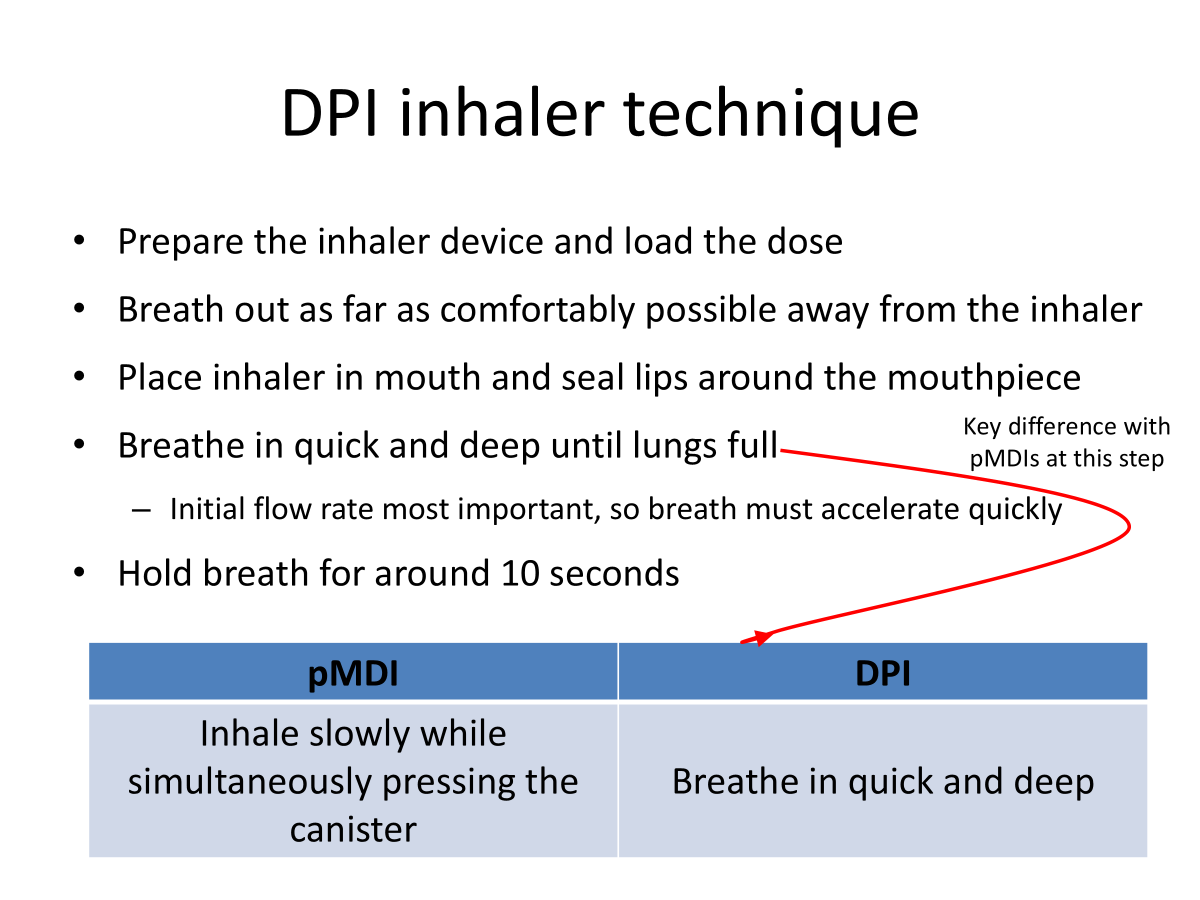
DPI inhaler technique: