Vision, Hearing, and other senses
Our sense of vision allows us to perceive light waves, which vary in wavelength (determining hue), amplitude (determining brightness), and purity (determining vividness). Light enters the eye through the cornea and pupil (controlled by the iris), is focused by the lens via accommodation onto the retina, where it's converted into neural impulses and sent to the brain via the optic nerve.
Parts of the Eye
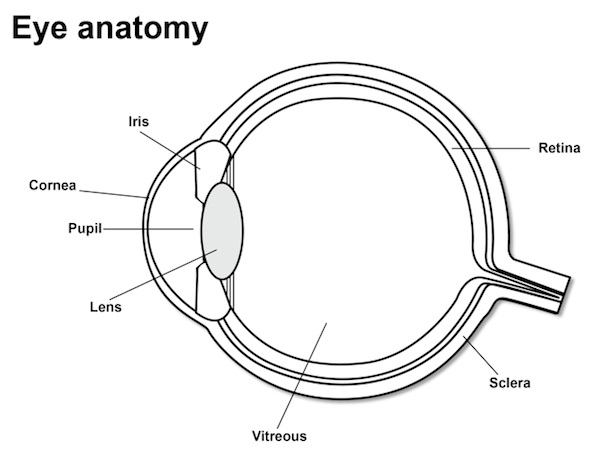
The retina contains specialized receptor cells and areas crucial for vision:
Rods: Detect black, white, and gray, crucial for movement and peripheral vision.
Cones: Concentrated near the fovea, responsible for daylight and color vision.
Fovea: The central focal point of the retina where visual acuity is highest due to a cluster of cones.
Blind Spot: The point where the optic nerve leaves the eye, lacking receptor cells.
How We See Color: Theories of Vision
While light waves themselves are colorless, our brain interprets them as color. Two primary theories explain color vision:
Young-Helmholtz Trichromatic Theory: This theory proposes that the retina has three types of color receptors, sensitive to red, green, and blue. When stimulated in combination, these receptors can produce the perception of any color. For example, stimulating red and green receptors simultaneously creates the perception of yellow.
Opponent-Process Theory: This theory suggests that color vision relies on three sets of opposing retinal processes: red-green, blue-yellow, and white-black. When one color in a pair is stimulated, the other is inhibited. This explains phenomena like afterimages (e.g., staring at red for a long time and then looking away to see a green afterimage).
Common Vision Problems
Perfect vision involves a spherical eyeball where images fall precisely on the retina. Deviations can lead to:
Nearsightedness (Myopia): Occurs when the eyeball is too long, causing distant objects to appear blurry.
Farsightedness (Hyperopia): Occurs when the eyeball is too short, causing close objects to appear blurry.
Colorblindness: Typically a sex-linked genetic defect (more common in males) where individuals lack functional red- or green-sensitive cones, resulting in monochromatic or dichromatic vision instead of trichromatic (full color) vision. They struggle to distinguish between certain colors, like red and green.
Feature Detectors and Facial Recognition
Feature detectors are specialized nerve cells in the visual cortex that respond to specific visual characteristics, such as edges, angles, and movement. Humans also possess specialized feature detectors for faces. Damage to these specific feature detectors or the temporal lobe area responsible for facial recognition can lead to prosopagnosia, also known as face blindness, where an individual cannot recognize faces.
Our sense of hearing, known as audition, involves the perception of sound waves, which are created by the compression and rarefaction of air molecules. These waves have two main properties: amplitude, which determines the volume (measured in decibels), and frequency, which determines the pitch.
The Journey of Sound Through the Ear

Sound waves are meticulously funneled and processed through different parts of the ear:
Pinna: The exterior part of the ear that collects and funnels sound waves into the auditory canal.
Auditory Canal: The passage that directs sound waves to the eardrum.
Eardrum (Tympanic Membrane): A tight membrane that vibrates in response to sound waves.
Ossicles (Middle Ear): Three small bones—the hammer (malleus), anvil (incus), and stirrup (stapes)—that amplify the vibrations from the eardrum.
Oval Window: The membrane of the cochlea (inner ear) that vibrates from the stirrup's movement.
Cochlea: A coiled, fluid-filled tube in the inner ear where sound waves are transduced into neural impulses.
Basilar Membrane: Lines the cochlea and contains hair cells that convert the mechanical vibrations into electrical signals.
Auditory Nerve: Carries these neural impulses to the brain for interpretation.
Note: The semicircular canals, located above the cochlea, are involved in the vestibular sense (body position) and not directly in hearing.
Theories of Pitch Perception
While hair cells along the basilar membrane transduce sound, how pitch is perceived is explained by two main theories:
Place Theory: Suggests that specific hair cells on the basilar membrane are activated for different pitches, similar to how individual keys on a piano produce distinct notes.
Frequency Theory: Proposes that the entire basilar membrane vibrates in response to sound, and the speed of this vibration is interpreted as pitch, much like a drum's vibration speed.
Sound Localization
Our two ears enable us to localize sound by detecting the minute differences in the time sound waves arrive at each ear, allowing us to determine the sound's source direction.
Types of Hearing Loss
There are two primary types of hearing loss:
Sensorineural Hearing Loss (Nerve Deafness):
Cause: Damage to the cochlea's receptor cells (hair cells) or the auditory nerves.
Impact: Often results from repeated or prolonged exposure to loud sounds.
Treatment: Can be helped by cochlear implants.
Conduction Hearing Loss:
Cause: Damage to the mechanical elements of the ear (e.g., eardrum, ossicles), excluding the cochlea.
Treatment: Can be helped by hearing aids.
Impact of High-Frequency Sounds and Aging on Hearing
High-Frequency Sounds: These sounds cause greater movement among hair cells, overworking them and leading to faster decay than normal. This contributes to hearing damage.
Aging: Hearing naturally declines with age, as it has a critical period. Protecting hearing from continuous loud and/or high-pitched sounds can help preserve it. Hearing aids or cochlear implants can assist in maintaining hearing as we age.
Touch (Tactile Sense)
Touch is fundamental for development and survival, contributing to contact comfort and processed by the parietal lobe. It encompasses several sensations:
Pain: Signals tissue damage and is initiated by sensory neurons called nociceptors.
Gate-Control Theory (Melzak & Wall): Proposes that the spinal cord acts as a 'gate,' regulating pain signals to the brain. Pain perception is a balance between large and small nerve fiber activity.
Brain's Role in Pain: The brain can create pain, as seen in phantom limb sensations, where misinterpretation of central nervous system activity leads to pain in a nonexistent limb.
Pressure
Touch
Temperature
Taste (Gustation)
Taste is a chemical sense with receptors on papillae that detect five primary sensations:

Sweet: Identifies energy-rich sugary foods.
Sour: Detects spoiled or potentially harmful foods.
Salty: Essential for physiological functions.
Bitter: Signals potential poisons.
Umami (Savory): Indicates protein-rich foods for growth and repair.
Oleogustus: Relates to fats/carbohydrates for energy, insulation, and cell growth.
Smell (Olfaction)
Smell is also a chemical sense that profoundly influences taste through sensory interaction (e.g., losing taste when your nose is plugged).
Process: Odorants stimulate 5 million receptors in the olfactory bulb, bypassing the thalamus and directly stimulating the temporal lobe.
Evolutionary Significance: This direct pathway is suspected to be an evolutionary trait, linking smell to memory and aversion (e.g., avoiding spoiled food).
Other Senses
Beyond the primary senses, there are specialized senses essential for body awareness and balance:
Vestibular Sense:
Monitors head/body position and balance.
Receptors are in the semicircular canals and vestibular sacs of the ear.
Works in conjunction with the cerebellum.
Kinesthetic Sense:
Detects the position and movement of individual body parts.
Receptors are located in muscle tissues and joints.
Sensation, Perception, and Embodied Cognition
Sensation and perception work together in a continuous loop, leading to embodied cognition—the influence of bodily states on cognitive preferences and judgments. Synesthesia is an example where sensory stimulation triggers multiple senses (e.g., seeing sounds).
Extrasensory Perception (ESP) and Parapsychology
Extrasensory Perception (ESP) refers to claims of perception without normal sensory channels. Parapsychology is the study of such phenomena, including:
Telepathy: Reading another person's thoughts.
Clairvoyance: Perceiving things not physically present.
Precognition: Knowing future events in advance.